W-8BEN-E for a South African (Pty) Ltd: 0% on Royalties and Interest, Part III for Services, and the Right Line 14b Test
This article was created with AI assistance and has not been reviewed by a human editor. It is provided for general informational purposes only and does not constitute tax, legal, or financial advice.
Treaty articles and rates on this page are checked against the US–South Africa Income Tax Convention signed at Cape Town on 17 February 1997, generally effective 1 January 1998. There is no protocol. Last checked: 03.11.2026.
 AI-generated image
A US client, marketplace or platform asked your (Pty) Ltd for Form W-8BEN-E. Work the company does in South Africa is not US-source income: nothing is withheld on it, and Part III of the form (Lines 14a, 14b and 15) stays blank. The treaty matters for income on which a US payer would otherwise withhold US tax: royalties and interest at 0%, dividends at 5% or 15%, services performed in the United States, equipment rent (Article 7(1) or 21(1), 0%, with no US permanent establishment and no US activity), and a lease of containers used in international traffic (Article 8(3), 0%, with or without US activity).
The convention was signed at Cape Town on 17 February 1997 and is generally effective from 1 January 1998. There is no protocol. The IRS text is the US–South Africa income tax treaty PDF. Last checked: 03.11.2026. Every company fills Line 9b with the SARS income tax reference number. Only a company that claims the treaty fills Part III: the limitation-on-benefits test on Line 14b and the article, paragraph, and rate on Line 15. The filled example further down shows that claim case: developers performing services on site in the United States, with no US permanent establishment, Article 7(1) at 0%. Software work done in Johannesburg would leave Part III blank.
A sole proprietor or freelancer uses the shorter Form W-8BEN, not this form: start the W-8BEN wizard. Work done in South Africa leaves Part II of Form W-8BEN (Lines 9 and 10) blank; pay for services performed in the United States is claimed under Article 14 on Form 8233, not on Form W-8BEN. A (Pty) Ltd, a public company, an Inc., and a close corporation use Form W-8BEN-E.
Or skip the reading and start the W-8BEN-E wizard — guided questions, a suggested treaty article and rate, and a signature-ready PDF for $30. A rental of ships or aircraft under Article 8(2) is the one case you enter by hand: Article 8(1).
Blank form or already filled in?
You can download the official, blank form from the IRS and complete it yourself — or get the same file already filled in by the wizard.
- Blank official W-8BEN-E (IRS, free): Download W-8BEN-E as a PDF directly from the IRS — for a (Pty) Ltd, a public company, an Inc., and a close corporation.
- Blank official W-8BEN (IRS, free): Download W-8BEN as a PDF directly from the IRS — for a sole proprietor or freelancer.
- US–South Africa treaty (IRS): Income tax treaty PDF on IRS.gov — signed at Cape Town on 17 February 1997, generally effective 1 January 1998, no protocol.
- Already filled in (5–10 minutes): W-8BEN-E for a South African company ($30) or W-8BEN for a sole proprietor or freelancer ($5) — treaty article and rate suggested from the convention, ready to sign as a PDF. A rental of ships or aircraft under Article 8(2) is the one case you enter by hand: Article 8(1).
Which form does a South African business file?
The form follows the legal person who owns the income, not the marketplace that asked for a document.
- (Pty) Ltd, public company (Ltd), Inc., and close corporation (CC): Form W-8BEN-E. These are companies (or a close corporation) for this purpose.
- Sole proprietor and freelancer: Form W-8BEN. Work done in South Africa leaves Part II (Lines 9 and 10) blank. Pay for services performed in the United States is claimed under Article 14 on Form 8233, not on Form W-8BEN.
- South African branch of a foreign company: The foreign parent is the person claiming the income. The parent files the form that matches the parent.
- US citizen or green-card holder in South Africa: Form W-9. A W-8 series form is for a person who is not a US person.
Chapter 3 on Line 4 is a separate question from which form you picked. The next section is that classification.
Who fills in Form W-8BEN-E?
A South African company that a US payer asks to document itself. The form claims the treaty only for income on which the payer would otherwise withhold US tax: royalties, interest, dividends, services performed in the United States, equipment rent, or a lease of containers used in international traffic (Article 8(3)). For work done in South Africa it documents the company, and Part III stays blank.
- A US client: The (Pty) Ltd invoices a US business and the client asks for Form W-8BEN-E before paying. For work done in South Africa, Part III (Lines 14a, 14b and 15) stays blank.
- A marketplace or platform: Payouts from a US platform, including software licences, YouTube, or AdSense royalties.
- US shares: Dividends on US shares held through EasyEquities, Interactive Brokers, or a similar broker.
- Interest or royalties: US-source interest, or royalties that include a software licence.
What the payer withholds without the form
Without a valid Form W-8BEN-E, a US payer withholds 30% of US-source income such as royalties, interest, and dividends. Services the (Pty) Ltd performs in South Africa are not US-source income: no 30% applies to them, though a payer may hold the payment until it has the form. With the form, royalties including software are Article 12(1) at 0%, ordinary interest is Article 11(1) at 0%, and dividends are 5% or 15%. Article 7(1) at 0% is only for services performed in the United States when the company has no US permanent establishment, which includes staff working there for more than 183 days on the same or a connected project (Article 5(2)(k)).
The form goes to the US payer (the client, platform, or broker). It is not filed with SARS and it is not filed with the IRS. It only documents the withholding rate at source.
Chapter 3 (Line 4): which box a South African entity checks
Line 4 is the Chapter 3 status. The default below is the classification with no Form 8832 on file.
| Entity | Line 4 | Notes |
|---|---|---|
| Public company (Ltd / Limited, including SOC Ltd) | Corporation | Per se corporation. 26 CFR 301.7701-2(b)(8)(i) lists "South Africa, Public Limited Company". Form 8832 cannot change that classification. |
| (Pty) Ltd | Corporation | Corporation by default. A single shareholder does not make it a disregarded entity. Disregarded treatment requires a filed Form 8832. |
| Inc. (personal liability company) | Corporation | Corporation by the member-liability test. Directors are jointly liable for the company's debts. Confirm the classification with an adviser. |
| Close corporation (CC) | Corporation | Corporation by default. |
| Partnership | Partnership | Check Partnership. |
| Trust | Ask an adviser | This page does not classify a trust. |
An operating (Pty) Ltd, like the one in the sample below, is Corporation on Line 4 and Active NFFE on Line 5.
Line 6 and Line 9b: the address and the SARS tax number
Line 6 is the company's registered address in South Africa. Line 9b is the foreign TIN. For treaty benefits, that foreign TIN is enough. A US EIN is not required.
| Number | Use on Line 9b |
|---|---|
| Income tax reference number | Yes. This is the SARS tax number: 10 digits, and the first digit is 0, 1, 2, 3, or 9. The sample uses 9123456783. |
| 13-digit ID number | No. An ID number is not a tax number and goes on neither form. An individual enters their own 10-digit income tax reference number on Line 6a of their own Form W-8BEN. |
| VAT number | No. A VAT number starts with 4. It is the wrong number for Line 9b. |
| CIPC company registration number | No. The company registration number is not the tax number. |
| US EIN | Not required for treaty benefits. Line 8 stays blank unless the payer asks for a US TIN. The foreign TIN on Line 9b is enough. |
The income tax reference number on the sample, 9123456783, is a 10-digit example with a valid check digit. It is not a real SARS number.
What a completed W-8BEN-E looks like for a South African (Pty) Ltd
An example: Savanna Software (Pty) Ltd, with staff and payroll in Johannesburg, sends two developers to perform services on site in the United States for six weeks, with no US permanent establishment. Article 7(1) at 0% on those services (business profits, no US permanent establishment), Line 14b active trade or business. Work done only in South Africa would leave Part III (Lines 14a, 14b and 15) blank.
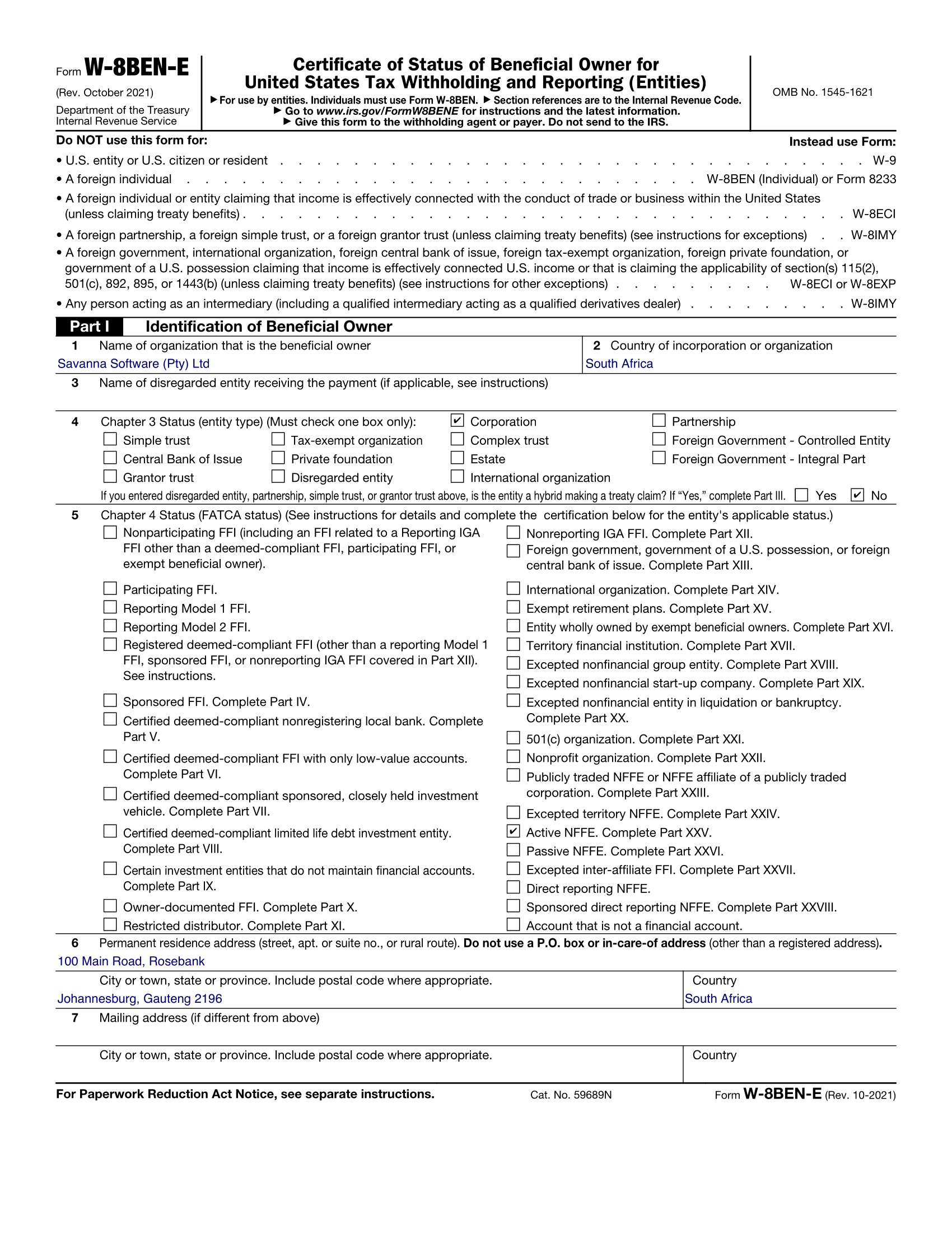
For illustration only. Sample facts: Savanna Software (Pty) Ltd, 100 Main Road, Rosebank, Johannesburg, Gauteng 2196, income tax reference number 9123456783, Chapter 3 Corporation, Active NFFE, Part III South Africa, Line 14b Company with an item of income that meets active trade or business test, Line 15 Article 7(1), 0%, for services performed in the United States with no US permanent establishment (business profits). Signed by Thabo Ndlovu. The name, address, and tax number are fictional.
Treaty rates by income type
Each row is the US withholding rate for that income when the condition in the last column is met. Line 15 cites the rate paragraph; when no row applies, Part III stays blank.
| Income | Article (Line 15) | US rate | Condition |
|---|---|---|---|
| Services by a (Pty) Ltd performed in South Africa | None: Part III blank | No US withholding | Services performed in South Africa are not US-source income. Part III (Lines 14a, 14b and 15) stays blank. |
| Services by a (Pty) Ltd performed in the United States | Article 7(1) | 0% | 0% only for services performed in the United States when the company has no permanent establishment there. Staff working in the US for more than 183 days in any 12-month period commencing or ending in the taxable year concerned, on the same or a connected project, creates a permanent establishment (Article 5(2)(k)). |
| Services by an individual | Article 14, on Form 8233 | 0% on Form 8233 | Work done in South Africa: no US withholding, and Part II (Lines 9 and 10) of Form W-8BEN stays blank. Pay for services performed in the United States is claimed on Form 8233, not Form W-8BEN: exempt unless the individual has a fixed base regularly available there, and more than 183 days in the US in any twelve-month period commencing or ending in the fiscal year counts as one. |
| Software licence fees, YouTube/AdSense, other royalties | Article 12(1) | 0% | 0% on royalties. Copyright explicitly includes computer software, films, and audio and video recordings. Line 15 cites Article 12(1). Article 12(2) is the definition, not the rate. |
| Interest | Article 11(1) | 0% | 0% on interest under Article 11(1). Contingent interest that does not qualify as portfolio interest under US law is up to 15% under Article 11(5)(a). An excess inclusion on a residual interest in a REMIC may be taxed by the United States under its domestic law (Article 11(5)(b)). |
| Dividends — company holding directly at least 10% of the voting stock | Article 10(2)(a) | 5% | 5% only when a company holds directly at least 10% of the voting stock. Never for a dividend paid by a RIC or REIT (Article 10(2)). |
| Dividends — everyone else, including individuals | Article 10(2)(b) | 15% | 15% for everyone else, including an individual. A RIC dividend is 15% whatever the holding. A REIT dividend is 15% only for an individual holding a less than 10% interest in the REIT; for anyone else it is 30%. |
| Equipment rental | Article 7(1) for a lease in the company's trade with no US activity, or Article 21(1) for a passive lease with no US activity | 0% | Equipment rental is not a royalty under this treaty. Equipment rent from a lease in the company's trade is business profits, Article 7(1) at 0% when the company has no US permanent establishment and no activity in the United States. Equipment rent from a passive lease with no activity in the United States is other income, Article 21(1) at 0%. A lessor with activity in the United States, with or without a permanent establishment there, makes no claim for that rent: Part III (Lines 14a, 14b and 15) stays blank. A lease of containers used in international traffic takes neither line: it is Article 8(3) (next row). |
| Lease of containers (including trailers, barges and related equipment for the transport of containers) used in international traffic | Article 8(3) | 0% | Article 8(3) makes the profits of an enterprise from the use or rental of such containers taxable only in South Africa, with or without activity or a permanent establishment in the United States. It is not Article 7(1) or Article 21(1). A rental of ships or aircraft operated in international traffic by the lessee, or one whose rental profits are incidental to other profits described in Article 8(1) (the company's own profits from the operation of ships or aircraft in international traffic), counts under Article 8(2) as profit from that operation, taxable only in South Africa under Article 8(1): the wizard writes no line for it; edit the fields by hand and enter Article 8(1), 0%. |
Line 15 cites the rate paragraph: Article 7(1), Article 8(3), Article 10(2)(a), Article 10(2)(b), Article 11(1), Article 12(1), or Article 21(1). For a rental of ships or aircraft under Article 8(2) the wizard writes no line, and Article 8(1) is typed by hand. A (Pty) Ltd has no 0% dividend rate: Article 10(8) exempts only a Contracting State, its political subdivisions and local authorities, and their government pension trusts. Royalties are 0%, not the 15% people sometimes type from habit.
Line 14b: the Article 22 test
Line 14b is filled only when the company claims the treaty, for example for royalties, interest, or services performed in the United States. An operating (Pty) Ltd usually checks “Company with an item of income that meets active trade or business test” (Article 22(3)). That test has three parts: the company is engaged in the active conduct of a trade or business in South Africa, the US income is connected with or incidental to that trade or business, and the South African trade or business is substantial in relation to the activity of the company (and any related parties) in the United States that generates the income. Substantial is decided on all the facts and circumstances; it is deemed met if, for the preceding taxable year or the average of the three preceding taxable years, the asset value, gross income, and payroll expense of the South African business are each at least 7.5% of the company's (and related parties') proportionate share of those of the US activity, and the average of the three ratios exceeds 10%. Making or managing investments is not an active trade or business unless it is banking, insurance, or securities activity of a bank, insurance company, or registered securities dealer. The alternative is ownership and base erosion under Article 22(2)(f): on at least half the days of the taxable year, persons described in Article 22(2)(a) to (e), each a resident of South Africa or the United States (individuals; a Contracting State or its political subdivisions or local authorities; companies that meet Article 22(2)(c); the tax-exempt charitable and similar organizations of Article 22(2)(d); and the tax-exempt pension organizations of Article 22(2)(e) more than 50% of whose beneficiaries, members, or participants are individuals resident in either country), own, directly or indirectly through a chain of ownership in which each person is entitled to benefits under Article 22(2), at least 50% of each class of shares, and less than 50% of the company's gross income is paid or accrued, directly or indirectly, to persons who are not residents of either country as deductible payments, unless the payment is attributable to a permanent establishment situated in either country. A company whose shares representing more than 50% of the voting power and value are regularly traded on a recognized stock exchange (the Johannesburg Stock Exchange, NASDAQ, or a US national securities exchange) uses the publicly traded test in Article 22(2)(c)(i); a company at least 50% of each class of whose shares is owned, directly or indirectly, by such listed companies, each intermediate owner itself entitled to benefits under Article 22(2), uses the subsidiary test in Article 22(2)(c)(ii). A company that meets none of these tests can still ask the IRS for benefits under Article 22(4); it checks the discretionary determination box only after that determination is granted. This treaty has no derivative benefits test, so that box stays empty. Article 22 is the limitation on benefits article, so the “No LOB article in treaty” box is the wrong one.
A blank IRS form, or a filled PDF?
The blank form is free from the IRS. The wizard asks the South Africa questions and fills Line 14b and Line 15 from the same rates as the table above, or leaves Part III blank when there is nothing to claim. For a rental of ships or aircraft under Article 8(2) it writes no line: you enter Article 8(1) by hand.
| Step | What you do |
|---|---|
| Blank form | Download W-8BEN-E or W-8BEN from irs.gov and complete every line yourself. |
| Line 15 | Only when the company claims the treaty: cite Article 7(1) (services performed in the United States with no US permanent establishment), 8(3) (containers used in international traffic), 10(2)(a), 10(2)(b), 11(1), 12(1), or 21(1), with the rate from the table. For a rental of ships or aircraft under Article 8(2) the wizard writes no line: enter Article 8(1), 0% by hand. Blank for services performed in South Africa. |
| Line 14b | Only when the company claims the treaty: an operating (Pty) Ltd uses the active trade or business test. There is no derivative benefits test. |
| Wizard | {path|w8ben-e-form#wizard|W-8BEN-E ($30)} for a company, or {path|w8ben-form#wizard|W-8BEN ($5)} for a sole proprietor or freelancer. |
Frequently asked questions
Short answers for a (Pty) Ltd and for a freelancer paid from the United States.
Is there a US–South Africa tax treaty?
Yes. The convention was signed at Cape Town on 17 February 1997 and is generally effective from 1 January 1998. There is no protocol.
My client withheld 30% on my software licence fee. Why?
The payer did not have a Form W-8BEN-E that claims Article 12(1) at 0%. After you give the payer that form, ask the payer about a refund or an adjustment. A refund is the payer's process, and this page does not promise one.
Which number goes on Line 9b: tax number, company registration number (CIPC) or VAT?
The income tax reference number: 10 digits, first digit 0, 1, 2, 3, or 9. The CIPC registration number is not the tax number. A VAT number starts with 4 and is the wrong number. A 13-digit ID number is not the TIN and goes on neither form: an individual enters their own income tax reference number on Line 6a of their own Form W-8BEN.
I'm a freelancer on Upwork — Article 7 or 14?
For work you do in South Africa, neither: that pay is not US-source, so Part II of Form W-8BEN (Lines 9 and 10) stays blank. Pay for services you perform in the United States is claimed under Article 14 on Form 8233, not on Form W-8BEN. Article 14 exempts it unless you have a fixed base regularly available in the United States, and more than 183 days there in any twelve-month period commencing or ending in the fiscal year counts as one. Article 7 is business profits of a company.
Does my single-shareholder (Pty) Ltd count as disregarded?
No. A (Pty) Ltd is a Corporation by default. One shareholder does not make it a disregarded entity. Disregarded treatment requires a filed Form 8832.
How much is withheld on US shares I hold through EasyEquities or IBKR?
15% for an individual, under Article 10(2)(b). 5% only for a company that holds directly at least 10% of the voting stock, under Article 10(2)(a). That 5% rate never applies to a RIC or REIT dividend. A RIC dividend is 15%. A REIT dividend is 15% only for an individual holding a less than 10% interest in the REIT; otherwise 30%.
Do I need a US EIN?
No. For treaty benefits the foreign TIN on Line 9b is enough. That number is the SARS income tax reference number.
Which Line 14b box does an operating (Pty) Ltd check?
Only when it claims the treaty, for example for royalties or for services performed in the United States: usually “Company with an item of income that meets active trade or business test” (Article 22(3)), when its South African business is substantial in relation to the US activity that generates the income. This treaty has no derivative benefits test. Article 22 exists, so “No LOB article in treaty” is the wrong box. For services performed in South Africa, Line 14b stays blank with the rest of Part III.
Is equipment rental a royalty?
No. Under this treaty, equipment rental is not a royalty. Equipment rent from a lease that is part of the (Pty) Ltd's trade is business profits: Article 7(1) at 0% when the company has no US permanent establishment and no activity in the United States. A passive lease with no activity in the United States is other income, Article 21(1) at 0%. A lessor with activity in the United States, with or without a permanent establishment there, makes no claim for that rent: Part III (Lines 14a, 14b and 15) stays blank. A lease of containers used in international traffic is neither: Article 8(3) makes it taxable only in South Africa, 0% with or without US activity. A rental of ships or aircraft under Article 8(2) gets no wizard line: enter Article 8(1) by hand.
How long is Form W-8BEN-E valid?
Generally through the last day of the third calendar year after the year of signing, unless the facts on the form change. A form signed in 2026 is valid through 31 December 2029.
Related guides
The same form in other English-speaking countries, plus the individual wizard.
- Australian Pty Ltd: W-8BEN-E for an Australian Pty Ltd
- New Zealand limited company: W-8BEN-E for a New Zealand limited company
- UK Ltd: W-8BEN-E for a UK Ltd
- Entity type on Line 4: Full guide to Line 4
- Sole proprietor or freelancer: W-8BEN wizard ($5)
Common mistakes
- ID number on Line 9b: A 13-digit ID number is not the TIN and goes on neither form. Line 9b is the company's 10-digit income tax reference number; an individual enters their own on Line 6a of their own Form W-8BEN.
- Filling Part III for work done in South Africa: Services performed in South Africa are not US-source income. Leave Part III (Lines 14a, 14b and 15) blank.
- Article 14 for a (Pty) Ltd: Article 14 is independent personal services of an individual, claimed on Form 8233 for work performed in the United States. A (Pty) Ltd cites Article 7(1) only for services performed in the United States when it has no US permanent establishment.
- 15% on royalties: A 15% royalty rate is a habit from other forms. Software, YouTube, AdSense, and other royalties are Article 12(1) at 0%.
- Derivative benefits on Line 14b: This treaty has no derivative benefits test. Leave that box empty.
- “No LOB article in treaty”: Article 22 is the limitation on benefits article. That box is the wrong one.
- Form W-8BEN-E from a sole proprietor: A sole proprietor and a freelancer file Form W-8BEN.
- Equipment rental as Article 12: Equipment rental is not a royalty under this treaty. A lease in the company's trade is business profits, Article 7(1), with no US permanent establishment and no activity in the United States; a passive lease with no activity in the United States is other income, Article 21(1). A lessor with activity in the United States, with or without a permanent establishment there, makes no claim for that rent: Part III (Lines 14a, 14b and 15) stays blank. A lease of containers used in international traffic is Article 8(3), not Article 7(1) or 21(1).
US withholding, not South African company tax
This page is about US withholding on payments to a South African company or freelancer. It does not decide how South Africa taxes those profits.
South African company tax on the income, once it is received, is a question for a tax adviser in South Africa. Form W-8BEN-E only documents what the US payer withholds.
Ready to finish Form W-8BEN-E for the (Pty) Ltd?
The wizard asks the same questions as this page and suggests the article and rate for Line 15, or leaves Part III blank when there is nothing to claim. A rental of ships or aircraft under Article 8(2) is the one case you enter by hand: Article 8(1).