W-8BEN-E for Amazon Sellers in Spain: Fill It Online
If you run a Spanish company that sells on Amazon—whether you ship from Spain, use FBA abroad, or sell across the EU—US payers often ask for IRS Form W-8BEN-E before they treat your account as fully documented. That certificate tells Amazon who receives US-source payments, how Chapter 3 withholding should run, and how Chapter 4 (FATCA) reporting applies. It is the standard path for legal entities, not the individual W-8BEN.
Getting Amazon W-8BEN-E Spain documentation right matters for cash flow: without a coherent certificate, automated withholding and compliance checks can bite before money hits your Spanish bank. When your facts support a claim under the US–Spain income tax treaty, Part III of the form is where you structure that position—including limitation on benefits (LOB) when the treaty requires it. This page explains the Spain-specific context in plain language, clears up autónomo versus company confusion, and links to a guided wizard that builds a ready-to-sign PDF.
Primary focus: incorporated businesses (for example an SL). If you are self-employed as a natural person, you usually belong on W-8BEN instead—see the comparison section below.
Do Spanish companies need a W-8BEN-E for Amazon?
Yes—when Amazon pays your Spanish company and the legal recipient on disbursements is that entity, the IRS certificate designed for foreign businesses is Form W-8BEN-E. The individual W-8BEN is for natural persons. Teams that route Amazon income through an SL or another non-US entity should expect the entity form, including FATCA (Chapter 4) and any treaty claim in Part III.
Spain and the United States maintain a bilateral income tax treaty (the Convention for the avoidance of double taxation and the prevention of fiscal evasion with respect to taxes on income). When your entity type, income characterization, and certifications line up—and LOB is addressed where required—US payers may rely on a valid W-8BEN-E to apply treaty-based withholding treatment instead of defaulting to the strictest backup path on documented payments. We do not quote a single “Amazon rate” here: articles, paragraphs, and outcomes depend on facts and on how Amazon classifies each payment stream.
Treaty relief is not automatic. Amazon still expects internal consistency: legal name and address aligned with your Registro Mercantil extract and Seller Central legal entity screen, a FATCA category that matches real operations, and treaty lines that match the income Amazon reports. That is what finance teams mean when they search amazon w8ben e spain or w8ben e amazon spain—they need fewer surprises on the next payout.
- Companies (SL, SA, etc.) paid by Amazon in the entity name typically file W-8BEN-E; individuals trading as autónomos and paid personally usually use W-8BEN instead.
- The US–Spain treaty is the framework that may reduce withholding on eligible categories when certifications are accurate; results still depend on income type, treaty tests, and payer systems.
- Until Amazon has a valid, consistent certificate, withholding and documentation workflows can delay or restrict amounts that require a documented foreign status.
Generate Your W-8BEN-E for Amazon (Spain)
You do not need to memorize IRS instructions or guess which Chapter 4 checkbox fits a Spanish trading company. The W8GetEasy wizard asks practical questions, branches to the sections that matter for your entity, and builds a formatted PDF you can review, sign, and upload in Seller Central.
The flow matches our main W-8BEN-E product: answer step by step, preview the output, then download when you are ready. Form generation is a $30 one-time payment, including your downloadable PDF.
Because Amazon reconciles your certificate against the legal entity on the account, the wizard emphasizes consistency between Latin-letter company names, registered addresses in Spain, and the treaty narrative you certify—details Spanish teams often juggle alongside IVA and corporate tax compliance at home.
How US tax applies to Spanish Amazon sellers
When sellers say “US tax on Amazon,” they usually mean US federal withholding collected at source on specific US-source payments—not your entire Spanish corporate tax picture. Queries such as amazon tax spain company usa often point to the same issue: a US payer needs documentation before it can treat certain flows as eligible for treaty-based relief instead of the harshest default withholding path.
The United States and Spain have a comprehensive income tax treaty. Treaties allocate taxing rights and can provide reduced withholding or exemptions for defined categories of income when the beneficial owner meets eligibility tests. Your W-8BEN-E is where the entity certifies whether it claims those benefits, cites relevant treaty articles and paragraphs when applicable, and completes LOB disclosures when required. The form does not replace reading the treaty with a professional when classifications are uncertain.
Withholding is not one flat percentage for every SL. Marketplace fees, retail margins, reimbursements, advertising charges, and streams that behave like royalties can be treated differently for Chapter 3 purposes. Amazon’s internal classification drives which rules attach to each payment type. That is why responsible guides avoid promising a single “US withholding rate for Spanish Amazon sellers”: your certificate must match the income stories Amazon sees.
Income characterization matters. Some payment labels look like “services” in everyday Spanish, while US tax reporting may treat similar economic flows as royalties or business profits depending on facts. Treat Part III as a structured map between your treaty position and the income types involved—not as a place to guess a favorable article without reconciling Seller Central tax labels.
FATCA (Chapter 4) is a separate chapter in the same PDF. Many Spanish operating companies that are not financial institutions certify as active non-financial foreign entities when their facts support that category. Passive holding companies or entities with predominantly passive income may belong elsewhere. Misclassification can invalidate the certificate or force a full re-upload.
This page explains mechanics, not individualized tax outcomes. If your structure involves US branches, related-party logistics, or large royalty flows, involve a qualified adviser before you sign under penalties of perjury.
W-8BEN vs W-8BEN-E in Spain: autónomo vs company
Spanish search traffic often mixes “w8ben e empresa españa” with autónomo situations. The IRS forms split by who receives the payment, not by whether you feel like a “small business.” If Amazon wires gross receipts to your personal name as a self-employed natural person, you are generally on the individual certificate (W-8BEN). If disbursements go to your SL (Sociedad Limitada) or another entity, you are generally on W-8BEN-E—even if you are the sole shareholder and work in the business every day.
Why the confusion? In Spain, autónomos and SL owners both “sell on Amazon.” The difference is legal form and who signs tax certifications for the payee of record. Uploading the wrong form is one of the most common rejection reasons we see in forums: an SL account with a personal W-8BEN attached, or the reverse after a restructuring.
Use the table below as a quick map. When facts are borderline—for example you changed from autónomo to SL mid-year—refresh Seller Central and align the certificate with the entity that actually receives payouts going forward.
| Topic | Autónomo / individual | Spanish company (SL, SA, etc.) |
|---|---|---|
| Typical IRS form | W-8BEN (individual) | W-8BEN-E (entity) |
| Who Amazon pays | Natural person as payee | Legal entity as payee |
| FATCA (Chapter 4) | Not applicable on W-8BEN | Required on W-8BEN-E |
| Treaty claim (Part III) | On W-8BEN when applicable | On W-8BEN-E when applicable; LOB may apply |
| Common Spain keyword mix-up | w8ben e autónomo vs empresa searches often mean “which form?” | If the payee is the empresa, use W-8BEN-E—not the individual form. |
Who this applies to in Spain
Use this checklist if you are deciding whether the Spain-focused Amazon W-8BEN-E path matches your account. It is not legal advice, but it mirrors what we see from Spanish sellers onboarding in Seller Central:
- Sociedades limitadas (SL) and other incorporated companies paid by Amazon in the company’s legal name.
- E-commerce brands, private-label sellers, and Amazon-native retailers that consolidated accounts under a Spanish parent for liability, banking, or investor reasons.
- Founders who moved from autónomo payouts to an SL and now see Seller Central requesting entity tax documentation for the first time.
- Agencies or brand operators that invoice through a Spanish company while managing Amazon stores for clients—when your entity is the payee, W-8BEN-E is the usual certificate.
How to fill W-8BEN-E as a Spanish company
Treat the form as a structured interview you export to a PDF. Spanish filers get the fastest approvals when these checkpoints match Registro Mercantil data, NIF/CIF usage consistent with Amazon, and the legal profile Amazon already shows:
Company name in Latin characters
Enter the legal entity name exactly as it appears on your escritura or nota simple and on Amazon’s legal entity screen. If you trade under a commercial name (nombre comercial), the certificate still starts with the registered SL or SA name unless Amazon’s contract party is different. Avoid mixing accented characters in one field and stripped transliterations in another unless that is how the payer expects the line to read.
Country of incorporation: Spain
Select Spain as the jurisdiction of formation. That choice unlocks the US–Spain treaty module in Part III when you claim benefits. If you also operate branches or warehousing abroad, confirm with your adviser which entity is the beneficial owner receiving Amazon payouts before you attach the wrong treaty country.
Chapter 3 entity classification
Map your Spanish company to the US Chapter 3 category that fits—often a corporation for many SL structures, but not always. US labels do not automatically match Spanish corporate law names. The wizard explains common paths, but you remain responsible for accuracy.
FATCA status — Active NFFE is common, not universal
Many Spanish trading businesses that are not financial institutions certify as active non-financial foreign entities when they meet the active trade or business tests. Passive holding companies, treasury vehicles, or entities with predominantly passive income may belong in a different Chapter 4 category. Pick the category supported by operations, not the one that “sounds fastest.”
Treaty claim in Part III
If you claim benefits, identify Spain as the treaty country, cite the articles and paragraphs that match your income type, and complete the LOB path you rely on. If you are not claiming treaty benefits, certify that clearly instead of leaving ambiguous blanks that make payers disregard the form.
Authorized signatory and signature
An administrator (administrador), director, or other officer with authority to bind the company signs under penalties of perjury. Keep internal escrituras or board resolutions consistent with who signs. Amazon risk models sometimes compare signer titles to registry filings when mismatches appear.
Common mistakes Spanish companies make
These patterns appear in seller forums, asesorías fiscales inboxes, and payer rejection logs. They are easy to avoid once you know what to double-check:
- Choosing the wrong form after reading “w8ben e autonomo vs empresa” threads: an SL receiving payouts still needs W-8BEN-E, not a personal W-8BEN copied from an old autónomo profile.
- Incorrect entity type in Chapter 3—treating an SL like a US “LLC” box without checking US classification rules.
- Misunderstanding US withholding versus Spanish impuestos: IVA, IS, and autónomo or payroll charges answer to Spanish rules; W-8BEN-E answers US payer questions on US-source payments and FATCA bucketing.
- Wrong treaty usage—citing articles that do not match the income type certified, or skipping LOB when the treaty demands it—so the payer cannot rely on the certificate.
Example of a completed W-8BEN-E (Spain)
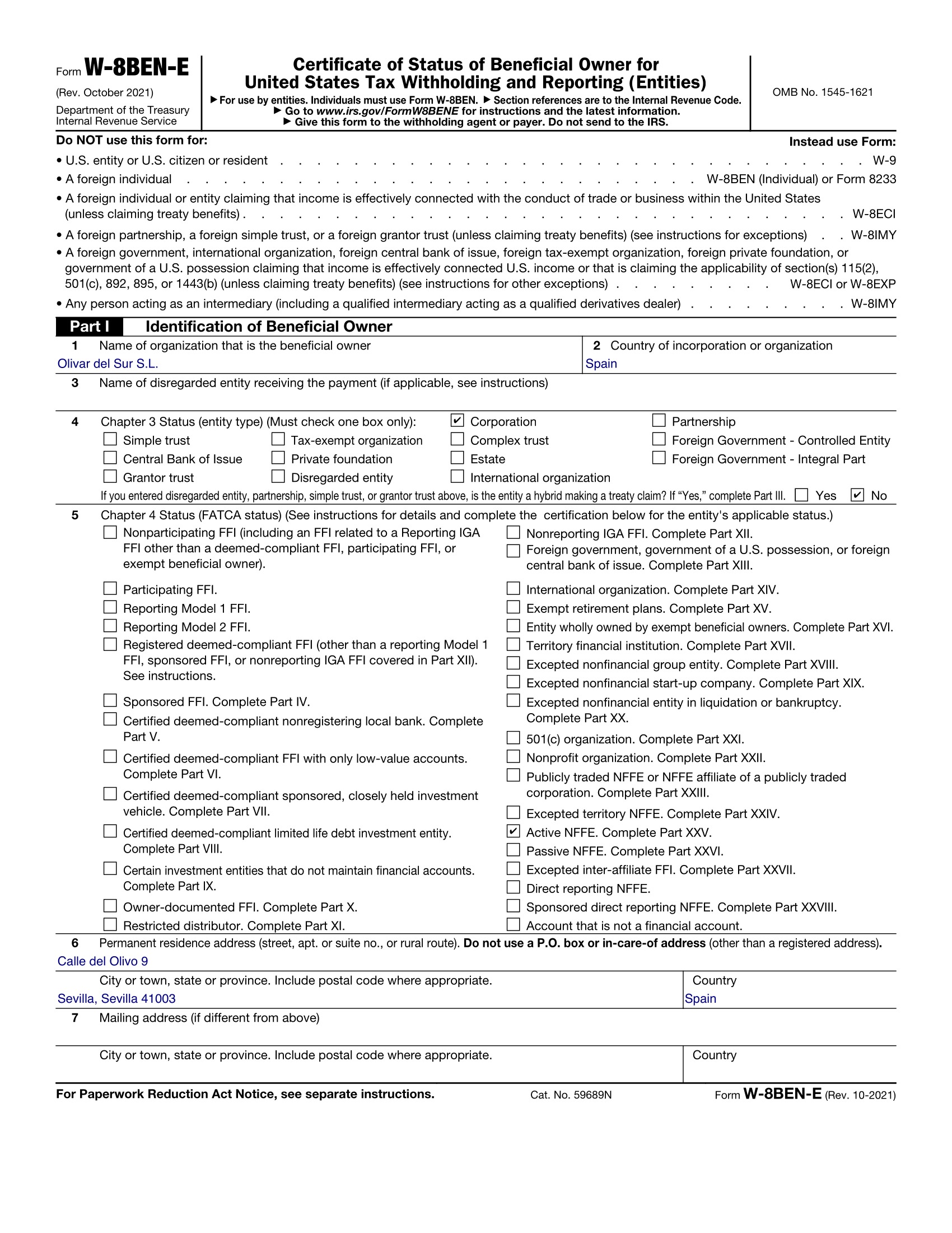
The preview below illustrates how a fictional Spanish SL might appear on page one of the certificate. Your downloaded PDF uses the same IRS layout but reflects your real name, addresses, Chapter 3 and Chapter 4 selections, and any treaty language generated from your answers. Use it to brief your finance team before you open Seller Central’s upload dialog, then switch to the wizard when you are ready to produce your own file.
FAQ for Spanish Amazon sellers
Do Spanish companies pay US tax on Amazon sales?
US federal income tax on worldwide profits is generally not the first question for a Spanish company selling inventory through Amazon marketplaces. What sellers usually encounter is US withholding at source on specific US-source payments when documentation is incomplete, plus information reporting tied to Chapter 4 (FATCA). Whether you have additional US filing obligations depends on facts such as permanent establishment, income characterization, and treaty positions. Use this page to understand withholding mechanics; engage a tax adviser for material amounts or complex structures.
What treaty applies to a Spanish company?
The Convention between the United States of America and the Kingdom of Spain for the avoidance of double taxation and the prevention of fiscal evasion with respect to taxes on income—and related instruments—is the bilateral framework people mean when they discuss treaty rates. The W-8BEN-E is where your entity certifies whether it claims benefits under that treaty, cites the relevant articles and paragraphs for the income types involved, and completes LOB disclosures when required. The form does not replace reading the treaty text with a professional when classifications are uncertain.
Do autónomos need W-8BEN-E?
Usually no—if you are a natural person receiving payments in your own name, the individual W-8BEN is the typical path. W-8BEN-E is for entities (SL, SA, partnerships treated as entities for this purpose, etc.). If you restructured from autónomo to SL, update Seller Central and switch to W-8BEN-E when the company is the payee.
How is this related to Spanish taxes?
Spanish corporate income tax, IVA, payroll, and autónomo reporting answer to Spanish authorities under domestic law. W-8BEN-E answers US payer questions: whether the recipient is foreign for US purposes, what withholding applies on documented US-source payments, and how FATCA buckets the entity. Cash flow after US withholding still hits your Spanish books, but the forms and concepts are not interchangeable.
Is an SL treated the same as an SA on the form?
Both are Spanish corporate forms and usually file W-8BEN-E when Amazon pays the entity. Chapter 3 classification still depends on US rules, not the colloquial Spanish label. Match the Chapter 3 category to your legal form and tax treatment with adviser input when unsure.
What does “Active NFFE” mean for a seller SL?
In Chapter 4, many operating sellers that are not banks or insurers certify as active non-financial foreign entities when they pass the active business tests. It signals you are not primarily a passive financial vehicle. If your income is mostly passive rents, dividends, or similar, another FATCA category may fit better. LOB may still matter for treaty claims even when Chapter 4 looks straightforward.
How long is a W-8BEN-E valid?
Validity depends on facts and IRS rules: material changes to name, address, treaty claim, or Chapter 4 status generally require a new form. Amazon may also prompt renewal on its own schedule. Treat any major restructuring—capital increases, registered office moves, or new beneficial owners—as a trigger to refresh documentation.
Can I keep registry names in Spanish on the Amazon side?
Seller Central and IRS forms are English-first. Spanish legal names can stay as registered, but narrative fields should be clear to US reviewers. The W8GetEasy wizard generates English certificate text aligned with IRS expectations while you supply accurate Spanish source data.
If I only sell on Amazon.es, do I still need this?
Need is driven by how Amazon routes payments and what Seller Central requests for your entity, not only by which storefront customers see. Many Spanish companies still touch US payers or US-source flows in marketplace economics. Follow the prompts in your tax interview and upload path rather than assuming EU-only storefronts exempt documentation.
Does Amazon accept electronically signed PDFs?
Practices vary by console workflow and region. Many sellers sign digitally or with typed signatures on the PDF, then upload. Always follow the latest Seller Central guidance for your account. If a upload is rejected, compare field-by-field consistency with your legal entity profile before resubmitting.
Continue on W8GetEasy
Looking for the general marketplace walkthrough or the main entity landing?
Fill your W-8BEN-E for Amazon in Spain
Stop bouncing between PDF fields, forum threads, and outdated screenshots. Answer guided questions tailored to foreign companies, preview the certificate, then download a formatted W-8BEN-E you can sign and upload. Checkout is a single $30 payment with clear steps—built for teams that need Amazon W-8BEN-E Spain documentation done carefully the first time.
Start Now ($30)