W-8BEN-E for IBKR & Dividends in Poland: Fill It Online
This article was created with AI assistance and has not been reviewed by a human editor. It is provided for general informational purposes only and does not constitute tax, legal, or financial advice.
Polish companies that invest in US-listed stocks through Interactive Brokers (IBKR) often receive cash dividends paid from the United States. Those payments are usually subject to US tax withheld at the source before the net amount reaches your brokerage cash balance.
To document who the beneficial owner is—and whether a US income tax treaty might support a rate lower than the default—brokers ask for Form W-8BEN-E for entity accounts. This page targets the intent behind searches such as IBKR W-8BEN-E Poland, W-8BEN-E investing USA company, and withholding tax dividends Poland company: practical onboarding for treasury and tax leads who need a coherent certificate without becoming IRS specialists overnight.
We write for finance and tax teams at Polish companies that use IBKR and care about dividend cash flow, treaty claims, and FATCA classifications in plain language. This is education, not legal advice; when ownership chains, hybrid entities, or prior US filings are in play, confirm positions with your own advisers.
If you are ready to produce a structured PDF you can sign and upload, start the guided W-8BEN-E flow below.
Treaty benefits depend on your entity’s facts and how IBKR classifies the payment. The 1974 US–Poland treaty has no LOB article. The wizard helps you document your position—it does not guarantee a specific withholding percentage.
Jump to the W-8BEN-E wizard · Main W-8BEN-E form guide · Investors (dividends) hub
Do Polish companies need a W-8BEN-E for IBKR?
In most cases, yes—when the brokerage account is in the name of a Polish (or other non-US) company and the account receives US-source dividends, IBKR needs entity tax documentation. Form W-8BEN-E is the standard IRS certificate for foreign entities; it is different from the individual Form W-8BEN used for natural persons. If a founder trades in a personal IBKR profile, that path is usually W-8BEN, not W-8BEN-E—so the first sanity check is always the account title screen.
Without a valid W-8BEN-E, US withholding on dividends paid to a foreign company is 30%. Under Article 11(2)(b) of the 1974 US–Poland treaty it falls to 15%. It is 5% under Article 11(2)(a) if the company directly holds at least 10% of the voting stock of the US company paying the dividend. The treaty has no LOB article, so line 14b is "No LOB article in treaty".
Completing W-8BEN-E does not automatically pick a treaty rate. It tells IBKR how you classify the entity under Chapter 3 (withholding rules) and Chapter 4 / FATCA, and whether you claim treaty benefits for specific income types such as dividends. When certifications are consistent and complete, many Polish companies position themselves to have a reduced rate applied if the US–Poland treaty supports the rate claimed—subject always to review by the broker’s tax desk. If IBKR disagrees with a position, the answer is usually a revised form or supporting memo, not an argument in the trade ticket window.
If you use a holding structure, see this guide on W-8BEN-E for holding companies (dividends, passive income, FATCA, and parent/subsidiary issues).
Generate Your W-8BEN-E for IBKR (Poland)
You do not need to memorize every IRS checkbox to build a coherent W-8BEN-E for a Polish company investing through IBKR. The guided interview asks for legal name, country of formation, addresses, Chapter 3 entity type, Chapter 4 / FATCA status, and treaty sections when you claim benefits for dividend income. Where helpful, short context explains jargon such as beneficial owner, Chapter 3, and FATCA without turning the screen into a tax treatise.
The flow hides sections that do not apply to your answers, explains terms in plain language, and outputs a formatted PDF after a one-time $30 payment. You can pause, return with fresher data, and regenerate when board-approved wording changes. Most teams finish in one session when KRS extracts, VAT/NIP identifiers where relevant, authorized signatory names, and IBKR account snapshots are already in a folder.
After download, print for ink signatures or follow your internal e-sign policy, then upload through IBKR’s tax document workflow. Keep a dated copy in your data room next to other cross-border certifications.
W-8BEN-E wizard
For an organization
For companies, funds, partnerships registered outside the USA.
Free to start. Payment is only required at the final step to download your completed PDF.
Loading...
How US tax applies to dividends for Polish companies
When a US corporation pays a dividend to shareholders, US rules generally require someone in the payment chain to withhold income tax at the source on the portion paid to foreign beneficial owners. For many brokerage workflows, that means the cash you see in IBKR is already net of US withholding, with the withheld amount reported and remitted upstream. The gross dividend announcement you read on the issuer’s IR site is therefore not the same number as the credit that lands in PLN or USD after conversion—finance teams should reconcile both.
Without a valid W-8BEN-E, US withholding on dividends paid to a foreign company is 30%. Under Article 11(2)(b) of the 1974 US–Poland treaty it falls to 15%. It is 5% under Article 11(2)(a) if the company directly holds at least 10% of the voting stock of the US company paying the dividend. The treaty has no LOB article, so line 14b is "No LOB article in treaty".
The United States and Poland have an income tax treaty—the version currently in force is the 1974 convention (Article 11 covers dividends); a newer 2013 treaty text exists but has not entered into force, so do not rely on its article numbering. Treaties sometimes cap the US withholding rate on dividends for residents of the treaty partner that meet eligibility requirements. The 1974 US–Poland convention has no Limitation on Benefits (LOB) article — on W-8BEN-E Line 14b the matching checkbox is “No LOB article in treaty,” not an active-trade or ownership test from a later treaty.
The exact rate that applies to your company is fact-specific; it depends on ownership chains, entity type under US rules, whether the payment is portfolio dividends versus other categories, and how the broker interprets your certifications. Two Polish spółki with similar names can still end on different withholding paths if one is a blocker in a larger group and the other is a standalone investor.
Form W-8BEN-E is where you certify those positions. IBKR uses it to decide what rate it is comfortable applying on US-source dividends credited to your entity account. If you later discover that a distribution was reclassified (for example substitute payments), revisit whether your treaty claim still matches the statement narrative.
Separately, Polish corporate income tax, accounting recognition, and foreign tax credits are a second conversation. US withholding is not a substitute for local compliance—it is one layer that shows up first on the brokerage statement. Your statutory auditor and Polish tax adviser remain the right voices for CIT modeling, participation regimes, and how foreign tax credits interact with what IBKR already withheld.
How IBKR uses W-8BEN-E
Interactive Brokers onboard foreign corporate clients through compliance questionnaires and tax document uploads. For entity accounts that receive US equity income, IBKR typically requests a signed W-8BEN-E so it can document Chapter 3 withholding status and, where claimed, treaty benefits on categories such as dividends. The request is not unique to Poland; it follows US rules for foreign entities. Still, Polish corporate users often discover it when scaling US allocations or moving a family portfolio into a spółka for governance reasons.
The form matters because IBKR must align customer certifications with how it reports and withholds on US-source payments it processes. If the certificate is missing, expired, or inconsistent with account facts, many brokers apply the default withholding rate until a corrected form is accepted. That operational reality is why searches for ibkr w8ben e poland cluster around both compliance setup and live dividend receipts.
You will usually see prompts in Client Portal under tax forms or certifications, sometimes labeled generically as “W-8” or “tax withholding.” Corporations should confirm they are submitting W-8BEN-E—not the individual W-8BEN—when the account title is a Polish spółka or other non-US entity. Uploading the wrong series delays relief because the withholding engine is looking for entity certifications, not personal TIN statements.
IBKR also cares about consistency between beneficial ownership disclosures and tax form representations. If UBO screens show one narrative while W-8BEN-E shows another, expect follow-up questions before treaty rates stick.
Dividend withholding is the pain point most Polish IBKR users notice first, but IBKR may also route substitute payments, some lending-related cash flows, or other US items through different classifications. Always match your treaty claim language to what your statements show rather than copying wording from unrelated invoices. If you run both a corporate treasury account and a separate payments business on Stripe or Amazon, resist the temptation to reuse the same treaty paragraph everywhere—each payer reads its own facts.
After material changes—merger, re-domicile, ownership shifts, or a new FATCA storyline—refresh the form so certifications stay true. IBKR may block treaty treatment on new dividends until an updated certificate is on file. Periodic refreshes are cheaper than reconstructing withholding history during an audit or M&A diligence.
Who this applies to in Poland
This guide targets Polish companies and similar Polish-resident entities that hold US stocks in an IBKR entity account and receive dividends, not individuals trading in their own names. If your strategy is mostly buy-and-hold US blue chips inside a corporate balance sheet, you are exactly the profile that notices withholding on every distribution.
Typical profiles include holding companies that consolidate portfolio income, family offices structured as Polish companies, investment SPVs, and operating businesses that deploy surplus cash into listed US equities. Venture-backed startups sometimes park treasury cash in short-duration instruments; when those positions include US equities paying dividends, the same documentation rules appear even if operating revenue is mostly Polish.
Dividend-focused entities—where a meaningful part of return comes from payouts—especially care about getting withholding documentation right before scale builds in the account. A few hundred dollars of leakage on the first test position becomes material when allocations move into seven figures.
If you are unsure whether the account is individual or entity, check the account title on IBKR’s profile screen. The title drives which IRS form path applies. Also confirm whether a partnership or hybrid structure sits above the Polish company; look-through issues can change who must certify treaty benefits.
Dividends vs services vs other income
US tax rules bucket income into categories—dividends, interest, royalties, services, and more—because income tax treaties attach different articles and often different rates to each bucket. Form W-8BEN-E asks you to describe the income for which you claim treaty benefits; that description should match what IBKR actually pays you. Think of each bucket as a different “color” on your statement; mixing colors on the form invites questions.
Dividends on US-listed shares are usually treated as dividends for Chapter 3 purposes when the broker codes the distribution that way. Services billed to a US client follow a different treaty paragraph than portfolio dividends. Royalties for US use of intellectual property are another storyline entirely. Interest on US deposits or margin balances is yet another line—sometimes overlooked until it becomes material.
Mislabeling income is a common reason brokers disregard treaty claims. If part of your IBKR cash is dividends and part is interest, fees, or substitute payments, your certifications should reflect the dominant facts or be discussed with advisers when the mix is material. Some teams try to paste generic “business profits” treaty language; that rarely maps cleanly to a brokerage dividend feed.
Marketplaces such as Amazon or processors such as Stripe generate different US payment stories than a custody account at IBKR. If your group has both operating platform income and brokerage dividends, you may maintain more than one compliance narrative—each payer cares about its own chain. Internal finance policies should tag income by ultimate US character, not only by internal GL codes.
Finally, classification can depend on how the broker reports the item internally. If a description looks wrong, fix underlying account data with IBKR before debating treaty percentages. Screenshots of corrected activity statements often travel faster than long email threads when you need a withholding adjustment reviewed.
How to fill W-8BEN-E for IBKR
Use this as a practical checklist aligned with what IBKR’s tax reviewers expect for many Polish corporate accounts. Your exact path can vary when facts are non-standard—for example, if a Polish company is disregarded for US purposes, if a partnership holds the IBKR account, or if the investor is a collective investment vehicle with its own Chapter 3 storyline.
Before you type anything, gather KRS or CEIDG extracts, the latest IBKR account profile PDF, wire instructions that show the legal account name, and any prior W-series forms the group filed with other US payers. Consistency across documents shortens review cycles.
Legal company name and addresses
Enter the entity name exactly as it appears on the National Court Register (KRS) extract or equivalent formation documents and as IBKR expects on the account profile. Use mailing and permanent residence addresses the broker already has on file—small mismatches are a frequent cause of rejected uploads. If the company recently changed its commercial name but not the legal name, use the legal name on W-8BEN-E even if marketing materials show something shorter.
When IBKR holds both Latin and Polish diacritics in addresses, mirror their spelling choices to avoid OCR mismatches.
Country of incorporation: Poland
Select Poland as the country of incorporation or organization. That selection frames whether a US–Poland treaty claim is on the table for eligible dividend income and which treaty articles your team will cite when claiming benefits. If the entity was formed elsewhere but tax residence is Poland, do not guess—residence and incorporation can diverge, and the treaty storyline follows technical rules, not intuition.
When in doubt, align the country fields with the opinion letter your advisers already issued for other US forms.
Chapter 3 entity type
Choose the US classification that fits—but do not assume every Polish company is automatically a "Corporation" for this form. Under 26 CFR §301.7701-2(b)(8), Spółka Akcyjna (S.A.) is a per se corporation. A spółka z ograniczoną odpowiedzialnością (sp. z o.o.) is not on that list, but its shareholders are not liable for its debts, so it is a Corporation by default — with one shareholder or several. It is a disregarded entity or a partnership only if it filed Form 8832 to elect that. Partnerships (sp.j., sp.k.) and reverse hybrids follow different rules.
See our separate guide on classifying Polish companies for W-8BEN-E (sp. z o.o., S.A., and partnership forms) for the full decision tree, linked below. If the Polish company is a single-member LLC treated as transparent somewhere else in the group, Chapter 3 may require a different beneficial owner narrative—this is not the place to improvise without counsel.
Chapter 4 / FATCA: Passive NFFE (typical for an investment company)
A company whose income is mainly dividends, interest and gains is a Passive NFFE. Active NFFE needs less than 50% passive income and less than 50% passive assets. A Passive NFFE also states whether it has substantial US owners (US persons with more than 10%) and names them if it has. A Polish trading company that only parks spare cash at IBKR can still be an Active NFFE if it passes both 50% tests.
Treaty claim for dividends
When you claim benefits, identify the treaty country (Poland), the income type (dividends on portfolio equity), and complete certifications. For the 1974 US–Poland treaty, Line 14b is “No LOB article in treaty”—not an active-trade or ownership LOB test. If you are not claiming treaty benefits, state that clearly so IBKR can document default withholding. The 15% rate needs no line 15; for 5%, line 15 states Article 11(2)(a), 5%, and the 10% direct holding.
If the portfolio includes REITs or other pass-through US issuers, confirm whether distributions are still treated as dividends for treaty purposes in your fact pattern before recycling boilerplate.
Signature and date
An authorized officer signs under penalties of perjury. Unsigned PDFs or stale dates are rejected. After major corporate changes, regenerate and re-upload so representations stay accurate. Some teams adopt a calendar reminder every two and a half years so renewals happen before busy season, not during dividend peaks.
Store the signed PDF with version control alongside board minutes authorizing the signatory.
Common mistakes Polish IBKR users make
Incorrect income classification
Copying treaty language from a services contract while the IBKR feed is only portfolio dividends invites rework. Align the treaty section with dividend wording when dividends are the US-source item at issue. The same company might still file different narratives for Stripe invoices—keep IBKR’s certificate clean and specific.
Wrong treaty claim or LOB checkbox for a treaty with no LOB article
The 1974 US–Poland convention has no Limitation on Benefits article. Checking an active-trade or ownership LOB box because another company received a lower rate can backfire. Match the claim to residency and Line 14b “No LOB article in treaty.” Screenshots from social media groups are not a substitute for treaty analysis.
Misunderstanding withholding timing
US withholding usually happens before cash credits. Waiting until year-end Polish filings to “fix” US withholding rarely helps if documentation was missing when dividends posted. Retroactive relief, when available, often requires formal processes rather than a polite email to support.
Mixing US withholding with Polish CIT mechanics
US withholding is collected by the US side of the chain. Polish corporate tax, dividend taxation at the shareholder level, and foreign tax credits are separate analyses—model both with your adviser. Treasury dashboards should show US gross, US withheld, and Polish expected liability as different lines, not one blended “tax cost.”
Example of a completed W-8BEN-E (Poland)
The preview below walks through a representative first page layout. Your generated PDF will reflect the answers you enter—Polish entity name, Chapter 3 and Chapter 4 selections, and any treaty claim for dividends—so executives can see the structure before signing.
Use the preview to brief board members who have never opened an IRS PDF. It is also helpful when comparing your output to a prior-year form to spot unintended changes before upload.
Sample W-8BEN-E for a UK royalties company
Harbour Apps Ltd claims Article 12, Paragraph 1 at 0% on software licence fees. The name, address, and company number are fictional.
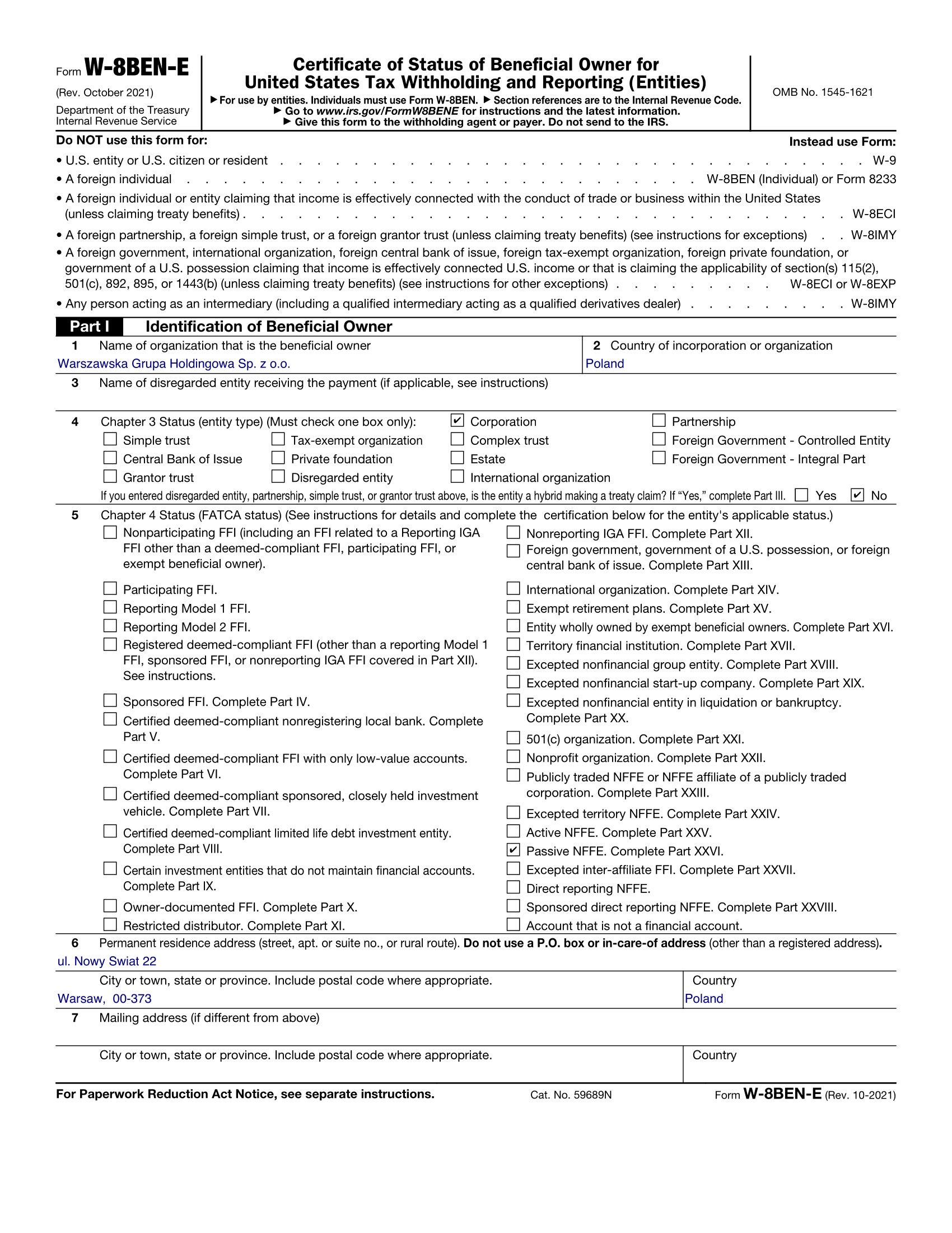
Example only. Harbour Apps Ltd, 20 Wharf Road, London N1 7GR, is fictional.
Related guides
Use these internal guides when you need a broader investor context beyond IBKR in Poland or want the main W-8BEN-E walkthrough.
W-8BEN-E for investors (dividends & US stocks)
Broker-agnostic overview for companies receiving US dividends.
Main W-8BEN-E form page
Full form guide, wizard entry, and withholding basics for entities.
Is your sp. z o.o. a Corporation? Polish entity classification & services income (PL)
Full decision tree for sp. z o.o., S.A., and partnership forms, plus the services-income (Article 8) scenario — in Polish.
FAQ for Polish IBKR users
What tax applies to US dividends for a Polish company?
Without a valid W-8BEN-E, US withholding on dividends paid to a foreign company is 30%. Under Article 11(2)(b) of the 1974 US–Poland treaty it falls to 15%. It is 5% under Article 11(2)(a) if the company directly holds at least 10% of the voting stock of the US company paying the dividend. The treaty has no LOB article, so line 14b is "No LOB article in treaty".
Does IBKR require W-8BEN-E?
For accounts opened in the name of a non-US entity, IBKR typically requires W-8BEN-E (or another acceptable IRS W-series form) before relying on reduced withholding on US-source dividends. Exact portal wording varies, but the requirement is standard for corporate clients.
Can Polish companies reduce US withholding tax on dividends?
Without a valid W-8BEN-E, US withholding on dividends paid to a foreign company is 30%. Under Article 11(2)(b) of the 1974 US–Poland treaty it falls to 15%. It is 5% under Article 11(2)(a) if the company directly holds at least 10% of the voting stock of the US company paying the dividend. The treaty has no LOB article, so line 14b is "No LOB article in treaty".
How does US withholding relate to Polish taxes?
They are separate layers. US withholding is taken at the US source. Polish corporate income tax, shareholder taxation, and foreign tax credit positions are governed by Polish rules and your facts. Model both with a qualified adviser.
When during IBKR onboarding am I asked for the form?
IBKR may prompt during account opening or before paying US dividends at a reduced rate. You can also upload proactively through Client Portal tax sections. Earlier submission usually avoids cash flow surprises on the first large distribution.
Active or Passive NFFE?
A company whose income is mainly dividends and interest is a Passive NFFE. Active NFFE applies when both passive income and passive assets are under 50%.
How long is W-8BEN-E valid?
Generally three years from the signature date unless a change in circumstances makes any certification incorrect. IBKR may request a refresh sooner during periodic compliance reviews.
We use an individual IBKR account for our founder. Is that W-8BEN-E?
Individuals normally file Form W-8BEN, not W-8BEN-E. If the account title is a Polish company, W-8BEN-E is typically the correct certificate. Match the form to the account name on IBKR.
Sources
Country-specific guides
Fill your W-8BEN-E for IBKR in minutes
Answer the guided questions for your Polish company, review Chapter 3, FATCA, and treaty sections, then download a PDF ready for signature and IBKR upload.
Start Now ($30)