Generate W-8BEN-E Online — $30, Step-by-Step, Instant PDF
- $30 one-time paymentNo subscription or hidden fees
- Guided step-by-step wizardPlain language — no IRS jargon
- Ready-to-sign PDFAvailable immediately after completion
- Treaty benefitsChapters 3, 4 & treaty claims in one flow
Form W-8BEN-E is how a non-US company certifies its tax status to US payers—so they can apply the right withholding and reporting rules when they send you royalties, services income, marketplace payouts, or other US-source payments.
Start W-8BEN-E FormIf a US tax treaty applies to your entity, claiming benefits correctly can reduce default withholding—rates depend on your facts and the payer’s classification of the payment.
What this page helps you do
If you are searching for a W-8BEN-E form online, a W-8BEN-E generator, or practical guidance on how to fill W-8BEN-E, you are in the right place. This guide explains—in plain English—what the form is, who must use it (including many LLCs and corporations), and how US withholding tax usually works when documentation is missing.
US platforms, marketplaces, and clients often ask foreign businesses to upload a completed W-8BEN-E before they release full payments. Without it, payers may fall back on statutory backup withholding that can feel surprisingly large on invoices and payouts. The sections below walk through the main boxes on the form so you know what to expect before you open the guided wizard.
Whether you need a W-8BEN-E for LLC income routed through a US marketplace, a foreign parent company receiving US royalties, or a services contract with a US enterprise, the same certificate language applies: you identify the entity, certify Chapter 3 and Chapter 4 status, and sign so the payer can document its withholding position. Searching for a W-8BEN-E example usually means you want a realistic checklist—use the step-by-step section first, then open the wizard when you are ready to answer field-by-field questions.
Companies that hold US stocks and receive dividends (for example through IBKR or other brokers) often need the same form for withholding at source—see W-8BEN-E for investors (dividends and US stocks) for a dedicated walkthrough.
Polish companies on IBKR can follow the country-specific guide: W-8BEN-E for IBKR Poland (dividends, treaty withholding, and broker uploads).
German companies investing via Interactive Brokers should also use our dedicated guide: W-8BEN-E for IBKR Germany.
UK LTDs receiving US dividends through IBKR can follow: W-8BEN-E for IBKR UK — treaty withholding, LTD classification, and step-by-step filing.
See W-8BEN-E for holding companies for dividends, passive US income, FATCA (passive vs active NFFE), and treaty withholding in group structures.
Common use cases
See how W-8BEN-E applies to your specific scenario.
Country-specific guides
See how W-8BEN-E applies in your country.
- YouTube W-8BEN-E Germany →
- YouTube W-8BEN-E Poland →
- Amazon W-8BEN-E Poland →
- Stripe W-8BEN-E Poland →
- Stripe W-8BEN-E Germany →
- Stripe W-8BEN-E UK →
- Stripe W-8BEN-E Netherlands →
- Amazon W-8BEN-E UK →
- Amazon W-8BEN-E Germany →
- Amazon W-8BEN-E France →
- Amazon W-8BEN-E Spain →
- Amazon W-8BEN-E Netherlands →
- Amazon W-8BEN-E Italy →
W-8BEN-E Form Generator — $30 (one-time payment)
You do not need to memorize IRS instructions to produce a coherent W-8BEN-E. Our W-8BEN-E generator walks through entity questions in plain language, applies conditional steps so you only see the parts relevant to your classification, and builds a formatted PDF you can review, sign, and upload.
Form generation costs $30 (one-time payment), including a ready-to-sign PDF for download.
You can fill W-8BEN-E online at your own pace, save progress in the browser on return visits, and download when you are ready—without manually editing a blank IRS PDF field by field.
- Step-by-step prompts instead of a static blank form
- No assumed tax expertise—we explain what each section is asking for
- Automatic PDF generation aligned with your Chapter 3 and Chapter 4 selections
- Treaty and certification sections handled in the same flow
- Fixed $30 (one-time payment) with no hidden fees
Why not just use a free W-8BEN-E tool?
Most free online tools give you a blank copy of the 8-page IRS form and let you type into the fields. That works if you already know which of the 30+ sections apply to your entity — and which ones to leave blank. Most foreign businesses don't. The W-8BEN-E covers corporations, partnerships, trusts, disregarded entities, financial institutions, and more. Each path has different required fields, different FATCA schedules, and different treaty logic. A blank form does not tell you which path is yours.
The wizard skips sections that don't apply to you
If your entity is an active NFFE, the FFI schedules never appear. If your country has no US tax treaty, Part III is hidden. You only answer questions relevant to your specific classification — typically 6–8 screens instead of 30+ fields.
Plain-language questions instead of IRS definitions
Free forms ask: "Chapter 3 status of beneficial owner." The wizard asks: "Is your company a corporation, an LLC, or a partnership?" and explains how your local company type (GmbH, Ltd, sp. z o.o., SRL) maps to US tax categories.
Classification mistakes are flagged before they happen
Foreign companies frequently choose the wrong entity type because local legal labels don't map one-to-one to IRS categories. A wrong Chapter 3 classification cascades into incorrect FATCA status and invalid treaty claims — all of which can cause the payer to reject the form or apply 30% default withholding anyway.
Treaty logic is handled automatically
If your country has a US income tax treaty, the relevant Part III fields appear with guidance on which article and rate applies to your income type. If no treaty applies, that section is skipped entirely — no risk of leaving treaty fields half-filled, which is a common rejection trigger.
The output is a properly structured, signable PDF
Not a scanned blank with typed text overlaid, but a formatted document generated from your answers — the same structure payers expect. Download, sign, and upload directly to your platform or client.
A form filled incorrectly with a free tool gets rejected by the payer — or worse, accepted but wrong, leading to excess withholding you'll need to reclaim. At $30, the wizard costs less than 15 minutes of a tax adviser's time, and you get it done correctly the first time.
You are filling: W-8BEN-E (for companies)
What is the W-8BEN-E form?
W-8BEN-E is an IRS form titled “Certificate of Status of Beneficial Owner for United States Tax Withholding and Reporting (Entities).” In practice, it is the standard certificate foreign entities use to tell US payers who they are for US tax purposes.
The form combines two big ideas. First, it captures basic entity facts: legal name, country of formation, address, and tax identification details where required. Second, it records Chapter 3 treatment (how the entity is classified for income-tax withholding on US-source payments) and Chapter 4 / FATCA status (how the entity is classified for information-reporting rules that financial institutions and many payers follow).
Completing W-8BEN-E does not by itself decide your final US tax liability for the year. It helps the payer document your status so they can withhold at the rate that matches your certifications—or use the default rate when treaty relief does not apply or is not claimed.
Who needs Form W-8BEN-E?
You typically file W-8BEN-E when you are not a US entity for tax purposes and a US payer or platform asks for entity certification. Common situations include:
- Non-US LLCs and corporations that sell services, goods, or digital products to US customers or through US platforms.
- Foreign partnerships and other non-US businesses that receive US-source income paid to the entity (not to an individual owner’s personal name).
- Holding companies and operating subsidiaries formed outside the United States that contract with US payers.
- Any non-US business asked during onboarding for “tax forms,” “W-8,” or “FATCA classification” at the entity level.
How to fill W-8BEN-E (step-by-step overview)
The official PDF is long because it must cover many entity types. Most filers touch the same core sequence. Use this as a mental map; the guided flow asks these questions in order and hides sections that do not apply.
Entity details
Enter the entity’s legal name exactly as it appears on formation documents and contracts. Consistency matters because payers match this line to their vendor records.
Country of incorporation or organization
Select where the entity was formed. This drives treaty questions later and helps payers understand whether you are a foreign or US entity for Chapter 3 purposes.
Tax classification for Chapter 3
Choose the Chapter 3 category that fits the entity—such as corporation, partnership, disregarded entity, or trust—based on US tax principles. This step is easy to get wrong if you assume your local label (for example “Ltd” or “GmbH”) maps one-to-one to a US category.
Chapter 4 (FATCA) status
Pick the Chapter 4 status that describes the entity under FATCA rules (for example, active or passive non-financial foreign entity paths, participating FFI, or other listed categories). Some selections open extra schedules or GIIN fields.
Tax treaty claim (Part III)
If your entity qualifies for treaty benefits on specific income, you claim them here with article references, income type, and—when required—limitation-on-benefits explanations. If no treaty applies or you are not claiming benefits, you certify that instead.
Signature and capacity
An authorized person signs under penalties of perjury, confirming that the information is accurate and that the signer has authority to bind the entity. Many platforms require a dated signature before they accept the form.
See an example of a completed W-8BEN-E form
Preview a sample W-8BEN-E form generated by our wizard. The final PDF will reflect your company details, tax classification, and treaty selections based on your answers.
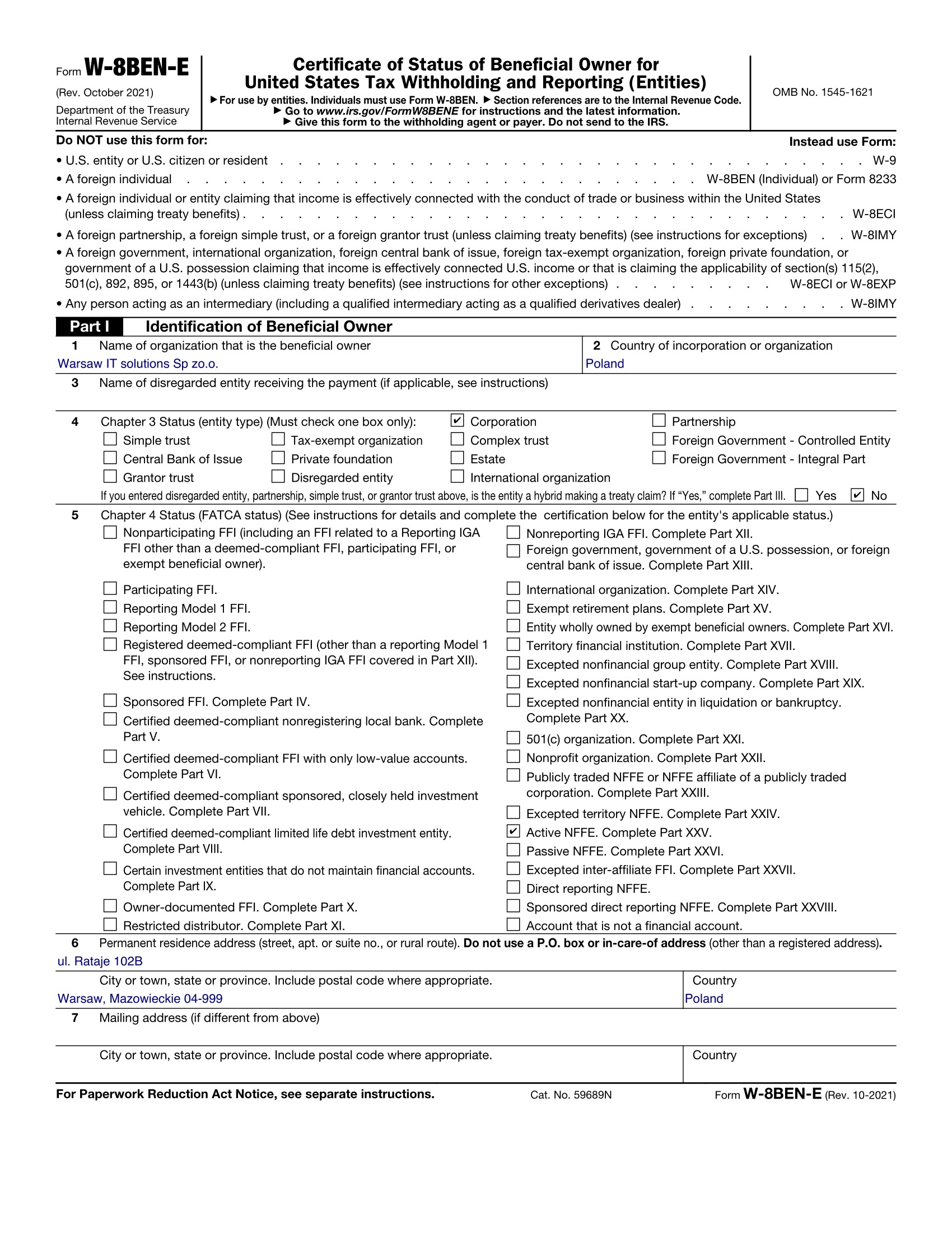
Sample data for demonstration purposes
US withholding tax in plain language
When people read about “30% withholding” in the context of US payments to foreign persons, they are usually hearing about the default rate that can apply when a payer lacks valid documentation or cannot rely on a treaty claim. It is not a universal tax on every wire—actual withholding depends on income type, entity status, and whether you submitted a complete W-8BEN-E on time.
Tax treaties between the United States and many countries can reduce or eliminate withholding on certain categories of income when the beneficial owner meets treaty tests. Those benefits are not automatic: you must certify eligibility on the form so the payer can apply the correct article and rate. If information is missing or inconsistent, the payer may default to the statutory backup rate until the account is corrected.
Always read notices in your payer’s tax center. Rates can differ between marketplaces, direct invoices, and card payouts—even for the same business—because classification and routing affect which rules apply.
Common W-8BEN-E mistakes (and how to avoid them)
Choosing the wrong entity type
A foreign label like “limited company” does not always equal “corporation” for US Chapter 3 purposes. Misclassification can cascade into the wrong treaty lines and FATCA selections.
Mixing up Chapter 3 and Chapter 4 answers
Chapter 3 is about income-tax withholding on payments; Chapter 4 is about FATCA reporting buckets. They are related but not identical—copying answers between them without reading the definitions is a frequent source of rejections.
Leaving treaty fields incomplete
Claiming treaty benefits requires specific article and income descriptions when you elect them. Vague treaty claims or missing limitation-on-benefits statements can cause a payer to disregard the claim.
Outdated signatures or stale forms
Many payers expect a signed form dated within their stated window. After major ownership or address changes, regenerate and re-sign so certifications stay true.
W-8BEN vs W-8BEN-E
Form W-8BEN is for individuals who are not US persons. Form W-8BEN-E is for foreign entities—including many LLCs and companies—that receive US-source payments in the entity’s name. If you pay yourself from the business as an individual, your payer may still ask for an individual form; if the contract and payouts are with the company, W-8BEN-E is usually the entity path.
Need the individual route? Start from our homepage wizard and select W-8BEN for personal income.
Create Your W-8BEN-E Form in Minutes
Jump into the guided steps, confirm your classifications, and download a structured PDF you can sign and send to your payer.
Start the WizardW-8BEN-E FAQ
Is there an official W-8BEN-E form online from the IRS?
The IRS publishes the official PDF and instructions. Third-party tools like ours help you complete the fields correctly and produce a formatted file; you should still review the output against current IRS guidance.
Does an LLC file W-8BEN-E?
Many non-US LLCs use W-8BEN-E when payments are made to the LLC and the payer treats the account as an entity. If you are unsure whether your LLC is disregarded or regarded for US purposes, confirm with a qualified adviser—the wizard explains common paths but cannot give legal advice.
What is a simple W-8BEN-E example?
A typical example is a foreign software company paid by a US marketplace: the company lists its legal name, country of formation, Chapter 3 corporate classification, an active non-financial entity Chapter 4 path when applicable, and signs under penalties of perjury.
How does US withholding tax interact with treaties?
Treaties may lower withholding on eligible income when certification is complete and the limitation-on-benefits tests are met. If you do not claim treaty benefits, or the payer cannot rely on your claim, they may use default withholding rules.
How long does it take to fill W-8BEN-E online?
Most organizations complete the guided flow in one sitting once they have formation details, addresses, and tax IDs ready. Complex FATCA paths or treaty claims can take longer because supporting schedules may appear.
Can I switch between W-8BEN and W-8BEN-E in the tool?
Yes. This page opens the entity form by default, but you can change the form type inside the wizard if your situation requires the individual certificate instead.