W-8BEN-E for Stripe Accounts in Poland: Fill It Online
This article was created with AI assistance and has not been reviewed by a human editor. It is provided for general informational purposes only and does not constitute tax, legal, or financial advice.
If your Polish company uses Stripe to charge US customers, receive SaaS subscriptions, invoice agency work, or process recurring payments, Stripe may ask for IRS Form W-8BEN-E before it treats your account as a documented non-US entity.
For founders and finance teams, this is less about legal theory and more about smooth operations: clear tax profile, fewer payout surprises, and consistent onboarding records. W-8BEN-E helps Stripe document that your business is outside the United States and apply withholding logic based on your certified status instead of a conservative default path.
This guide is written in simple language for non-US companies in Poland. You get a practical flow, an online wizard, and a ready-to-sign PDF so you can submit with confidence.
Do Polish companies need a W-8BEN-E for Stripe?
In most Stripe business-account scenarios, yes. If payouts and contracts are in your company name (not your personal name), Stripe often expects a valid W-8BEN-E to document foreign entity status for US withholding and reporting rules.
Think of the form as your official tax identity card for US-facing payments. It confirms that the beneficial owner is a non-US entity, records key classification fields, and gives Stripe the documentation it needs to avoid treating your company as undocumented.
Without this certification, platform compliance systems can apply stricter defaults, keep asking for tax details, or delay certain account actions until the profile is complete. Submitting a correct W-8BEN-E early reduces friction when your Stripe volume grows.
For high-intent teams, this is one of the fastest compliance tasks you can close before scaling US revenue.
- If your Stripe account belongs to a Polish company, W-8BEN-E is usually the entity form Stripe requires.
- The form certifies non-US status and supports withholding treatment based on documented facts.
- Uploading the wrong form type or incomplete tax details can cause repeated compliance prompts.
Generate Your W-8BEN-E for Stripe (Poland)
Use our guided wizard to complete W-8BEN-E without reading IRS instructions line by line. You answer plain questions, follow a structured flow, and download a formatted PDF ready for signature and upload.
No IRS background is required. The wizard covers the sections Stripe teams usually care about first: legal entity details, country of incorporation, FATCA status, treaty fields (if you claim them), and signature.
Price is a one-time $30 payment, including your instant PDF.
W-8BEN-E wizard (companies)
For an organization
For companies, funds, partnerships registered outside the USA.
Free to start. Payment is only required at the final step to download your completed PDF.
Loading...
How US tax applies to Polish companies using Stripe
Stripe is a payment platform, but from a US tax-documentation perspective it also acts like a withholding workflow checkpoint. When US-source payment rules can apply, Stripe needs reliable tax status data from the payee entity before relying on reduced treatment.
A practical way to read this: Stripe does not decide your global tax life, but it does need enough documentation to classify your account correctly for US-facing payment streams. W-8BEN-E is where your Polish company certifies that it is a foreign entity and, where relevant, claims treaty positions.
The US-Poland tax treaty may reduce withholding in some income categories when eligibility is met and the claim is documented correctly. That does not mean every Stripe payment automatically gets a reduced rate. Outcomes can differ by income character, contractual setup, and how payment flows are labeled in platform systems.
Service revenue, software subscriptions, licensing-like income, and mixed platform settlements can be analyzed differently. Two Polish companies using Stripe can see different withholding treatment if their facts are different.
It also helps to separate three layers: (1) what your contract says you sell, (2) how Stripe records and routes the payment, and (3) what category that payment may fall under for withholding analysis. These layers often overlap, but they are not always identical. A recurring SaaS invoice can look operationally simple, yet still require careful tax-documentation fields to avoid misclassification.
For Polish SaaS and agency teams, the operational goal is usually straightforward: provide complete, coherent W-8BEN-E data early so your compliance profile is stable as you scale into higher monthly volume. Clear records reduce back-and-forth when onboarding new entities, adding team members, or changing payout settings.
This page is educational, not legal advice. It helps you prepare consistent documentation so Stripe can process your profile with fewer gaps.
Who this applies to in Poland
This page is designed for Polish businesses that process international revenue through Stripe, especially when US customers or US-linked payment flows are involved.
- SaaS companies charging recurring subscriptions and enterprise plans through Stripe.
- Digital agencies billing US clients through Stripe checkout links or invoices.
- IT outsourcing companies with Stripe-enabled payment collection for US contracts.
- Startups that incorporated in Poland and use Stripe from day one for global payments.
- Subscription and membership businesses that need reliable payout operations at scale.
Why Stripe asks for W-8BEN-E
Stripe asks for W-8BEN-E because the platform needs tax documentation that matches the legal entity receiving funds. This is part of compliance and risk control, not a random extra step.
When a company account is marked as foreign, Stripe still has to verify how that foreign status should be treated under US withholding and reporting concepts. W-8BEN-E gives Stripe a standardized IRS format to store those certifications.
The form also reduces ambiguity. Without a valid entity certificate, payment systems can default to cautious assumptions because they cannot rely on treaty claims or entity classifications that are not documented.
In day-to-day operations, this protects both sides. Stripe can justify how it handled tax fields, and your company can show that it submitted the required declarations in a recognized format. That matters when finance teams reconcile payouts, explain effective rates to leadership, or prepare for external accounting reviews.
Another practical reason: Stripe scales globally, so its compliance workflows are standardized. W-8BEN-E is one of the standard documents that lets a foreign entity fit into that workflow without one-off manual interpretation. The clearer your form, the lower the chance that your account is treated as incomplete during later checks.
For operators, the key point is simple: Stripe is not replacing the IRS, and the IRS is not operating your Stripe dashboard. Stripe is the platform implementing documentation requirements in real workflows. If your form is coherent and aligned with account data, tax onboarding usually becomes easier to maintain over time.
How to fill W-8BEN-E as a Polish company using Stripe
Use this practical sequence when preparing your Stripe upload. The goal is consistency between your company records, Stripe account details, and the final signed form. Keep your KRS/registration information, registered address, and signer authorization details open while you complete the wizard so you can verify each field in one pass.
1) Enter your legal company name exactly
Use the same legal name shown in your registration records and Stripe account profile. Avoid abbreviations or alternate trading names unless they are formally listed where required. Small mismatches can trigger manual checks.
2) Set country of incorporation to Poland
Choose Poland as the jurisdiction where the entity is organized. This anchors the foreign-status narrative and treaty eligibility path in Part III if you claim benefits.
3) Select FATCA status (Active NFFE is often common)
For many operating companies, Active NFFE is a frequent option, but not universal. Holding-heavy or passive-income structures may need a different FATCA classification. Choose based on real activity, not convenience.
4) Complete treaty section if applicable
If your company is claiming treaty benefits, include treaty country, relevant article/paragraph, income type, and line 14b marked "No LOB article in treaty". The 1974 convention has no limitation-on-benefits article. If you are not claiming benefits, state that clearly so the form is internally consistent.
5) Review signer authority and sign
The signer should be authorized to certify on behalf of the company. Confirm date, title, and signature block details before generating the final upload copy for Stripe.
Common mistakes Polish Stripe users make
Most issues come from form mismatch, not bad intent. These are the patterns teams most often fix after Stripe requests re-submission.
- Submitting W-8BEN (individual) instead of W-8BEN-E (entity) for a company-owned Stripe account.
- Classifying income too broadly without checking how Stripe payment flows are actually documented.
- Assuming Stripe determines final IRS tax outcomes rather than applying platform compliance rules.
- Claiming treaty outcomes as automatic without matching article, income type, and entity facts.
Example of a completed W-8BEN-E (Poland)
The sample preview below shows how a completed W-8BEN-E layout can look for a Polish non-US company. It is useful for founders, finance leads, and operations teams who want to see the structure before preparing a real filing. Use this section to sanity-check field order: entity identity details, classification block, withholding statements, and signature area. Seeing the full flow in advance makes internal review easier when several people (founder, accountant, operations manager) need to approve one final upload. Your generated version keeps the IRS format but reflects your own company data, classification choices, and signature details. Use it as a visual reference, then create your own file in the wizard. Before uploading to Stripe, compare your final PDF with live account details one more time. Matching legal name, address, and signer role in both places lowers the risk of repeat compliance tickets and keeps operations moving.
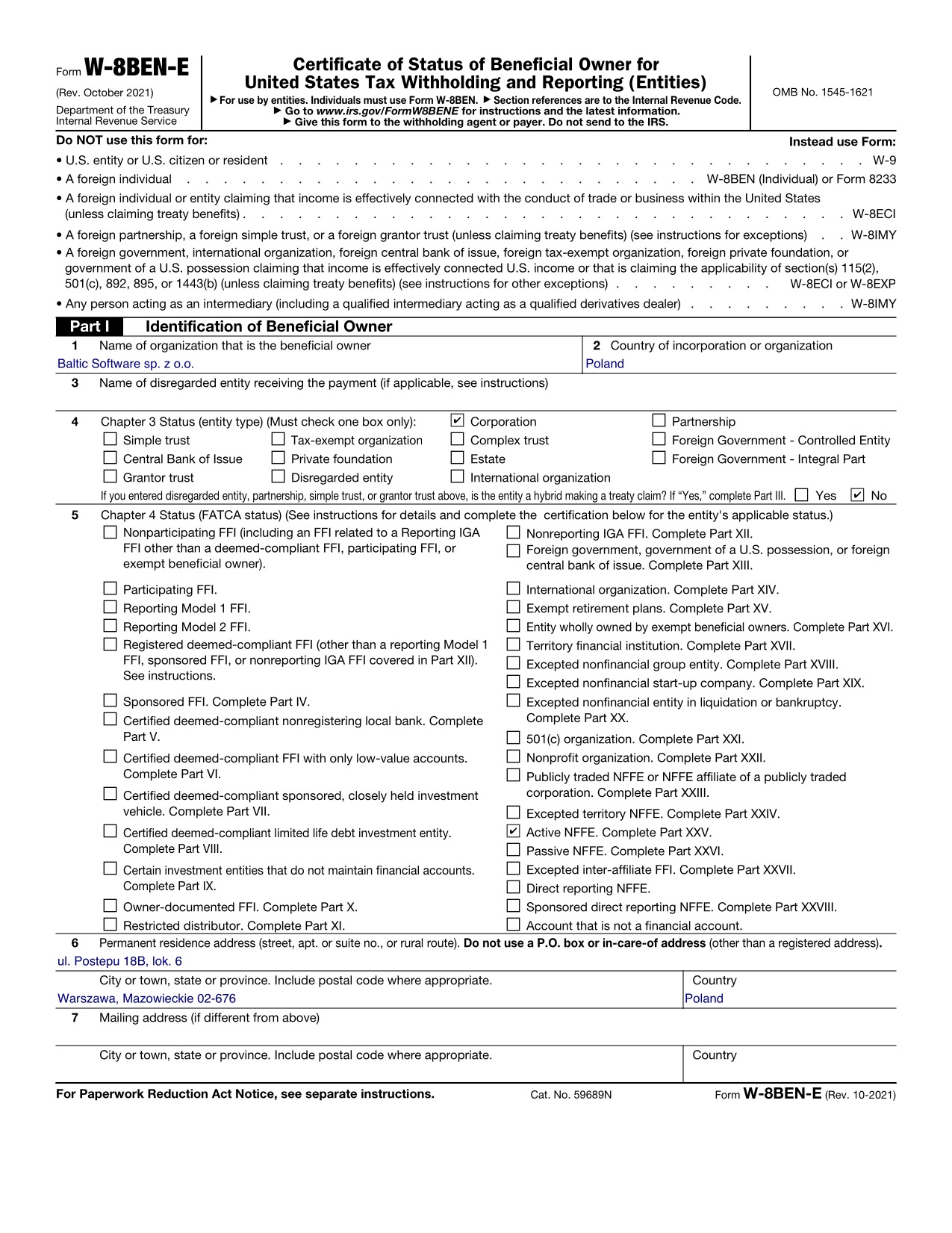
Example only. Always use your real company details before signing.
FAQ for Polish Stripe users
Do Polish companies pay US tax via Stripe?
Stripe itself is not your final annual tax return. What usually appears first is withholding treatment on specific US-source payment categories when documentation is missing or incomplete. Broader company tax obligations depend on your structure and facts.
Does Stripe withhold tax?
Not on your sp. z o.o.'s own sales: card payments Stripe settles for you are your revenue from customers, not US-source income paid by Stripe. A US platform paying you through Stripe Connect collects the W-8BEN-E in Stripe's onboarding. If it pays royalties, the US–Poland treaty gives 10% under Article 13(2); services your company performs in Poland are not US-source and need no claim. The Polish treaty has no limitation-on-benefits article.
Do I need W-8BEN-E for Stripe?
If Stripe payouts are made to your Polish company (not you personally), W-8BEN-E is usually the required form. It documents foreign entity status and supports consistent withholding/reporting treatment in Stripe compliance workflows.
Is this related to Polish taxes?
It is related in cash-flow effect, but it is not a Polish domestic tax form. W-8BEN-E addresses US payer documentation requirements. You still handle Polish CIT/VAT and local filings separately under Polish rules.
Related Stripe and form resources
Need broader guidance beyond the Poland-focused page?
Fill your W-8BEN-E for Stripe in Poland
Complete your entity form with a guided flow, generate a ready-to-sign PDF, and upload to Stripe with confidence. Designed for Polish companies that want a practical compliance workflow without legal jargon overload. When speed matters, use the wizard now and finalize your Stripe tax documentation in one focused session.
Start Now ($30)