W-8BEN-E for Shopify: Fill It Online (Non-US Companies)
This article was created with AI assistance and has not been reviewed by a human editor. It is provided for general informational purposes only and does not constitute tax, legal, or financial advice.
Shopify and the payment or payout partners behind your store may ask for US tax documentation when your legal entity is outside the United States. For companies—not sole traders filing as individuals—that documentation is usually IRS Form W-8BEN-E.
Your Shopify W-8BEN-E tells the US payer side who the beneficial owner is, that you are foreign for Chapter 3 withholding rules, and—when you qualify—how any tax treaty position should be read alongside your income type.
This page is plain English for operators who searched shopify w8ben e, w8ben e shopify, shopify tax form non us company, how to fill w8ben e for shopify, or shopify withholding tax non us company. You will get a quick answer, the same guided W-8BEN-E wizard our customers use, a withholding overview without fake guarantees, and an FAQ that matches what finance teams ask before payouts scale.
 AI-generated image
Do non-US companies need a W-8BEN-E for Shopify?
Often yes—when money is paid to a foreign company and a US payer or platform workflow needs to document that you are not a US domestic corporation. Shopify’s own tax screens and partner flows change over time, but the underlying pattern is stable: US rules expect a standardized certificate before certain US-source payments can be treated with anything other than conservative defaults.
Form W-8BEN-E (Certificate of Status of Beneficial Owner for United States Tax Withholding and Reporting—Entity) is the entity form. Individuals paid in their own name typically use Form W-8BEN instead. Mixing those two is one of the fastest ways to stall verification.
Why it matters: without a complete, internally consistent certificate, a payer may keep backup withholding or default withholding positions on documented payment types, delay settlements, or keep asking for tax information until the profile matches your legal entity story.
- You are generally in W-8BEN-E territory when the Shopify store, payouts, or merchant agreement are in a non-US company’s name—Ltd, GmbH, UAB, foreign LLC treated as an entity, and similar—not a personal sole proprietor using W-8BEN.
- The form supports treaty claims when your facts and the treaty text align; it does not invent a rate. Treaties depend on entity type, income characterization, limitation-on-benefits rules, and how the payer classifies the payment stream.
- If tax information is missing or contradicts your formation documents, bank KYC, or the way revenue is actually earned, you risk shopify withholding tax non us company defaults on covered flows, repeated prompts, or payout holds until the mismatch is fixed.
Generate Your W-8BEN-E for Shopify (Step-by-Step)
You do not need deep IRS knowledge to start. The W8GetEasy wizard asks guided questions, shows the sections that apply to your entity, and produces a formatted PDF you can review, sign, and upload wherever your payout or tax settings ask for it.
The flow covers company details, country of incorporation, Chapter 4 (FATCA) status, treaty claims and limitation-on-benefits language when relevant, and authorized signer details—so you can answer how to fill w8ben e for shopify without staring at a blank government PDF.
Generation is a $30 one-time payment and includes your downloadable file. You remain responsible for accuracy: the tool formats your answers; your certifications must match real contracts, banking records, and how US-source amounts are classified.
W-8BEN-E wizard (companies)
For an organization
For companies, funds, partnerships registered outside the USA.
Free to start. Payment is only required at the final step to download your completed PDF.
Loading...
What is the W-8BEN-E form for Shopify businesses?
W-8BEN-E is the IRS certificate foreign entities give US withholding agents and payers. It identifies the beneficial owner, states where the entity is organized, and sets out Chapter 3 withholding classification for many US-source payment types.
It also includes Chapter 4 (FATCA) status so payers can meet information-reporting expectations. Shopify-related setups are still “US payer documentation” problems: someone on the US side needs a coherent story before money moves in regulated ways.
For Shopify stores, the form is not a Shopify-only variant. It is the same W-8BEN-E other platforms request. What changes is your facts—brand name on the storefront versus legal entity on formation papers, who signs, which country’s treaty you might cite, and whether revenue is services, goods margin, platform fees, or a mix routed through Shopify Payments, Shop Pay, payouts partners, or invoices to US customers.
Think of your Shopify W-8BEN-E as the PDF mirror of the compliance questions you see in dashboards: legal name, addresses, entity type, FATCA category, optional treaty article, and signature under penalties of perjury. Screens may shorten the language; the certificate still has to line up end to end.
This page explains common situations; it is not legal advice. Use professionals when you have US subsidiaries, inventory or people on the ground in the US, complex royalty stacks, or large balances where characterization disagreements are expensive.
Who needs to submit W-8BEN-E for Shopify?
Use the entity form when payouts and contracts run through a company. If you are unsure, compare the legal name on bank KYC and formation documents to the name on tax prompts—the certificate type should match that layer, not only the brand customers see.
- Shopify stores owned or operated by non-US companies selling digitally or shipping goods where the merchant of record is the foreign entity.
- Consumer brands that run Shopify as the storefront while contracts, Stripe-style card rails, or marketplace settlements still settle to the parent company outside the US.
- Agencies and e-commerce rollouts where the invoice path and tax profile are the agency’s foreign corporation rather than a freelancer’s personal name.
- Companies receiving US-source payments or platform-related payouts that pass US compliance checks—whether labeled as Shopify, a payments partner, or a US customer paying a foreign vendor.
- Teams expanding US revenue who were told to upload “tax forms for foreign entities” during onboarding, bank linkage, or a payouts review.
Worked example: a UK outdoor-gear company on Shopify
Halden Outdoor Ltd runs a Shopify store selling camping and hiking gear from its warehouse in Bristol, shipping directly to customers including a growing share in the United States. Income from selling goods isn't the kind of payment US withholding applies to.
A US retailer placing wholesale orders asked for a W-8BEN-E before setting the company up as a vendor; Part III stayed blank, because sales of goods aren't subject to US withholding.
- Own Shopify store: no US withholding on the sales.
- US wholesale vendor setup: W-8BEN-E with Part III blank — still reportable to HMRC as normal.
Shopify sales on your UK Corporation Tax return
Shopify sales income must be reported to HMRC regardless of what happens on the US side, and the company still needs its usual Companies House filings.
If a meaningful share of your inventory, staff, or fulfilment operations end up physically located in the US, that presence can be a permanent establishment. Confirm your specific structure with an accountant.
- Keep the signed W-8BEN-E and any 1042-S issued by your US payment processor with your company tax records.
- Report Shopify sales income through normal UK Corporation Tax filings, regardless of US withholding treatment.
- Reassess whether a US warehouse, US-based staff, or a US fulfilment partner with decision-making authority creates a permanent establishment.
What tax can apply to Shopify-related payments?
US tax rules often describe a 30% concept on certain fixed, determinable, annual, or periodical (FDAP) US-source payments to foreign persons when a valid reduced rate is not documented. That headline is why finance leads search shopify withholding tax non us company before they scale US card volume.
In practice, the rate you see depends on payment type, how the payer classifies the income, whether a treaty applies to your entity and that income bucket, and whether your certificate includes a supportable claim with any required limitation-on-benefits explanation. Two similar stores can still see different outcomes if one sells digital downloads classified as royalties and another sells services billed hourly—even inside the same Shopify theme.
Treaty relief can reduce withholding when the treaty, your residency, and your facts align. Treaties are not a universal switch to zero. Some articles support reduced rates for specific items; some combinations offer no relief at all; some benefits require tests you must truthfully certify.
Shopify and its partners implement their own compliance stacks, so the exact wording in your admin may differ by product, region, and time. The stable part is the documentation expectation: a foreign company should be ready to present a consistent W-8BEN-E when asked, then maintain it when facts change.
We do not guarantee any withholding outcome on this page. Use your advisors when characterization is unclear or material dollars are at stake.
- Physical goods versus digital delivery: margin on goods and shipping facts can differ from SaaS-style recurring revenue for treaty and sourcing questions—your certificate should match how you actually earn income, not only how the product page reads.
- Shopify Payments and partner rails: the entity receiving settlement must match the beneficial owner named on the form; mismatched parent or subsidiary routing is a common review trigger.
- US customers alone do not automatically create a US corporation, but people, warehouses, or dependent agents in the US can change analysis—do not ignore operational facts when you certify status.
How to fill out W-8BEN-E for Shopify
Treat this as a practical map you can follow in the wizard and in any payout settings. The goal is one coherent story from company records to signature block.
Company details
Enter the full legal name, mailing and permanent establishment addresses, and tax identification numbers exactly as they appear on formation documents, bank KYC, and your Shopify business profile. “Close enough” legal names slow automated reviews.
Country of incorporation
Select the jurisdiction where the entity was formed. This anchors treaty availability and confirms you are certifying as a foreign entity rather than a US domestic corporation. If you recently reorganized, align the form with today’s structure.
FATCA status
Choose the Chapter 4 category that reflects real operations—active NFFE, passive NFFE, participating FFI, exempt beneficial owner, or another listed path as appropriate. FATCA selections should agree with your Chapter 3 entity type; contradictions invite manual review.
Treaty claim and limitation on benefits
If you qualify, identify the treaty country, relevant articles, income type, and claimed rate. If limitation-on-benefits statements apply, include them when required. If you are not claiming benefits, say so clearly instead of copying unrelated forum examples.
Signature details
An authorized officer signs under penalties of perjury, confirms capacity to bind the entity, and dates the form. Keep a signed PDF for your records; many platforms re-prompt on changes or refresh cycles even while the IRS validity window still runs.
Common mistakes when filling W-8BEN-E for Shopify
Most delays come from small inconsistencies that machines catch before humans do. Fix these early to avoid support loops.
- Wrong entity type: certifying as a corporation when banking records show a partnership, or the reverse, breaks the Chapter 3 story.
- Wrong income type: citing a royalty article when most US-source receipts are services—or the opposite—creates treaty positions the payer cannot rely on.
- Misunderstanding treaty benefits: assuming any foreign company automatically receives 0% US withholding; treaties are specific and often require tests you must truthfully meet.
- Incorrect limitation-on-benefits choice: copying a narrative from another country or another SaaS without matching your ownership and operations.
- Missing signer details or outdated titles: the signer must have authority the payer expects; stale officer names or blank capacity lines stall uploads.
Sample: Halden Outdoor Ltd's W-8BEN-E for Shopify
Halden Outdoor Ltd's UK company number is on line 9b and Part III is blank.
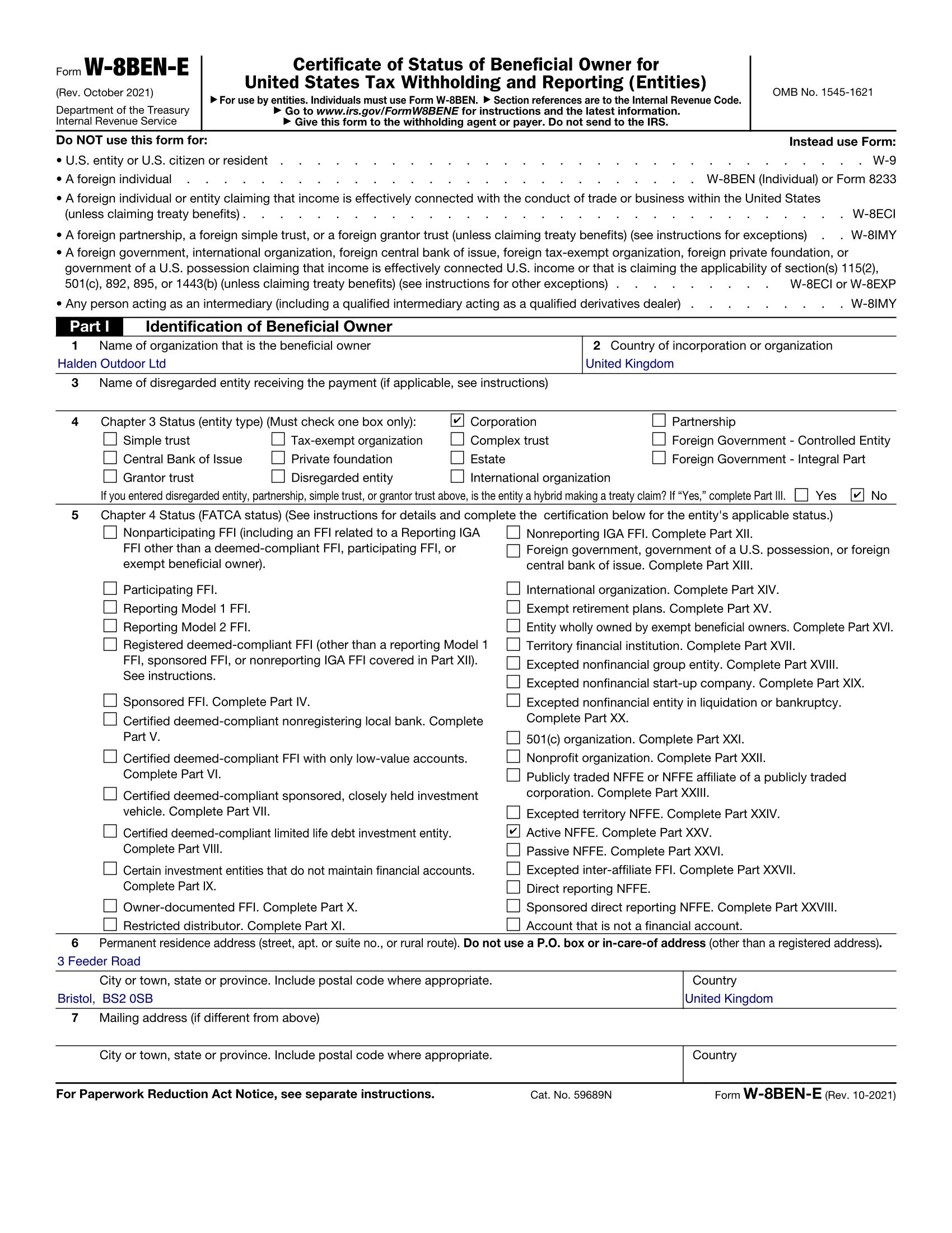
Example only. Halden Outdoor Ltd, 3 Feeder Road, Bristol BS2 0SB, is fictional.
FAQ
Do I need W-8BEN-E for Shopify?
If payouts are made to a non-US company and a US payer or partner flow requests foreign-entity documentation, you usually complete W-8BEN-E. Individuals paid in their own name typically use W-8BEN. Exact prompts depend on your Shopify products, region, and payout path—compare the legal entity on tax screens to your formation documents.
Is it different from W-8BEN?
Yes. W-8BEN is for foreign individuals. W-8BEN-E is for foreign entities and includes FATCA (Chapter 4) sections the individual form does not carry. Uploading the wrong certificate type commonly delays verification because automated checks compare entity type to the form.
What happens if I do not submit it?
Payers may keep default withholding on documented payment types, delay settlements, or block capabilities until tax information is complete and consistent. Exact messages vary by partner and account mode; the underlying issue is missing documentation for foreign status or treaty positions.
Can a company use W-8BEN-E?
Yes—that is the purpose of the form. Non-US corporations, eligible foreign partnerships, and other foreign organizations use W-8BEN-E to certify to US withholding agents. Individuals acting as sole proprietors in their own name generally file W-8BEN instead.
How long is the form valid?
Generally, a signed W-8BEN-E stays valid until the last day of the third calendar year after signing unless a change in circumstances makes it incorrect sooner. Submit a new form when legal name, address, classification, treaty claims, or FATCA status changes. Platforms may also prompt for refresh on their own schedules.
Does a Shopify W-8BEN-E automatically reduce withholding?
There is usually nothing to reduce. Selling goods through a Shopify store is not income US payers withhold 30% on — gains from sales of property are excluded from FDAP. A W-8BEN-E matters only when a US payer asks for it, for example a Stripe Connect platform that pays you; then it certifies your company is foreign, so you aren't treated as a US payee.
Where do I submit the form?
Follow the tax or verification prompts in Shopify admin or the payout partner your store uses. Labels move between products and regions, but the goal is consistent: upload a signed PDF that matches your legal entity profile and keep a copy with the signature date.
Related links
Want the full W-8BEN-E product walkthrough without the Shopify framing? Open our main entity page for deeper context on Chapter 3, Chapter 4, and withholding mechanics.
Selling as yourself—not through a company? Use the individual W-8BEN path or the Shopify W-8BEN landing below so personal and entity certifications stay separated.
Fill your W-8BEN-E for Shopify in minutes
Answer guided questions tailored to foreign companies, preview the output, then download a formatted W-8BEN-E you can sign and upload when Shopify or a payouts partner asks for it. Clear checkpoints, plain language, and a single $30 checkout for PDF generation—built for teams that need compliance shipped without turning operators into part-time tax counsel.
Start Now ($30)