W-8BEN-E for YouTube & AdSense: Fill It Online (Companies)
This article was created with AI assistance and has not been reviewed by a human editor. It is provided for general informational purposes only and does not constitute tax, legal, or financial advice.
YouTube and Google AdSense pay creators and partners through Google’s tax systems. When the payee is a non-US company—not an individual in their own name—Google typically asks for IRS Form W-8BEN-E (Certificate of Status of Beneficial Owner for United States Tax Withholding and Reporting, Entity).
That certificate tells Google who the foreign entity is, where it is organized, and how it should be treated for US withholding and reporting. It is also where you may claim a reduced withholding rate if a tax treaty applies to your facts.
Studios often consolidate multiple channels, catalog rights, and brand integrations behind one legal payee. Agencies sometimes route creator payouts through a corporate entity for contracting and liability reasons. In both cases, the “creator economy” story still meets a corporate tax certificate on the banking and payments layer.
This guide is for media companies, studios, and agencies that searched YouTube W-8BEN-E, youtube w8ben e, adsense w8ben e, w8ben e google adsense, youtube tax form non us company, or adsense withholding tax non us. You will get a quick answer, a guided wizard near the top of the page, plain-language withholding context without fake guarantees, common mistakes teams repeat under deadline pressure, and an FAQ that matches the visible page for schema.
 AI-generated image
Do YouTube creators need a W-8BEN-E?
Individuals paid in their own name usually complete Form W-8BEN, not W-8BEN-E. You need W-8BEN-E when YouTube or AdSense pays a foreign legal entity—a corporation, partnership, or other organization—because the IRS certificate for entities is different from the individual form.
Google requires tax documentation so it can apply US withholding rules correctly. The company path is W-8BEN-E when the beneficial owner receiving payments is the entity.
If you skip the form or submit the wrong type, Google may default to conservative withholding on amounts where documentation is required. Exact messages and timing depend on your account region and product surface, but the underlying issue is the same: without a valid certificate, Google cannot rely on a documented treaty position for your entity.
- Yes—if AdSense or YouTube revenue is credited to a non-US company, you typically certify with W-8BEN-E, not W-8BEN.
- Google uses the form to confirm foreign status, align withholding where rules apply, and meet payer-side compliance expectations.
- Without it, adsense withholding tax non us defaults can apply on documented payment types until tax information is complete and consistent with your legal payee profile.
Generate Your W-8BEN-E for YouTube (Step-by-Step)
You do not need to memorize IRS instructions or guess which Chapter 4 (FATCA) checkbox fits a studio balance sheet. The W8GetEasy wizard asks plain-language questions, branches to the sections that matter for your entity, and builds a formatted PDF you can review and sign. Answer the same questions in Google's tax tool (Payments › Payments info › Manage settings › United States tax info › Manage tax info). Google generates the form for you to verify, so you copy the answers line by line and keep the PDF as your record.
The flow walks company details, country of formation, FATCA status, treaty claims where relevant—including royalties-style positions when your facts support them—and signature. Form generation is a $30 one-time payment, including your downloadable PDF.
You still own accuracy: the wizard formats your answers, but your certifications must match formation documents, bank KYC, and how Google actually pays your company.
W-8BEN-E wizard (companies)
For an organization
For companies, funds, partnerships registered outside the USA.
Free to start. Payment is only required at the final step to download your completed PDF.
Loading...
What is the W-8BEN-E form for YouTube and AdSense?
Form W-8BEN-E is the IRS certificate foreign entities give US payers and withholding agents. It states the entity’s legal name, mailing address, country of incorporation or organization, and Chapter 3 classification for US tax withholding on certain US-source payments.
It also includes Chapter 4 (FATCA) status so payers can meet information-reporting rules. Google acts as the withholding agent in the everyday sense: it is the US-facing payer platform that must document whether recipients are US or foreign persons—and what rate applies—before money moves in covered situations.
For YouTube and AdSense, much of the revenue is analyzed as US-source royalties or similar periodic amounts from the use of content or ad inventory in the United States. That is why teams compare notes on “royalties” language even when day-to-day cash feels like “ad revenue.” The important point is that your treaty claim and income description on the certificate should match how Google classifies the payment streams you receive—not only how your finance team labels invoices internally.
W-8BEN-E is not a business registration and not a substitute for local corporate tax filings. It is a withholding certificate. This page is guidance, not legal advice; use professionals when structures involve US subsidiaries, branches, or complex IP holding companies.
If you are comparing notes with a solo creator, remember they may be on W-8BEN while your finance stack is on W-8BEN-E. The forms look similar at a glance, but the entity sections, FATCA categories, and treaty narratives are not interchangeable—mixing them is one of the fastest ways to stall monetization reviews.
Who needs to submit W-8BEN-E for YouTube?
If AdSense or YouTube pays a foreign organization—not a sole proprietor treated as an individual—you are usually in W-8BEN-E territory. Typical profiles include:
- Media companies and broadcast groups that monetize catalogs through a corporate AdSense or YouTube entity.
- Content studios that centralize rights, channel revenue, and brand deals in a single non-US payee.
- Agencies managing multiple channels where the legal payee on Google tax records is the agency entity.
- YouTube channels owned by companies: the channel brand can look “creator-first,” but tax settings follow the legal entity receiving payouts.
- Multi-territory groups that consolidated US-facing monetization into a foreign holding company for operational reasons.
Worked example: a UK media production company on YouTube
Northgate Media Ltd operates a network of YouTube channels from its office in Manchester, earning AdSense revenue on behalf of the company rather than an individual creator. YouTube classifies these payments as royalty-type income for US withholding purposes. Under the US–UK tax treaty, this income is taxed at 0% under Article 12(1) once Form W-8BEN-E Part III is completed correctly.
Before filing, a company without a certificate on file could see the standard 30% withholding applied to payments classified as US-source royalties. After filing, with the United Kingdom named as country of residence and Article 12(1) claimed, YouTube now applies 0% US withholding on the same income. Northgate Media's UK corporation tax position is unaffected — only the US withholding layer is removed.
- No W-8BEN-E on file: 30% US withholding on reportable AdSense income.
- W-8BEN-E filed + Part III (United Kingdom, Article 12(1)): 0% US withholding — the full payment reaches the company account, still reportable to HMRC as normal.
YouTube AdSense on your UK Corporation Tax return
AdSense income must be reported to HMRC regardless of what the US side withholds, and the company still needs its usual Companies House filings.
If a meaningful share of production staff, editing, or decision-making ends up physically based in the US, that can change the Article 12 analysis — a genuine US presence may create a permanent establishment, which limits treaty relief. Confirm your specific structure with an accountant before assuming 0% applies indefinitely.
- Keep the signed W-8BEN-E and any 1042-S issued by YouTube/Google with your company tax records.
- Report AdSense income through normal UK Corporation Tax filings, regardless of US withholding treatment.
- Reassess treaty eligibility if you open a US office, hire US-based staff, or route decision-making through a US entity.
What tax does YouTube withhold from non-US companies?
US rules often describe a 30% statutory withholding rate on certain fixed, determinable, annual, or periodical (FDAP) US-source payments to foreign persons when a valid reduced rate is not documented. That headline number is why finance teams search adsense withholding tax non us before revenue scales.
Google applies those general US concepts through its own compliance systems, so what you see in AdSense or YouTube tax centers is Google’s documentation of your entity facts—not a universal forum answer copied from another creator.
Treaty relief can reduce withholding when your entity and income type qualify, but treaties are not automatic zero. The W-8BEN-E is where you certify eligibility, cite articles, and—when required—include limitation-on-benefits (LOB) statements. Many countries have public summaries that show 0% on certain royalty articles for eligible entities; others allow partial relief; some combinations do not reduce withholding at all.
We do not guarantee any rate. Outcomes depend on entity type, how Google characterizes the payment, treaty text, LOB rules, and whether your certifications are internally consistent. Two studios in the same country can still see different results if their entity stories or treaty claims differ.
Read Google’s in-product notices alongside this page. Product names change, thresholds move, and regional flows differ; your authoritative path is always the combination of your legal entity facts, the certificate you sign, and the messages Google returns for your account.
- Default path without documented relief: expect conservative withholding on amounts where rules require a certificate—often discussed as up to 30% in community posts, but your account notices are authoritative.
- Royalties classification: AdSense and YouTube documentation often discusses royalty-style FDAP; your treaty article should match the income type you actually certify, not a generic template from another platform.
- Treaty claims: reduced rates require truthful eligibility; citing the wrong article or mixing “services” and “royalties” narratives is a common reason certificates fail review.
- LOB: when the form requires it, a thin narrative can invalidate treaty benefits even if the headline country pairing looks favorable.
How to fill out W-8BEN-E for YouTube
Treat this as a checklist before you edit fields in Google tax settings or the PDF. Finance leads use it to align marketing (“we are a studio”) with tax facts (“this entity receives the payment”).
Step 1 – Company details
Enter the legal entity name, mailing address, and tax identification fields exactly as they appear on formation documents, your Google payments profile, and bank KYC. “Close enough” legal names are a top reason submissions bounce or leave accounts on default withholding while teams re-open support tickets.
Step 2 – Country of incorporation or organization
Select the jurisdiction where the entity was formed. This anchors treaty availability and confirms you are certifying as a foreign entity rather than a US domestic corporation. If you recently restructured, align the form with the current payee—not the old shelf company story.
Step 3 – FATCA (Chapter 4) status
Choose the category that reflects real operations: active non-financial foreign entity (NFFE), passive NFFE, participating foreign financial institution, exempt beneficial owner, or another listed path as appropriate. FATCA selections must harmonize with Chapter 3 entity type; contradictions trigger manual review.
Step 4 – Treaty benefits (royalties where applicable)
If you qualify, identify the treaty country, relevant articles, income type, and claimed rate. For YouTube W-8BEN-E workflows, teams often focus on royalty-style articles when that matches Google’s payment characterization and their facts. If you are not claiming benefits, certify that clearly instead of copying unrelated examples from forums. LOB narratives belong here when the form requires them.
Step 5 – Signature and date
An authorized officer signs under penalties of perjury, confirms capacity to bind the entity, and dates the form. Google typically needs this before reduced withholding settings can rely on your certificate. Keep a dated copy for your records and update promptly when legal name, address, classification, treaty claims, or FATCA status changes.
Common mistakes when filling W-8BEN-E for YouTube
These issues appear often because the form is long and dashboards compress complex tax ideas into short prompts. Fixing them early saves weeks of support loops.
- Choosing “services” instead of “royalties” (or the reverse) when Google’s documentation and your actual payment characterization point a different direction—treaty articles must match the income story you certify.
- Incorrect treaty article numbers copied from unrelated industries; a favorable-looking article is useless if it does not match your entity type and income.
- Misunderstanding Google payments: assuming “AdSense is always X” without reading the tax notices for your specific payee entity, region, and product combination.
- Wrong limitation-on-benefits (LOB) narrative or skipping LOB when the form expects it—treaty benefits can be denied even when the country pairing looks good.
- Submitting Form W-8BEN when the payee is a company—wrong form type stalls verification because automated checks compare entity type to the certificate.
Example of a completed W-8BEN-E for YouTube
The preview below shows a realistic first-page layout with sample data for a fictional non-US media company. Your generated YouTube W-8BEN-E PDF follows the same IRS structure but reflects your legal name, addresses, Chapter 3 and Chapter 4 selections, and any treaty language produced from your answers. Use it to orient executives who have never seen the form: it demonstrates field placement and the general density of certifications—then jump into the wizard when you are ready to answer for your real entity.
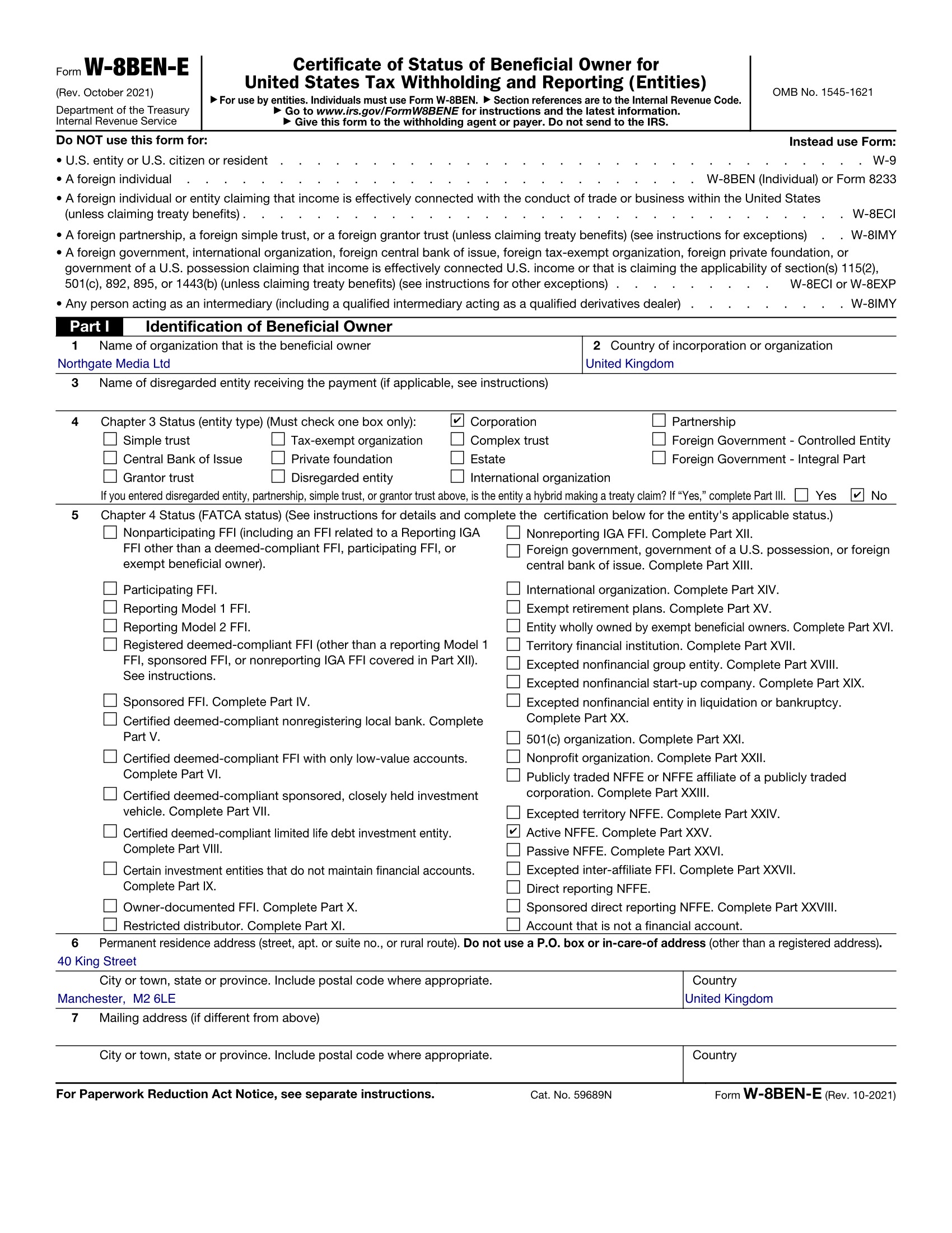
Illustration only—replace with your real data before signing. Answer the same questions in Google's tax tool (Payments › Payments info › Manage settings › United States tax info › Manage tax info). Google generates the form for you to verify.
FAQ
Do YouTube companies need W-8BEN-E?
When payments are made to a foreign legal entity, Google typically collects Form W-8BEN-E. Individuals paid in their own name usually use Form W-8BEN instead. Compare the legal payee on your Google payments profile to your formation documents—the certificate type should match that entity layer.
Is AdSense income royalties?
Google often discusses AdSense and YouTube payouts using royalty-style US tax concepts for certain FDAP streams, but classification can depend on your entity, region, and how the payment is documented. Your W-8BEN-E certifications should match Google’s characterization and your facts—not a label you prefer for internal reporting.
What tax rate applies to a non-US company on YouTube?
There is no universal rate. US rules may start from a 30% statutory withholding concept on certain documented payments when reduced rates are not established, but treaty relief can change outcomes when eligibility is met. Google applies its compliance stack to your account facts; treat in-product notices as authoritative.
What happens without the form?
Google withholds at the maximum rate: 30% of US earnings for a Business account outside the US. If the account is set up as Individual and Google cannot document the holder as foreign, 24% backup withholding can apply to a payment subject to it. The rate drops in the next payment cycle after valid tax info is approved, and amounts withheld earlier in the same calendar year can be refunded if you submit by Dec 10 with an affidavit of unchanged circumstances.
W-8BEN vs W-8BEN-E for YouTube and AdSense?
W-8BEN is for foreign individuals. W-8BEN-E is for foreign entities and includes FATCA sections absent from the individual form. Submitting the wrong certificate can delay verification because automated checks compare entity type to the form type.
How long is W-8BEN-E valid?
Generally, a signed W-8BEN-E remains valid until the last day of the third calendar year after signing unless a change in circumstances makes it incorrect earlier. Submit a new form when legal name, address, classification, treaty claims, or FATCA status changes. Google may also prompt for refresh independent of the IRS validity window.
Does a valid W-8BEN-E guarantee 0% withholding?
No. It gets you your treaty's royalties rate on US-viewer earnings, and that is 0% only under some treaties — the UK and Germany, for example — but 10% for Poland and 15% for India. Meet a limitation-on-benefits test only when that treaty has one. The 1974 convention with Poland has no LOB article, so line 14b is "No LOB article in treaty". Earnings from viewers outside the US are not withheld either way.
Related links
Need the full W-8BEN-E walkthrough without the YouTube framing? Visit our main entity landing for deeper context on Chapter 3, Chapter 4, and withholding mechanics.
If your channel pays you personally—not through a foreign company—start from the individual W-8BEN paths below so you do not mix entity and personal certifications.
W-8BEN-E for YouTube in your country
Fill your W-8BEN-E for YouTube in minutes
Answer guided questions tailored to foreign companies, then preview the output. The wizard gives you a completed W-8BEN-E PDF. Answer the same questions in Google's tax tool (Payments › Payments info › Manage settings › United States tax info › Manage tax info). Google generates the form for you to verify, so you copy the answers line by line and keep the PDF as your record. Plain language, clear checkpoints, and a single $30 checkout for PDF generation—built for operators who need to ship compliance without turning the finance team into part-time tax counsel.
Start Now ($30)