W-8BEN-E for Patreon: Fill It Online (Companies)
This article was created with AI assistance and has not been reviewed by a human editor. It is provided for general informational purposes only and does not constitute tax, legal, or financial advice.
Patreon asks creators and businesses for US tax documentation so it can treat payouts correctly for withholding and reporting. If your Patreon account is a non-US company, studio, or other legal entity—not a person in their own name—you typically complete IRS Form W-8BEN-E (Certificate of Status of Beneficial Owner for United States Tax Withholding and Reporting (Entity)).
That certificate tells Patreon you are foreign, how your entity is classified, and whether you are claiming any treaty position that may affect how US rules apply to your payouts. Getting the right form in place helps Patreon document your status instead of leaving you on conservative default paths where rules require backup withholding or standard withholding concepts.
Studios often discover the requirement when finance sees a tax banner next to payouts, or when a bank refresh triggers a re-verification. Treat the Patreon W-8BEN-E workflow as part of go-live readiness alongside contracts, VAT or GST registrations, and your chart of accounts—not a weekend task for whoever owns the admin email.
This Patreon W-8BEN-E guide is written for operators who searched patreon w8ben e, w8ben e patreon, patreon tax form non us company, patreon withholding tax companies, or how to fill w8ben e patreon and want plain language plus a fast online generator. It is not legal advice—use professionals when structures are complex.
 AI-generated image
Do Patreon creators need a W-8BEN-E?
It depends on who receives the money on tax records—not your brand name on the page.
If you are an individual creator paid in your own name, Patreon’s individual tax flow usually points you to Form W-8BEN. If you are a non-US company, partnership, or other entity receiving payouts in the entity’s legal name, you are generally in Form W-8BEN-E territory because the IRS certificate for entities includes Chapter 3 withholding details and Chapter 4 (FATCA) status that the individual form does not cover.
Studios and agencies often miss this split: the same Patreon page can still be “creator content,” but the payee on bank and tax settings must match the certificate type.
- Business creators operating through a foreign corporation or LLC treated as an entity for tax purposes typically file W-8BEN-E, not W-8BEN.
- Agencies and production companies that collect Patreon revenue for a roster usually need the entity certificate that matches the legal entity on the payout account.
- Media companies, game studios, and podcast networks paid as organizations should align Patreon tax settings with their formation documents before claiming treaty benefits.
Generate Your W-8BEN-E for Patreon (Step-by-Step)
You do not need to decode IRS instructions line by line. The W8GetEasy wizard asks plain-language questions, maps your answers to the correct W-8BEN-E sections, and produces a formatted PDF you can review and sign. Complete it electronically in Settings › Payouts and Taxes › Tax settings, so you copy the answers line by line and keep the PDF as your record.
The flow covers company details, country of formation, Chapter 4 (FATCA) status, treaty claims when they apply, and signature—so finance leads can answer how to fill w8ben e patreon without starting from a blank PDF.
Form generation is a $30 one-time payment, including your downloadable file. You remain responsible for accuracy: the tool formats your certifications; your facts must match how Patreon classifies your payouts and how your entity actually operates.
W-8BEN-E wizard (companies)
For an organization
For companies, funds, partnerships registered outside the USA.
Free to start. Payment is only required at the final step to download your completed PDF.
Loading...
What is the W-8BEN-E form for Patreon businesses?
Form W-8BEN-E is the IRS form foreign entities give US payers and withholding agents to certify beneficial owner status for US tax withholding and reporting.
Patreon sits on the US side of creator payouts in many situations, so it needs documentation that matches US rules before it can rely on reduced withholding or documented foreign status. The W-8BEN-E tells Patreon who the legal payee is, where the entity is organized, its Chapter 3 classification, and—when relevant—any treaty claim and limitation-on-benefits (LOB) language the form requires.
Chapter 4 (FATCA) selections describe how your entity fits FATCA categories so Patreon can meet information-reporting expectations that run alongside withholding rules. Even when the dashboard feels simple, the underlying idea is the same: a coherent story across entity identity, income type, and certifications.
Income classification still matters. Patreon may describe payouts in creator-friendly language, but US concepts distinguish among payment types such as royalties, services, or other amounts. Your certificate should match the economic reality of what the entity earns and how contracts describe it—not only the label you prefer internally.
This page explains common patterns for non-US companies; it does not guarantee a specific withholding outcome for any account.
Who needs to submit W-8BEN-E on Patreon?
If Patreon sends money to a foreign legal entity—and your tax profile lists that entity as the payee—you usually complete W-8BEN-E rather than the individual form. Typical profiles include:
- Content studios that operate memberships, bonus feeds, or early access as a company brand rather than a sole individual payee.
- YouTube teams or multi-channel networks that centralize Patreon revenue in one non-US company before allocating internally.
- Game studios funding development through Patreon tiers while the legal payee is the studio entity.
- Media companies publishing podcasts, newsletters, or educational series where invoices and banking run through the corporate entity.
- Agencies managing creators when the Patreon payout account and tax identity are the agency’s foreign company, not each creator personally.
One worked scenario: a UK indie game studio on Patreon (not a universal rate for every company)
Northlight Studios Ltd, a UK-incorporated indie game studio in Newcastle, runs a Patreon page where members pay for early access builds and exclusive dev content.
Patreon requires every creator who isn't a US citizen to submit a W-8BEN-E before paying out, so the first month of membership income stayed in the balance until the form was completed in Settings › Payouts and Taxes › Tax settings. The treaty question was answered "no": Patreon treats creator earnings as not subject to US income tax.
- No form yet: the first month stayed in the balance.
- W-8BEN-E completed in Tax settings, treaty question answered no: payouts released — still reportable to HMRC as normal.
Patreon income on your UK Corporation Tax return
Patreon revenue received by a UK limited company is normally included in taxable profits reported to HMRC and Companies House, regardless of what the US withheld or did not withhold.
If Patreon becomes a meaningful revenue line, confirm how your accountant wants the income classified in your statutory accounts (royalty income versus trading income can affect more than just the US withholding question), and check whether the studio needs to register for VAT as turnover grows—rules change, so confirm current thresholds with your accountant.
- Keep the studio's W-8BEN-E, its FATCA classification, and any Form 1042-S the studio receives.
- Report Patreon revenue in the company's UK corporation tax return, independent of US withholding.
- Review VAT registration thresholds as Patreon revenue grows alongside other company income.
What tax does Patreon withhold from non-US companies?
US rules often start from the idea that certain US-source payments to foreign persons can be subject to withholding when documentation does not support a reduced rate or a documented exemption. Public discussions sometimes anchor on a 30% headline for certain fixed, determinable, annual, or periodical (FDAP) concepts, but the rate that applies to your Patreon payouts depends on facts Patreon documents, how income is characterized, and whether a treaty position is available and correctly certified.
Patreon applies its own compliance workflow, so what you see in account settings is Patreon’s implementation of general US concepts plus your profile data—not a universal percentage copied from another creator’s forum post.
Treaty benefits can change the outcome when your entity and the income type qualify under the treaty text and any LOB article. Treaties are not automatic zero withholding: some articles support reduced rates, some support exemptions for narrow categories, and some combinations still leave withholding in play when documentation is incomplete or the claim does not match the income story.
Royalties versus services is a common Patreon question. Membership perks can bundle access, community, and digital goods; platforms may analyze components differently than creators expect. Two studios in the same country can still see different results if their certified income types, contracts, or entity profiles diverge.
If you operate both direct client invoices and Patreon memberships, keep narratives separate: the certificate should describe the Patreon relationship, not every unrelated revenue line in your accounting system. Mixed messaging between unrelated US payers is a common source of surprises during diligence when someone re-reads the PDF.
We do not quote exact Patreon withholding rates here because they can change with rules, product flows, and account facts. Treat any “always X%” social media answer as unreliable until matched to your entity documents and Patreon’s current prompts.
- Default withholding concepts can apply when Patreon lacks a valid certificate or cannot document a reduced rate you claim.
- Royalty-style treaty articles only help when the payment is actually royalty income for US purposes—not because the word “pledge” appears on your page.
- Service and professional-fee characterizations may use different treaty articles; mismatching the article to the real income type is a frequent audit and payer-review issue.
How to fill out W-8BEN-E for Patreon
Use this sequence as a checklist before you upload anything. Legal and finance teams use the same order to prevent mismatches between Patreon settings, banking KYC, and the PDF you sign.
Step 1 – Company details
Enter the legal entity name, mailing address, and tax identification fields exactly as they appear on formation documents, Patreon business verification, and bank records. “Close enough” names are a common reason automated reviews reject uploads or leave withholding on default paths until data matches.
Step 2 – Country of incorporation
Select the jurisdiction where the entity was formed. This anchors treaty availability and confirms you are certifying as a foreign entity rather than a US domestic corporation. If you recently reorganized, the form must follow the current entity—not the old brand shell.
Step 3 – FATCA (Chapter 4) status
Choose the category that matches real operations: active NFFE, passive NFFE, participating FFI, exempt beneficial owner, or another listed path as appropriate. FATCA selections must align with Chapter 3 entity type; contradictions invite manual review or invalid certificates.
Step 4 – Treaty (often royalties, sometimes not)
If you claim benefits, identify the treaty country, relevant articles, income type, and claimed rate only when your facts support them. Membership and digital access can be analyzed as royalties in some cases and as services or other income in others—copying a random treaty thread without matching your contracts is high risk.
Step 5 – Signature and date
An authorized officer signs under penalties of perjury, confirms capacity to bind the entity, and dates the form. Keep a signed copy of the same answers you complete electronically in Settings › Payouts and Taxes › Tax settings so finance can prove what was certified on which date if questions arise later.
Common mistakes when filling W-8BEN-E for Patreon
Creators read blogs; companies still need entity-grade accuracy. These issues show up often when studios rush the certificate before aligning accounting, contracts, and Patreon payout settings.
- Choosing the wrong income type: treaty articles must match how Patreon and your contracts characterize the payout, not only how you describe perks to fans.
- Misunderstanding royalties: digital access can look like a royalty to one analyst and a service bundle to another—your claim must match defensible facts, not buzzwords.
- Incorrect treaty claims, including citing articles your entity cannot satisfy or claiming zero withholding without documenting eligibility.
- Wrong LOB narratives or skipping LOB when the form requires it for the treaty position you selected—payers may reject incomplete treaty stories.
- Uploading W-8BEN when the payee is a company: wrong form type stalls verification because automated checks compare entity type to certificate type.
Sample: Northlight Studios Ltd's W-8BEN-E for Patreon
Northlight Studios Ltd's UK company number is on line 9b and Part III is blank.
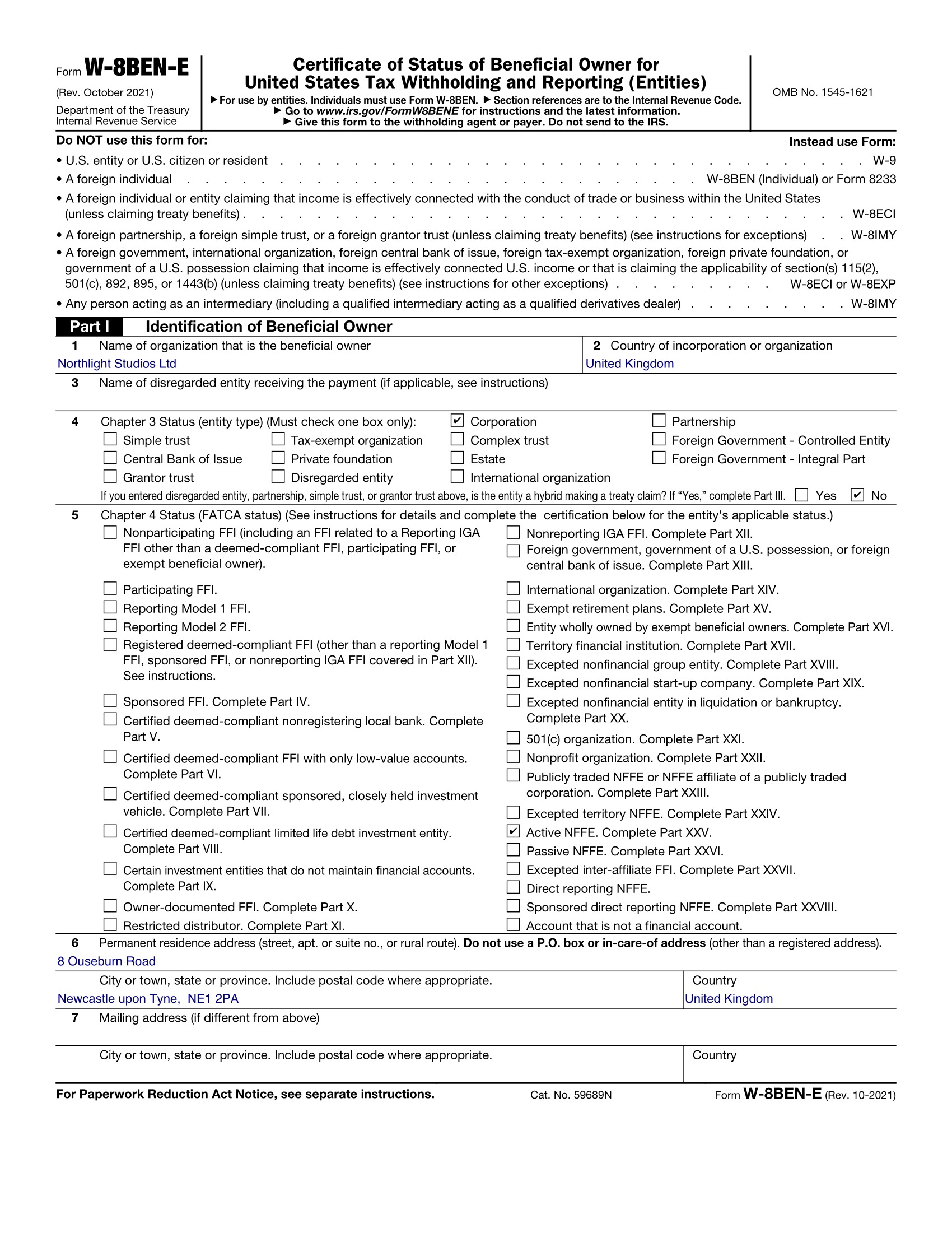
Example only. Northlight Studios Ltd, 8 Ouseburn Road, Newcastle upon Tyne NE1 2PA, is fictional.
FAQ
Do Patreon companies need W-8BEN-E?
Usually yes when payouts go to a non-US legal entity such as a corporation or foreign partnership. Patreon’s tax collection is designed to align with IRS withholding documentation rules for entities. Individuals paid in their own name typically use Form W-8BEN instead. Compare the legal name on your payout and tax settings to your formation documents—the certificate type should match that layer.
Is Patreon income royalties or services?
It can depend on what members pay for, how benefits are described, and how the platform analyzes the payment. Some memberships look like royalty-like digital access; others look more like support, community, or bundled services. Your W-8BEN-E should reflect a reasonable classification supported by contracts and operations, not a label picked only for a lower treaty rate.
What happens without the form?
Patreon may keep conservative withholding positions, delay payouts, or block tax-dependent features until documentation is complete and consistent. Exact messages depend on account region and product settings, but the underlying issue is usually missing or mismatched certificates so Patreon cannot document foreign status or a claimed reduced rate.
What is the difference between W-8BEN and W-8BEN-E for Patreon?
W-8BEN is for foreign individuals. W-8BEN-E is for foreign entities and includes FATCA (Chapter 4) sections and entity certifications that Patreon needs when the payee is a company or other organization. Uploading the wrong form type can stall verification because automated checks compare entity type to the certificate.
How long is W-8BEN-E valid?
Generally, a signed W-8BEN-E stays valid until the last day of the third calendar year after signing unless a change in circumstances makes it incorrect earlier. Submit a new form when legal name, address, entity classification, treaty claims, or FATCA status changes. Patreon may also prompt for refresh independent of the IRS validity window.
Where do I submit W-8BEN-E on Patreon?
Use Patreon’s tax or payout settings where the product requests withholding certificates. Labels move between dashboard versions, but you complete it electronically in Settings › Payouts and Taxes › Tax settings and keep a copy with the signature date.
Can a non-US studio claim treaty benefits on Patreon payouts?
Sometimes, when the studio’s residence country has a treaty with the United States, the income type matches a treaty article, and the entity satisfies any limitation-on-benefits tests the form requires. Treaties are fact-specific; a valid W-8BEN-E documents your position—it does not create eligibility out of thin air.
Does every country get the same Patreon withholding outcome?
No. Outcomes depend on entity profile, income characterization, documentation, and whether treaty relief applies. Two companies in different countries—or even similar businesses in the same country—can still see different withholding paths if certifications or payout structures differ.
Related links
Need the full W-8BEN-E product walkthrough without the Patreon framing? Start from the main entity landing for deeper context on Chapter 3, Chapter 4, and withholding mechanics.
If you are an individual creator—not a company—use the Patreon W-8BEN page or the general W-8BEN wizard so personal and entity certifications stay separated.
Fill your W-8BEN-E for Patreon in minutes
Answer guided questions tailored to foreign companies, then preview the formatted output. The wizard gives you a completed W-8BEN-E PDF. Complete it electronically in Settings › Payouts and Taxes › Tax settings, so you copy the answers line by line and keep the PDF as your record. Clear checkpoints, plain language, and a single $30 checkout for PDF generation—built for studios that need compliance shipped without slowing creative work.
Start Now ($30)