W-8BEN-E for Holding Companies: Dividends & US Income
This article was created with AI assistance and has not been reviewed by a human editor. It is provided for general informational purposes only and does not constitute tax, legal, or financial advice.
A non-US holding company that owns US shares, receives dividends, or collects other US-source passive income is usually asked for Form W-8BEN-E. That certificate is how you tell US payers and brokers who the beneficial owner is—and whether a tax treaty might support a lower US withholding tax rate than the default.
Searchers often land here with questions like w8ben e holding company, w8ben e dividends company, or us withholding tax holding company. In plain terms: when cash leaves the United States as dividends, interest, or royalties to a foreign corporation, rules often require tax to be collected at the source unless valid documentation supports a different rate. W-8BEN-E is the standard entity form for that documentation.
This guide is for finance and tax teams at holding and investment structures—not a substitute for your own adviser, but a practical map of how W-8BEN-E fits a holding company’s US passive income story. When you are ready, use the guided flow below to produce a structured PDF you can review, sign, and upload.
Treaty benefits and withholding rates depend on your country, entity facts, and how the payer classifies each payment. A limitation-on-benefits test applies only when the treaty has that article. The 1974 convention with Poland has no LOB article, so line 14b is "No LOB article in treaty". The wizard helps you document your position; it does not guarantee a specific percentage.
Jump to the W-8BEN-E wizard · Main W-8BEN-E form guide
 AI-generated image
Do holding companies need a W-8BEN-E?
Yes, in typical situations where a non-US holding company—not an individual—receives US-source dividends, interest, royalties, or similar passive income, US payers and financial intermediaries expect entity certification on Form W-8BEN-E. The form is required so withholding agents can apply the correct backup or statutory rate and meet their reporting obligations.
If your group uses a parent company that owns US portfolio stock, or an investment vehicle that receives distributions from US businesses, the same logic applies: someone in the US payment chain must document the beneficial owner. Without a complete form, many brokers and issuers fall back on default withholding on dividends—often described as 30% in disclosures—until they can rely on your certifications.
W-8BEN-E is also where you claim treaty benefits when your structure qualifies under the relevant US income tax treaty. That is why teams researching tax treaty holding structure usa or w8ben e passive income company end up on the same operational task: complete the form accurately, align Chapter 3 and FATCA classifications with facts, and keep the file current when ownership or activity changes.
Generate Your W-8BEN-E for Holding Companies
Holding groups often have layered ownership, multiple jurisdictions, and both operating and passive entities. Our guided interview asks plain-language questions, then maps answers to the official W-8BEN-E sections that brokers and payers care about—including Chapter 3 entity type, Chapter 4 (FATCA) status, and treaty claims tied to the income you actually receive.
You see a path tailored to your selections, avoid irrelevant boxes, and download a formatted PDF after a one-time $30 payment. Most corporate teams finish in one sitting when incorporation documents, signing authority, and tax identifiers are already assembled.
W-8BEN-E wizard
For an organization
For companies, funds, partnerships registered outside the USA.
Free to start. Payment is only required at the final step to download your completed PDF.
Loading...
How US tax applies to holding companies
When people say “US withholding tax holding company,” they usually mean tax taken out of a payment before the net amount reaches your account. For dividends on US stock paid to a foreign corporation, the withholding agent—often a US broker or the issuer’s paying agent—generally must document who receives the income and what rate applies under Chapter 3 rules.
The headline default in many broker materials is 30% on dividends paid to foreign persons when no treaty relief is available. That number is a starting point for documentation, not a prediction of your final economics. If a US income tax treaty applies and your entity qualifies, treaty tables sometimes cap dividend withholding at a lower rate for eligible beneficial owners—subject to the conditions the treaty text actually contains. A limitation-on-benefits test applies only when the treaty has that article; the 1974 convention with Poland has none.
Form W-8BEN-E does not replace your home-country corporate tax return. US withholding is one layer; your local participation regime, controlled foreign corporation rules, or foreign tax credits may interact with what was withheld in the US. Treasury teams should model both sides rather than treating the brokerage statement as the whole story.
Finally, the label “holding company” does not change the IRS form by itself. What matters is the legal entity named on the account or invoice, its country of formation, its classifications on the certificate, and the character of the US-source income. Getting those facts straight is what allows a payer to support a treaty claim on w8ben e dividends company flows—or to apply the default until documentation is fixed.
Passive income: dividends, interest, royalties
Holding companies and investment vehicles often receive passive income from the United States: cash dividends on listed shares, interest on certain US instruments, royalties from licensed intellectual property, and similar categories. US rules and treaty articles usually treat these buckets differently, which is why w8ben e passive income company research should always start with what the statement actually says.
Dividends are the most common trigger for a W-8BEN-E holding company profile. When a US corporation pays dividends to a foreign shareholder, the payer or intermediary withholds based on the documentation on file. Interest and royalties follow their own treaty lines and Chapter 3 descriptions; copying dividend language into a royalty fact pattern creates mismatches that payers may reject.
The IRS perspective is practical: passive income is money you earn without operating a US trade or business in the same way as a local factory—though real-world facts can blur lines when a group has US affiliates. For W-8BEN-E, the key is to describe the income for which you certify treaty benefits in words that match the payment. If part of your US receipts is portfolio dividends and part is services, you may need distinct narratives for distinct payers rather than one vague “US income” label.
Because passive flows repeat quarter after quarter, a missing or outdated certificate has a compounding cash effect. Fixing documentation before the next ex-dividend date is almost always cheaper than chasing refunds after the fact.
How holding company structures affect W-8BEN-E
Corporate groups use parents, subsidiaries, and parallel investment vehicles for good commercial reasons—liability, funding, regulatory separation—but US tax forms care about the specific entity that receives the payment. The W-8BEN-E holding company name on the certificate must match the brokerage account title or the contract counterparty, not a convenient group brand.
If a parent holds US shares directly, the parent is generally the beneficial owner for withholding purposes. If a subsidiary holds the shares while the parent consolidates accounts internally, the subsidiary may still be the named account holder for the broker—and the form should follow that fact pattern. Mixing parent and subsidiary names across onboarding screens and tax certificates is one of the most common reasons uploads bounce back.
Treaty eligibility also runs through entity residence and anti-abuse rules, not through a diagram alone. A tax treaty holding structure usa search usually reflects a real question: does the entity receiving the dividend meet the treaty’s definition of a resident of the partner country and, where the treaty has a limitation-on-benefits article, pass that test? The 1974 convention with Poland has no such article. No generic webpage can answer that for your group; the form is where you certify your position to the withholding agent.
When ownership chains cross several countries, internal memoranda should align before anyone signs. If the same US dividend is discussed in board packs under one name and submitted to IBKR under another, compliance teams lose time reconciling records.
Who this applies to
This page is written for non-US entities that primarily hold investments or receive passive US-source income—not for individuals trading in their own names (who normally use Form W-8BEN).
Typical readers include:
- Holding companies that own US subsidiaries or US portfolio equity - Investment companies and treasury vehicles receiving dividends - Foreign corporations that own shares in US businesses and receive distributions - Dividend-focused entities where withholding visibly affects cash forecasts
If your US receipts are mostly marketplace fees or SaaS payouts, you may still use W-8BEN-E—but the income description differs from pure portfolio dividends. Align each certificate with the payer that actually sends the cash.
Worked example: a UK holding company receiving US dividends
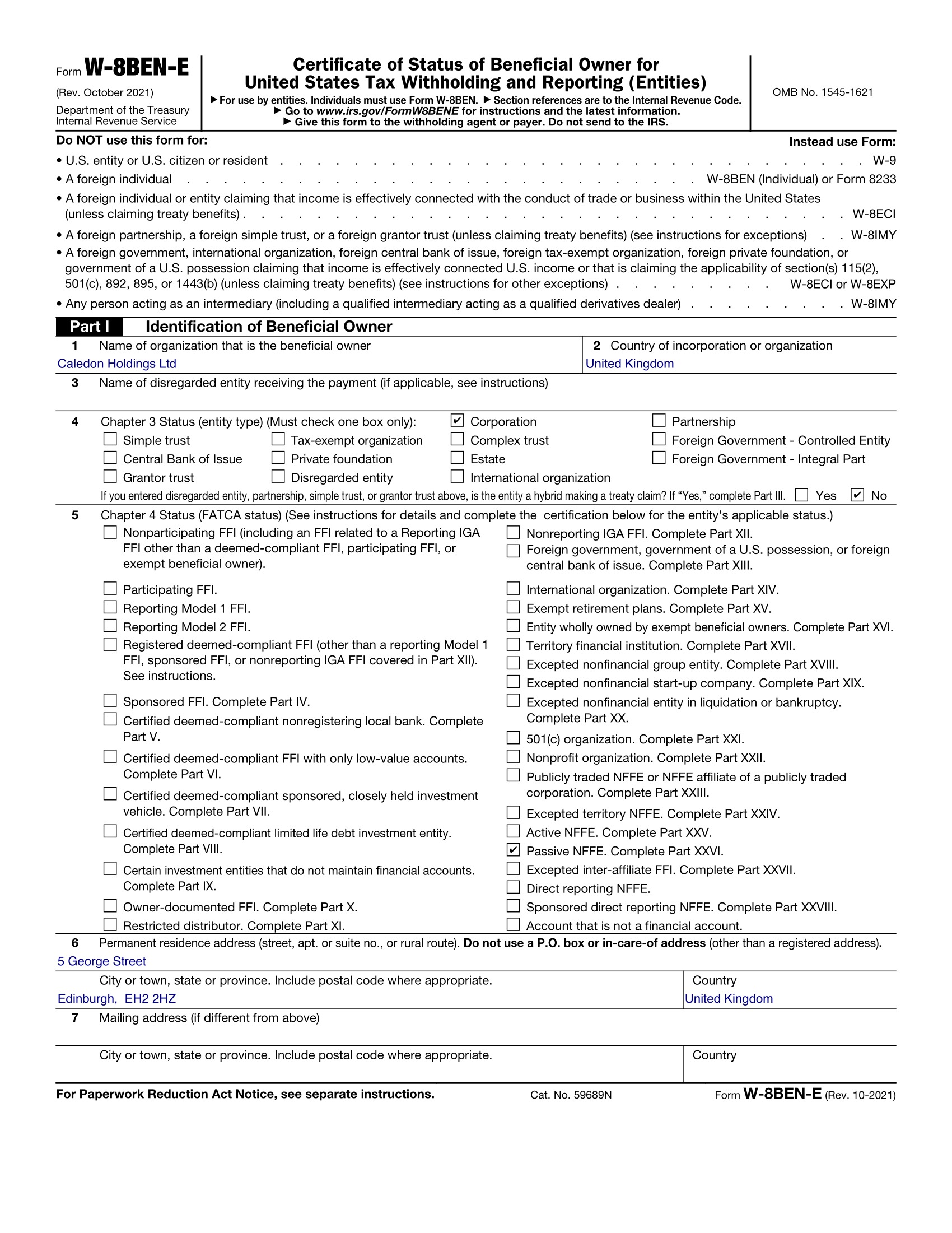
Caledon Holdings Ltd, an Edinburgh-registered investment holding company, holds a portfolio of US-listed shares and receives quarterly cash dividends of $20,000. Dividends paid by a US corporation to a foreign shareholder are taxed under Article 10 (Dividends) of the US–UK tax treaty, not Article 7—dividend withholding follows its own treaty article separate from business profits.
Before a W-8BEN-E was on file, the broker applied the default 30% withholding on US dividends—$6,000 held back from each $20,000 payment. After filing Form W-8BEN-E—citing the UK as country of residence, Article 10, and the treaty's 15% portfolio dividend rate—the broker now withholds only 15%, or $3,000, on the same payments. Caledon recovers $3,000 more per quarter that would otherwise sit with the US Treasury pending a refund claim.
- Without W-8BEN-E on file: 30% withheld on US dividends—$6,000 on a $20,000 quarterly payment.
- With W-8BEN-E filed (UK, Article 10, 15% treaty rate): only $3,000 withheld—$3,000 more reaches the account every quarter.
How these dividends are treated for UK Corporation Tax
A W-8BEN-E only affects US withholding at source—it does not by itself determine your UK tax treatment. Most dividends received by a UK company, including foreign dividends like US portfolio dividends, are exempt from UK Corporation Tax under the UK's dividend exemption rules, though the exemption has conditions worth confirming for your specific shareholding.
Even when the dividend itself is exempt, keep your US withholding records: if any UK tax were ever due on the same income, the 15% already withheld in the US could potentially be claimed as a foreign tax credit rather than suffering double taxation. Confirm your specific position with an accountant, since exemption conditions and credit mechanics depend on your shareholding structure.
- Keep your signed W-8BEN-E and any Form 1042-S from your broker with your company records.
- Check whether your shareholding qualifies under the UK's dividend exemption rules before assuming full exemption.
- Re-verify the treaty rate periodically—confirm current Article 10 terms against the IRS treaty table before relying on 15% indefinitely.
How holding companies are classified (FATCA)
Chapter 4 of the Internal Revenue Code—often discussed under the label FATCA—asks financial institutions and many payers to classify account holders for information reporting. On W-8BEN-E, you select a Chapter 4 status that should match your facts, such as whether the entity is a financial institution or a non-financial foreign entity (NFFE).
Many holding companies that mainly hold passive investments are classified as passive NFFEs (“passive” here is a US tax label, not a judgment about your business model). Active NFFE treatment can apply when the entity meets tests tied to passive income and assets described in the form instructions—again, fact-specific. Choosing the wrong box to “speed things up” can undermine both FATCA logic and the credibility of a treaty claim.
Why this matters for conversions: brokers look at Chapter 3 and Chapter 4 together. Even when your burning question is dividend withholding, an inconsistent FATCA selection can delay approval of the whole certificate. Read the definitions in the official instructions or rely on a professional when your group has both operating and investment branches.
None of this replaces specialized FATCA advice for complex fund structures. It is a reminder that W-8BEN-E is a combined withholding and classification certificate, not only a “withholding form.”
How to fill W-8BEN-E for a holding company
Treat these steps as the checklist withholding agents expect to see reflected in your PDF.
Company information
Enter the legal entity name, mailing address, and tax identifiers exactly as they appear on formation documents and the broker or payer onboarding file. Small mismatches between the account screen and the certificate are a frequent cause of rejections.
Country of incorporation or organization
The jurisdiction where the entity was formed drives which US income tax treaty might exist and which residency story you can certify. For groups with several entities, confirm which corporation is the beneficial owner of the specific US payment.
FATCA status (Chapter 4)
Select passive or active NFFE (or another applicable category) based on the form instructions and your income and asset mix. This should align with how you describe the entity to banks and brokers elsewhere.
Treaty claim
When you claim benefits, tie the treaty article and income type to dividends, interest, or royalties as appropriate. If you are not claiming benefits, state that clearly so the withholding agent can use the default rate without guessing.
Signature and date
An authorized officer signs under penalties of perjury. Refresh the form after material changes—mergers, new parent entities, or shifts from passive to active operations.
Common mistakes holding companies make
Wrong FATCA classification
Treating an investment-heavy vehicle as “active” without meeting the tests can unravel both Chapter 4 and the withholding agent’s comfort with your treaty story.
Incorrect treaty claim
Copying treaty paragraphs from an unrelated transaction—services or royalties—while the brokerage account only receives stock dividends invites rework and potential default withholding.
Misunderstanding passive income buckets
Lumping interest, dividends, and licensing income into one narrative ignores how treaty tables and payer systems separate categories.
Ownership and entity-name mismatches
Submitting a parent’s W-8BEN-E when the subsidiary owns the shares (or vice versa) breaks the beneficial-owner chain the broker must document.
Example of a completed W-8BEN-E for a holding company
The preview below illustrates how a finished first page can look once entity details, classifications, and treaty selections are populated. Your PDF will reflect the answers you enter in the wizard—use the sample to orient directors who have not reviewed IRS layouts before.
Sample W-8BEN-E for a UK royalties company
Harbour Apps Ltd claims Article 12, Paragraph 1 at 0% on software licence fees. The name, address, and company number are fictional.
Example only. Harbour Apps Ltd, 20 Wharf Road, London N1 7GR, is fictional.
Related guides and tools
Holding companies often sit next to brokerage dividend flows and broader W-8BEN-E education. These English hubs complement this page.
W-8BEN-E for investors (dividends & US stocks)
Broader investor framing for corporate accounts and US equity dividends.
W-8BEN-E for IBKR UK
UK limited companies using Interactive Brokers for US dividends.
W-8BEN-E for IBKR Germany
German entities on IBKR—treaty withholding and GmbH-style setups.
W-8BEN-E for IBKR Poland
Polish companies on IBKR with US dividend documentation.
Main W-8BEN-E form guide
Full walkthrough of the entity form, wizard access, and withholding basics.
FAQ
Are holding companies considered passive for W-8BEN-E?
Many investment-heavy holding vehicles are described as passive NFFEs under Chapter 4 (FATCA) because most of their income and assets are passive in the sense used by the form instructions. That is not automatic for every group; active NFFE or other categories can apply when facts support them. Your selection should match your entity’s operations and the official definitions.
What tax applies to dividends paid to a foreign holding company?
US rules generally require withholding on dividends paid to foreign shareholders. Brokers often quote a 30% default when no treaty rate is documented. A lower rate may apply when a valid treaty claim exists and the withholding agent accepts your certifications.
Can holding companies reduce US withholding tax?
Sometimes. Reduction depends on an applicable US income tax treaty, whether your entity qualifies as a resident and beneficial owner for treaty purposes (including a limitation-on-benefits test only where the treaty has that article; the 1974 convention with Poland has none), and accurate W-8BEN-E certifications. The payer applies the rate it believes it can support based on your form.
What documents are required besides W-8BEN-E?
The form itself is the core certificate. Brokers may also request corporate formation evidence, director resolutions, or beneficial ownership disclosures under their KYC programs—requirements vary by institution. Keep formation documents, signing authority proof, and any foreign tax IDs consistent with what you type into the PDF.
Does a W-8BEN-E holding company filing cover all subsidiaries?
No. Each legal entity that receives US-source payments in its own name should have its own coherent certificate. Parents and subsidiaries are not interchangeable on the form unless the specific facts and payer arrangements say otherwise.
How long is W-8BEN-E valid?
Generally, a signed W-8BEN-E remains valid for three years from the signature date unless a change in circumstances makes any certification incorrect. Many brokers refresh forms sooner during periodic reviews.
W-8BEN-E vs W-8BEN: which does a holding company use?
W-8BEN is for individuals. Non-US entities—including holding companies—use W-8BEN-E when they are the account holders or beneficial owners receiving the income.
Will treaty benefits eliminate all US tax for a holding company?
Not necessarily. Treaty articles may reduce withholding on specific income types, but other US reporting or filing concepts can still apply depending on facts. Withholding at source is only one layer of the overall picture.
Fill your W-8BEN-E for your holding company
Open the guided questionnaire, confirm entity, FATCA, and treaty details, then download a PDF ready for signature and broker or payer upload.
Start Now ($30)