W-8BEN-E for Investors: Dividends & US Stocks
This article was created with AI assistance and has not been reviewed by a human editor. It is provided for general informational purposes only and does not constitute tax, legal, or financial advice.
US-listed companies often pay dividends to shareholders around the world. W-8BEN-E investors—foreign companies holding US stocks—usually meet the same documentation rules as other non-US entities receiving US-source payments. When the shareholder is a foreign company, US rules generally require the payer (or broker acting as withholding agent) to take tax at source before cash hits your account.
If your business invests through Interactive Brokers (IBKR), Trading 212, eToro, or similar platforms, you will usually be asked for entity tax paperwork. Form W-8BEN-E is the standard certificate for non-US companies. It tells the broker who the beneficial owner is and whether a US tax treaty may allow a lower withholding rate on dividends than the default. This page explains how that fits together in everyday language—without replacing advice from your own tax professional.
When you are ready, use the guided flow below to build a structured W-8BEN-E PDF you can sign and upload.
 AI-generated image
Treaty rates depend on your country of residence, entity type, and whether you qualify for treaty benefits. The wizard helps you document your position; it does not guarantee a specific withholding percentage.
Do investors need a W-8BEN-E?
If you are an individual investing in your own name, brokers normally ask for Form W-8BEN (the personal version). If a non-US company, partnership, or other entity holds the brokerage account and receives dividends, W-8BEN-E is usually the right certificate.
Brokers such as IBKR, Trading 212, and eToro collect tax forms because US law places withholding responsibilities on US payers and many intermediaries. Without valid documentation, they may apply the default rate on US-source dividends—often quoted as 30%—until you supply a complete form. That is why teams search for phrases like W-8BEN-E dividends, W-8BEN-E IBKR, and W-8BEN-E for investing before they wire large ticket sizes into a new entity account.
Submitting W-8BEN-E does not remove US tax by itself. It allows the broker to see whether you are claiming treaty benefits and whether your Chapter 3 entity classification supports that claim. When everything lines up, many investors see treaty rates that are lower than the default, which keeps more cash inside the company brokerage account.
If you receive US dividends through a dedicated holding or investment structure, see our Holding companies guide for W-8BEN-E holding company coverage: passive income, FATCA classification, parent/subsidiary issues, and treaty withholding in one place.
Generate Your W-8BEN-E for Dividends (Step-by-Step)
You do not need to memorize IRS line numbers to produce a coherent W-8BEN-E for investors. Our guided interview walks through legal name, country of formation, beneficial-owner status, Chapter 3 and Chapter 4 (FATCA) classifications, and treaty sections when they apply to dividend income.
You answer plain-language questions, see only the sections relevant to your path, and download a formatted PDF. Form generation is a one-time $30 payment. Most teams complete the flow in one sitting once corporate details and tax identifiers are handy.
W-8BEN-E wizard
For an organization
For companies, funds, partnerships registered outside the USA.
Free to start. Payment is only required at the final step to download your completed PDF.
Loading...
How US tax applies to dividends
When people say “US dividend withholding,” they usually mean the amount a US payer or broker holds back from a gross dividend and remits to the US Treasury on your behalf. Think of it as tax collected at the source of the payment, not an invoice you pay later from your local bank.
If there is no treaty claim the broker can rely on, rules often point toward a 30% rate on dividends paid to foreign persons. That headline number is why searches like “US dividend tax non-US company” spike whenever a first payout arrives smaller than expected. Finance leads also look up withholding tax dividends company because the cash impact shows up directly on the brokerage cash report—not only on year-end financial statements.
The United States has income tax treaties with many countries. Those agreements sometimes cap how much the US may withhold on specific categories of income—including dividends paid to eligible residents of the treaty partner—when the beneficial owner meets the tests the treaty text actually contains. The 1974 convention with Poland has no limitation-on-benefits article, so line 14b is "No LOB article in treaty". Other treaties can still require that test. Form W-8BEN-E is where a foreign entity certifies that it qualifies for treaty benefits (or that it is not claiming them).
Important nuance: your local corporate tax return still matters. US withholding is only one layer. Your home-country adviser can explain how foreign tax credits or participation exemptions interact with what was withheld in the US.
Finally, brokers classify what they pay you. If the cash flow is truly a dividend on stock, treaty tables for dividends apply. If the payment is really interest, royalties, or service fees labeled awkwardly in your statement, different treaty lines may apply—another reason to read confirmations instead of assuming every wire is “dividends.”
W-8BEN-E for IBKR and other brokers
Interactive Brokers is widely used by companies and family offices that keep investments in a corporate account. IBKR’s compliance center typically asks foreign entities to upload a signed W-8BEN-E (or other W-series form) before crediting treaty rates on US dividends.
Trading 212 and eToro likewise onboard corporate clients with KYC and tax questionnaires. The exact wording differs by brand, but the underlying need is the same: the platform must document a Chapter 3 status and, where relevant, a treaty claim so it knows what rate to use when US-source dividend income is paid to a non-US entity.
Other custodians—bank brokerage arms, wealth managers, smaller US brokers—follow similar patterns because Chapter 3 withholding rules apply to the income, not to the app you happen to like best.
Always upload the form your specific broker requests. Some screens say “W-8” generically; corporations should confirm they are filing W-8BEN-E, not the individual W-8BEN, when the account is in the company name.
Polish companies using IBKR for US dividends should also read our dedicated guide: IBKR & Dividends (Poland) — a W-8BEN-E walkthrough focused on IBKR, treaty withholding, and common entity classifications.
Need Germany-specific guidance for corporate dividend flows? See IBKR & Dividends (Germany) for a focused walkthrough on W-8BEN-E, withholding, and Steuer-related misunderstandings.
UK limited companies investing through IBKR should read IBKR & Dividends (UK) — W-8BEN-E for UK LTDs, US dividend withholding, and broker uploads in plain English.
Who this applies to
This guide is written for non-US companies and similar entities that invest in US equities and receive dividends, not for retail individuals trading in a personal account.
Typical readers include holding companies that consolidate portfolio income, investment vehicles formed outside the United States, and operating businesses that park surplus cash in listed stocks. Dividend-focused entities—where a meaningful share of return comes from payouts rather than trading gains—especially notice withholding.
If the brokerage relationship is between the US broker and your foreign corporation, plan on entity forms. If you later move assets into a trust or partnership, classification can change; revisit the form when the facts change.
Worked example: a holding company's treaty rate didn't apply to a substitute payment
Ashcombe Capital Holdings Ltd, an investment holding company based in Manchester, holds a portfolio of US-listed shares through IBKR and had a valid W-8BEN-E on file certifying the UK as its country of residence and claiming the applicable treaty rate on dividend income. Part of the portfolio was enrolled in IBKR's fully-paid lending program, and during a period when specific shares were out on loan to short sellers, Ashcombe received "payments in lieu of dividends" instead of the actual dividend distributions on those shares.
The finance team assumed the same treaty-reduced rate applied automatically, since the cash amount matched what the ordinary dividend would have been. But substitute payments from securities lending are a different category for US withholding purposes—many treaties' dividend articles do not extend the same relief to them, and brokers commonly withhold at the standard 30% rate on these amounts even with a valid dividend treaty claim on file. Ashcombe only noticed the gap when reconciling the year-end Form 1042-S, which showed two different withholding rates on line items that looked identical on the monthly statements.
- Shares out on loan on the dividend record date: substitute payment received, withheld at the standard 30% rate despite the certified dividend treaty claim.
- Shares not on loan on other dividend dates: ordinary dividend, withheld at the certified treaty rate.
US withholding is only one side of the ledger—check your local participation exemption
The W-8BEN-E and the rate IBKR applies only govern the US side of the transaction—what Ashcombe actually keeps depends on how the UK taxes dividend income a company receives from a foreign shareholding.
The UK's dividend exemption under Corporation Tax Act 2009, Part 9A shields most dividends a UK company receives—including from US shareholdings—from further Corporation Tax, though the exact exempt class and any anti-avoidance conditions depend on the facts. Where a payment falls outside the exempt classes, ordinary Corporation Tax applies alongside a credit for the US tax already withheld. Ashcombe's own accountant, not the broker, is the one who can confirm which treatment applies to a given position.
- Confirm which exempt class under Part 9A a given dividend falls into before assuming the withheld amount is your full tax cost.
- Where a payment doesn't fall within an exempt class, check whether a credit is available for the US tax actually withheld, and keep the 1042-S as supporting evidence.
- Review this position by holding, not just in aggregate, since different shareholdings inside the same brokerage account can be taxed differently at home.
Dividends vs services vs royalties
US tax rules separate categories of income—dividends, interest, royalties, services, and more—because treaty articles often use different rates for each bucket. The W-8BEN-E treaty section asks you to describe the income for which you claim benefits. That line should match the income you actually receive.
Services income (for example consulting billed to a US client) follows different treaty paragraphs than dividends on Apple or Microsoft shares. Royalties for intellectual property licensed into the United States are another chapter entirely. Mixing labels is one of the fastest ways to have a payer disregard a treaty claim.
Marketplaces such as Amazon or payment platforms such as Stripe usually generate marketplace fees or processing income—helpful cousins, but not the same tax story as portfolio dividends. If part of your US cash is dividends and part is operating income, you may need more than one narrative in your compliance files, and you should rely on advisers when facts are mixed.
Classification can also depend on how the broker codes the payment internally. If something looks wrong, fix it with supporting documents before you argue about treaty rates.
How to fill W-8BEN-E for dividends
Treat this as a practical map of the same fields brokers care about. Your platform may not show IRS jargon, but the concepts line up with the official form.
Company and address details
Enter the legal entity name exactly as it appears on formation documents and the brokerage account application. Use the mailing address the broker expects on file. Small mismatches between the account screen and the certificate are a common reason forms bounce back.
Country of incorporation or organization
Select the jurisdiction where the entity was formed. That country drives whether a US income tax treaty exists and which treaty articles might apply to dividends for eligible beneficial owners.
Chapter 3 status (entity type for withholding)
Choose the classification that fits the entity under US rules—commonly corporation, partnership, or disregarded entity depending on facts. The label on your local certificate (Ltd, GmbH, Sp. z o.o.) does not automatically map to a US category; read the definitions carefully or ask a professional when unsure.
Chapter 4 (FATCA) status
FATCA sections describe how financial institutions report certain account holders. Brokers often need a coherent Chapter 4 selection even when your main question is dividend withholding. Passive investment entities sometimes follow different paths than active trading companies.
Treaty claim tied to dividends
When you claim treaty benefits, you identify the treaty country, relevant articles, and the income type—here, dividends on portfolio equity. You must meet eligibility tests in the treaty and certify truthfully. If you are not claiming benefits, you say so explicitly so the broker can use the default rate.
Signature and date
An authorized officer signs under penalties of perjury. Most brokers reject unsigned PDFs or stale dates. After major ownership changes, refresh the form so certifications remain accurate.
Common mistakes investors make
Choosing the wrong income storyline
Teams sometimes copy treaty language from a services contract while the brokerage account only receives dividends. The treaty section should describe dividend income when that is what the US source is paying.
Claiming a treaty rate without qualifying
Treaties contain anti-abuse rules, and many have a limitation-on-benefits article; the 1974 convention with Poland does not. Checking a box because “our neighbor got 15%” invites rework. Match the claim to your entity’s residency and substance facts.
Assuming the broker will refund withholding automatically
Even when documentation is late, recovery paths may require filings with the IRS or careful coordination with the broker. It is faster to submit W-8BEN-E before the first large distribution.
Confusing US withholding with home-country tax
US withholding is one piece. Your local return may offer credits or exemptions. Neither replaces the other—finance teams should model both sides.
Example of a completed W-8BEN-E
Scroll through a representative first page below. Your finished PDF will show your entity name, classifications, and treaty selections based on the answers you enter in the wizard. Use the preview to orient executives who have not seen IRS layouts before.
Sample W-8BEN-E for a UK royalties company
Harbour Apps Ltd claims Article 12, Paragraph 1 at 0% on software licence fees. The name, address, and company number are fictional.
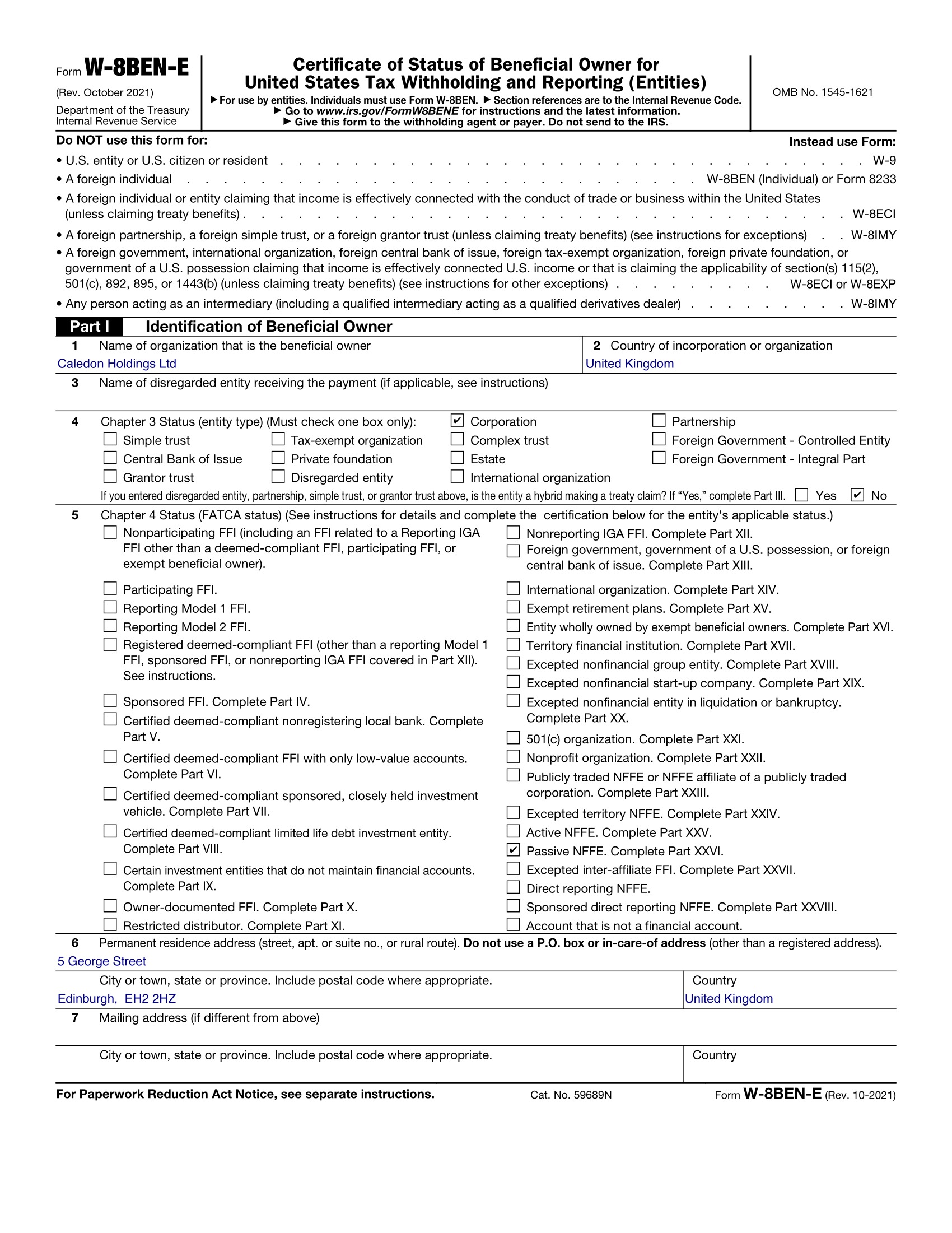
Example only. Harbour Apps Ltd, 20 Wharf Road, London N1 7GR, is fictional.
Related W-8BEN-E guides on W8GetEasy
Companies often have both operating income from platforms and separate brokerage accounts for investments. If marketplace or creator payouts are part of your story, these companion pages may help.
Amazon sellers (W-8BEN-E)
For marketplace sellers and vendors receiving US-source payouts through Amazon.
Stripe / SaaS (W-8BEN-E)
For subscription billing, SaaS, and card payouts where Stripe acts as the US payer context.
YouTube / AdSense (W-8BEN-E)
For creator and partner payments routed through Google’s US withholding programs.
FAQ
What tax applies to US dividends?
US rules often require withholding on dividends paid to foreign shareholders. The default rate quoted in many broker disclosures is 30% when no treaty relief applies. A lower rate may apply when a valid treaty claim exists and documentation is complete.
Do brokers require W-8BEN-E?
If the account is opened in the name of a non-US entity, major brokers typically require W-8BEN-E (or another acceptable substitute) before applying reduced withholding. Exact labels in the client portal vary, but the underlying requirement is standard.
Can companies reduce withholding tax on dividends?
Sometimes. Reduction depends on an applicable US income tax treaty, your entity’s eligibility, and accurate certifications on W-8BEN-E. The broker applies the rate it believes it can support based on your form.
How long is the form valid?
Generally, a signed W-8BEN-E stays valid for three years from the signature date unless a change in circumstances makes any certification incorrect. Brokers may ask for a refresh sooner during periodic reviews.
W-8BEN-E vs W-8BEN for investing: which do I use?
W-8BEN is for individuals. W-8BEN-E is for foreign entities. If your IBKR or other brokerage account title is a company, you normally file W-8BEN-E even if you personally own that company.
Does W-8BEN-E cover IBKR stock lending or payments other than cash dividends?
Brokers may classify substitute payments, lending fees, or other items differently. Use the treaty and income descriptions that match what the statement shows. Ask the broker’s tax desk when wording is unclear.
Will filing W-8BEN-E eliminate my US filing obligations entirely?
Not necessarily. Withholding is separate from annual reporting concepts such as Form 1120-F for foreign corporations in some fact patterns. The form supports withholding at source; it is not a blanket election for every US tax duty.
Can I reuse the same PDF for every broker?
You can reuse content when facts are identical, but each platform may require its own upload and sometimes its own signature date. Regenerate when addresses, entity names, or classifications change.
Fill your W-8BEN-E for dividends in minutes
Open the guided questionnaire, confirm entity and treaty details, then download a PDF ready for signature and broker upload.
Start Now ($30)