W-8BEN-E for IBKR & Dividends in the UK: Fill It Online
This article was created with AI assistance and has not been reviewed by a human editor. It is provided for general informational purposes only and does not constitute tax, legal, or financial advice.
If your UK company invests through Interactive Brokers (IBKR) and holds US-listed shares, dividend cash flows often arrive net of US tax taken at source. For corporate accounts, IBKR W-8BEN-E UK documentation is usually how you tell the broker you are a foreign entity and whether a US–UK tax treaty position may apply to dividend income.
This page is written for finance teams at UK limited companies (LTDs) who need plain-language orientation—not legal advice—before they upload a signed certificate. Search intent here is practical: w8ben e ibkr uk, withholding tax dividends UK company, and US dividends tax UK company all converge on the same operational job—get the broker a coherent entity form before the next ex-dividend date.
When you are ready, use the guided flow below to build a structured W-8BEN-E PDF for review and submission.
Treaty outcomes depend on your facts, entity classifications, and eligibility tests in the treaty text. The wizard helps you document your position; it does not guarantee a specific withholding percentage.
Jump to the W-8BEN-E wizard · Main W-8BEN-E form guide · Investors (dividends) hub
Do UK companies need a W-8BEN-E for IBKR?
In most setups where a UK company (not an individual) holds the IBKR account and receives dividends on US equities, yes—you should expect to provide entity tax documentation, and Form W-8BEN-E is the standard certificate for foreign companies. IBKR, like other US-facing brokers, needs a reliable record of who the beneficial owner is and how to treat US-source payments for withholding purposes.
Without a complete form, many brokers fall back on default withholding treatment on dividends until they can rely on your certifications. Submitting W-8BEN-E does not automatically set a rate in stone; it is the paperwork channel through which you describe classifications and any treaty claim. If the account is in your personal name, you are usually on the individual W-8BEN path instead. For UK LTD dividends via IBKR, W-8BEN-E is the typical corporate route.
If you use a holding structure, see this guide on W-8BEN-E for holding companies (dividends, passive income, FATCA, and parent/subsidiary issues).
Generate Your W-8BEN-E for IBKR (UK)
You do not need to memorise every line of the official PDF to produce a coherent IBKR W-8BEN-E UK filing. Our guided interview walks through legal name, country of formation, beneficial-owner status, Chapter 3 (withholding) classification, Chapter 4 (FATCA) status, and treaty sections when they apply to dividends.
You answer in plain language, see only the sections that match your path, and download a formatted PDF after a one-time $30 payment. Most teams finish in one sitting once Companies House details, the registered address, and signing authority are agreed internally.
W-8BEN-E wizard
For an organization
For companies, funds, partnerships registered outside the USA.
Free to start. Payment is only required at the final step to download your completed PDF.
Loading...
How US tax applies to dividends for UK companies
When people talk about “US dividend withholding” for a UK company, they usually mean the slice a US payer or broker holds back from a gross dividend before the net amount reaches your IBKR cash balance. It is collected in the US payment chain—not the same thing as your UK Corporation Tax return, even though both affect your overall picture.
Without a valid W-8BEN-E, US withholding on dividends paid to a foreign company is 30%. Under Article 10(2)(b) of the US–UK treaty it falls to 15% on portfolio dividends. It is 5% under Article 10(2)(a) if the company owns at least 10% of the voting stock of the US company paying the dividend. The 0% rate in Article 10(3) needs at least 80% ownership for 12 months plus extra tests, so it does not fit an IBKR portfolio.
To claim any treaty rate, the company must also pass the limitation-on-benefits article, Article 23 of the treaty. IBKR applies the rate once it accepts the form: after filing, the US tax on a portfolio dividend should be 15% of the gross amount.
Finally, remember classification: treaty articles often use different language for dividends, interest, royalties, and services. If the cash is truly a stock dividend, the treaty discussion should align with that fact, not with unrelated income types.
How IBKR uses W-8BEN-E
Interactive Brokers collects tax forms so its withholding and reporting systems can rely on certifications from the account holder. For a non-US entity receiving US equity dividends, W-8BEN-E is commonly the form IBKR expects you to upload or attest to in the client portal.
Practically, this matters because dividends are recurring. A missing, expired, or inconsistent certificate can mean each distribution is handled under less favourable documentation until the file is fixed. Teams often discover the issue when cash forecasts based on declared dividends do not match the net credits on the activity statement.
IBKR also checks that entity names, addresses, and tax classifications line up with the account profile. Where internal records and the certificate disagree, you may see follow-up messages or a hold on updated treaty treatment. Refreshing the form after material changes—rebrand, merger, new parent, change in FATCA-relevant activity—reduces avoidable friction.
You may be prompted at onboarding, when enabling US products, or during periodic compliance reviews. Treat the upload as part of treasury hygiene, not a one-time checkbox, especially if your UK LTD invests for the long term.
W-8BEN-E for UK LTD companies
Most UK trading and investment vehicles in this context are private companies limited by shares—what people simply call an LTD. The label is familiar at Companies House, but US tax forms use their own categories (“Chapter 3” entity types) that do not always map word-for-word from “LTD.”
What matters for IBKR is that the certificate describes the same legal entity as the brokerage account, with a coherent beneficial-owner story and FATCA selection. A company whose income is mainly dividends and interest is a Passive NFFE. Active NFFE needs both passive income and passive assets under 50%. A UK trading company that only parks spare cash at IBKR can still be an Active NFFE if it passes both tests.
Directors sometimes ask whether a small family investment company needs the same rigour as a large treasury desk. From a documentation perspective, the broker’s question is similar: who is the entity, how is it classified, and what income is at stake? Scale changes internal process, not the existence of the form requirement when US dividends flow to a foreign corporation.
Getting this right matters because treaty claims and withholding outcomes sit on top of accurate classification. If multiple UK entities exist in your group, confirm which LTD actually owns the portfolio before anyone signs—mixing parent and subsidiary names is a frequent source of rework.
Who this applies to in the UK
This guide is aimed at UK-resident companies using IBKR for US-listed investments, especially where dividends matter to cash flow. Typical readers include:
- UK LTDs with corporate brokerage accounts - holding companies consolidating US equity income - family investment companies structured as LTDs - trading or treasury vehicles that own US stocks
It is less relevant for individuals trading in their own names (different form) and is not a substitute for tailored advice when ownership chains or hybrid structures are complex.
Dividends vs other income types
US rules and treaty articles separate categories—dividends, interest, royalties, services, and more—because withholding logic is applied per income type. The W-8BEN-E treaty section should describe the income you actually receive from US sources, not the easiest template you found online.
Dividends on shares are different from consulting fees invoiced to a New York client, even if both hit the same bank account eventually. If IBKR’s statement labels a payment as a dividend, your treaty narrative should be consistent with dividends. If something is reclassified internally as interest or a substitute payment, copying dividend wording without checking can undermine the whole filing.
Getting this wrong has real cash effects: overstating a claim can trigger questions; understating may leave money on the table until you correct documentation. Marketplaces and payment processors (for example Amazon or Stripe payouts) usually generate platform or merchant income—related to W-8BEN-E, but not the same storyline as portfolio dividends from IBKR.
When your UK company has both operating income from US customers and separate investment income, keep narratives distinct and align each payer’s certificate with the income that payer actually sends. If facts are mixed or labels are unclear, pause and clarify with your broker or adviser before signing.
How to fill W-8BEN-E for IBKR
Treat this as a practical checklist for a common UK LTD + IBKR + US dividends path. Complex groups may need extra steps; use this as a baseline map before you upload.
Company name
Use the legal name exactly as it appears at Companies House and on your IBKR account opening documents. Trading names or “Ltd” versus “Limited” inconsistencies are a common trigger for manual review. Match spelling, punctuation, and the entity the account legally belongs to.
Country: United Kingdom
Select the United Kingdom as the country of incorporation or organisation when that reflects your LTD. This frames treaty context between the US and the UK. If you have unusual residence or formation facts, confirm them with a professional rather than guessing.
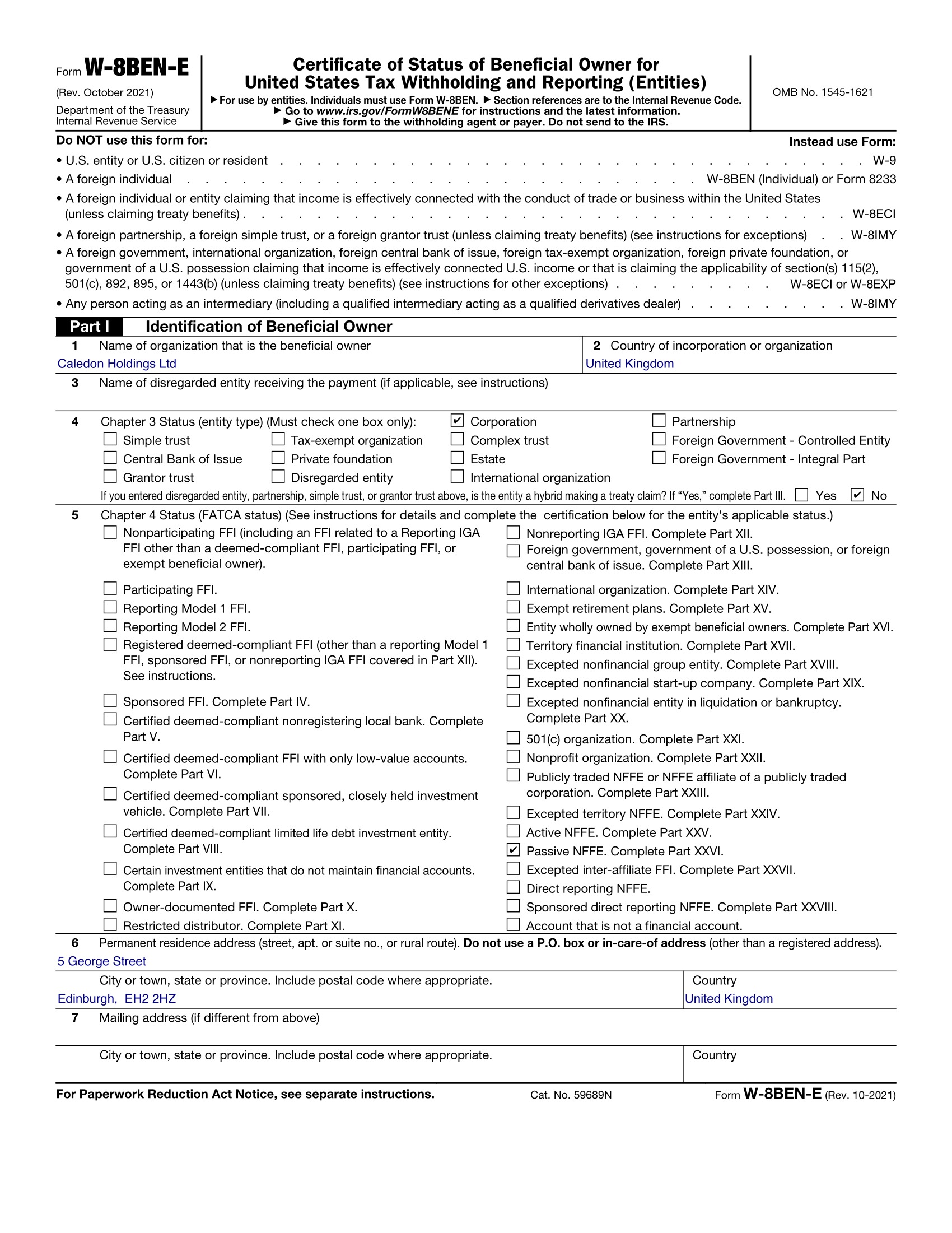
FATCA: Passive NFFE (typical for an investment company)
A company whose income is mainly dividends, interest and gains is a Passive NFFE. Active NFFE needs less than 50% passive income and less than 50% passive assets. A Passive NFFE also states whether it has substantial US owners (US persons with more than 10%) and names them if it has. A UK trading company that only parks spare cash at IBKR can still be an Active NFFE if it passes both 50% tests.
Treaty claim (dividends)
Line 14a: United Kingdom. Line 14b: the LOB test the company meets under Article 23 — for a private investment company owned by UK-resident individuals, usually the ownership and base erosion test. The 15% rate needs no line 15. For 5%, line 15 states Article 10(2)(a), 5%, and that the company owns at least 10% of the voting stock of the US payer.
Signature
An authorised officer should sign and date the form under penalties of perjury. Unsigned PDFs or stale dates are commonly rejected. After signature, keep a versioned copy for your records and renew when circumstances change.
Common mistakes UK IBKR users make
Incorrect treaty claim
Assuming a popular headline rate without checking limitation-on-benefits tests, ownership facts, and dividend-specific treaty language can lead to broker pushback or reapplied default withholding until the file is corrected.
Misunderstanding withholding tax
Some teams expect the gross dividend to land in IBKR and treat US withholding as a surprise line item. Model net cash from day one and separate US withholding from UK Corporation Tax planning—they are different layers.
Wrong income classification
Copying treaty paragraphs from a services contract while the brokerage account only receives equity dividends creates internal contradictions. Align certifications with what statements show.
Confusion with UK taxes
W-8BEN-E supports how US withholding is documented at source. It does not replace UK filings or tell you your final UK tax position. Finance leads should reconcile IBKR activity with HMRC-facing work separately.
Example of a completed W-8BEN-E (UK)
The preview below illustrates how a finished W-8BEN-E is laid out for a typical corporate profile. Your generated PDF reflects your own answers—entity name, UK formation details, Chapter 3 and FATCA selections, and any treaty section—so directors can review the structure before signing and uploading to IBKR.
Sample W-8BEN-E for a UK royalties company
Harbour Apps Ltd claims Article 12, Paragraph 1 at 0% on software licence fees. The name, address, and company number are fictional.
Example only. Harbour Apps Ltd, 20 Wharf Road, London N1 7GR, is fictional.
FAQ for UK IBKR users
What tax applies to US dividends?
30% by default. With an accepted W-8BEN-E claiming the US–UK treaty, 15% under Article 10(2)(b), or 5% under Article 10(2)(a) if the company owns at least 10% of the voting stock of the US payer.
Does IBKR require W-8BEN-E?
For non-US corporate accounts receiving US-source dividends, IBKR typically expects W-8BEN-E (or another acceptable W-series entity form) so it can document withholding and reporting status.
Can companies reduce withholding tax?
Yes: from 30% to 15% on portfolio dividends, if the company passes the LOB test in Article 23 and IBKR accepts its W-8BEN-E. 5% applies to a holding of at least 10% of the voting stock.
How does this relate to UK taxes?
W-8BEN-E addresses US withholding at source. UK Corporation Tax and related rules are separate. Model both with your advisers so treasury forecasts stay accurate.
Is IBKR W-8BEN-E UK the same as a personal W-8BEN?
No. W-8BEN is for individuals. W-8BEN-E is for entities. If the IBKR account title is your UK LTD, you normally file W-8BEN-E even if you personally own all the shares.
How long is W-8BEN-E valid once signed?
Generally, a signed W-8BEN-E remains valid for three years from the signature date unless a change in circumstances makes any certification incorrect. Brokers may still ask for a refresh during reviews.
What if my company name changed after incorporation?
Update IBKR account records and submit a new W-8BEN-E that matches the current legal name. Mismatches between the portal and the certificate are a frequent cause of delays.
Do subscription fees or margin interest follow the same treaty lines as dividends?
Not necessarily. Treaty articles differ by income type. Describe on the form what you actually receive. If statements show multiple categories, get professional help when the split is material.
Sources
Country-specific guides
Fill your W-8BEN-E for IBKR in minutes
Answer guided questions tailored to foreign entities, download your PDF, and move from a blank page to a submission-ready W-8BEN-E for your UK company’s IBKR account.
Start Now ($30)