W-8BEN-E for a German GmbH at Interactive Brokers
This article was created with AI assistance and has not been reviewed by a human editor. It is provided for general informational purposes only and does not constitute tax, legal, or financial advice.
A GmbH or UG that holds US shares at Interactive Brokers (or CapTrader, which runs its accounts at IBKR) needs Form W-8BEN-E. With a valid form, US dividends are withheld at 15% under Article 10 of the US–Germany treaty instead of 30%. Most investment GmbHs are Passive NFFEs for FATCA, claim the treaty through the ownership and base erosion test, and put the company's Steuernummer on line 9b. This page walks through exactly those answers.
The wizard asks the FATCA and LOB questions one by one and fills the right parts — Part XXVI for a Passive NFFE, Part XXIX if there are US owners.
Jump to the W-8BEN-E wizard · Main W-8BEN-E form guide · Investors (dividends) hub
What does a German investment GmbH put on the W-8BEN-E for IBKR?
Line 4: Corporation. Line 5: Passive NFFE if most of the income is dividends and gains — the usual case. Line 9b: the GmbH's Steuernummer, ideally in the 13-digit ELSTER format, not the VAT ID. Line 14a: Germany; line 14b: ownership and base erosion test (Article 28(2)(f)) only when both conditions are met. On at least half the days of the taxable year, at least 50% of each class of shares or other beneficial interests is owned, directly or indirectly, by residents of Germany who themselves qualify under Article 28(2)(a), 28(2)(b), 28(2)(c)(aa), 28(2)(d), or 28(2)(e), and each intermediate owner is also a German resident. Less than 50% of gross income for the taxable year is paid or accrued as deductible payments to persons who are not such residents of either state. Dividend rate: 15% under Article 10(2)(b), or 5% under Article 10(2)(a) if the GmbH directly holds at least 10% of the voting stock of the US company. Leave line 15 empty for that 15%. Lines 14a and 14b are enough. 0% under Article 10(3)(a) needs a direct 80% of the voting power for the 12 months before entitlement and one of aa)–dd). 0% under Article 10(3)(b) is a pension fund whose dividends are not from its business. For that zero, line 15 is Article 10(3), 0, dividends. A US RIC or a German Investmentvermögen does not get the company 5% under Article 10(2)(a) or the company 0% under Article 10(3)(a). They keep 15% under Article 10(2)(b), and a pension fund can still use Article 10(3)(b). A German Investmentvermögen also needs the 90% test of Article 28(6). A REIT never gets the company 5% or 0%. Article 10(2)(b) at 15% applies to a REIT only in one of three cases: an individual holding of not more than 10%; or a publicly traded class and a holding of not more than 5% of any class; or a holding of not more than 10% in a diversified REIT. Outside those cases the treaty sets no ceiling, so chapter 3 withholding is 30% even with a valid form. When Article 28(5) applies, dividends are capped at 15% of the gross amount. Without a valid form: 30%.
If you use a holding structure, see this guide on W-8BEN-E for holding companies of operating subsidiaries — a different FATCA case from an investment GmbH.
Generate Your W-8BEN-E for IBKR (Germany)
The wizard asks plain questions — where most of the income comes from, who owns the GmbH, whether any owner is a US person — and fills Chapter 3, FATCA and treaty parts accordingly. You get a completed PDF for a one-time $30.
W-8BEN-E wizard
For an organization
For companies, funds, partnerships registered outside the USA.
Free to start. Payment is only required at the final step to download your completed PDF.
Loading...
How much US tax a GmbH pays on dividends
US dividends paid to a German GmbH are taxed at source. With a valid W-8BEN-E that claims the US–Germany treaty, the rate is 15% (Article 10(2)(b)). Lines 14a and 14b are enough for that portfolio rate, so line 15 stays empty. It drops to 5% (Article 10(2)(a)) if the GmbH directly owns at least 10% of the voting stock of the US company paying the dividend — rare for a portfolio held at IBKR. That 5% may go on line 15. 0% under Article 10(3)(a) needs a direct 80% of the voting power for the 12 months before entitlement and one of aa)–dd). 0% under Article 10(3)(b) is a pension fund whose dividends are not from its business. For that zero, line 15 is Article 10(3), 0, dividends. A US RIC or a German Investmentvermögen does not get the company 5% under Article 10(2)(a) or the company 0% under Article 10(3)(a). They keep 15% under Article 10(2)(b), and a pension fund can still use Article 10(3)(b). A German Investmentvermögen also needs the 90% test of Article 28(6). A REIT never gets the company 5% or 0%. Article 10(2)(b) at 15% applies to a REIT only in one of three cases: an individual holding of not more than 10%; or a publicly traded class and a holding of not more than 5% of any class; or a holding of not more than 10% in a diversified REIT. Outside those cases the treaty sets no ceiling, so chapter 3 withholding is 30% even with a valid form. When Article 28(5) applies, the dividend is capped at 15% of the gross amount. Without a valid form, the broker withholds 30%.
Example: a $1,000 dividend from a US stock becomes $850 in the account with the form and $700 without it.
What happens with the 15% in Germany
The US tax withheld within the treaty rate is credited against the GmbH's Körperschaftsteuer (§ 26 KStG). Dividends from holdings below 10% are fully taxable in Germany (§ 8b Abs. 4 KStG), so the 95% exemption for larger holdings does not apply to a typical portfolio. The W-8BEN-E only decides the US side: 15% instead of 30%.
How IBKR uses the form
IBKR collects the tax certification when the corporate account is opened and asks again before it expires. A W-8BEN-E is valid until the end of the third calendar year after signing. The legal name, address and Steuernummer have to match the account application. Change the form within 30 days if the company's address, ownership or FATCA status changes. For CapTrader accounts the same applies, because they are held at IBKR.
Passive NFFE or Active NFFE?
FATCA status follows the numbers, not the legal form. A GmbH is an Active NFFE only if less than 50% of its gross income in the previous year was passive income (dividends, interest, royalties, rents) and less than 50% of its assets produce such income. An investment GmbH living from dividends and price gains fails both tests, so it is a Passive NFFE (Part XXVI): line 40b if no US person owns more than 10%, line 40c plus Part XXIX if one does.
Two exceptions. A GmbH whose depot is run by an external asset manager under a discretionary mandate can count as a financial institution rather than an NFFE — that needs a separate check. A holding of operating subsidiaries is a different case (Part XVIII or Active NFFE) — see the holding guide.
Who this applies to in Germany
This page is for German GmbHs and UGs that invest their own money in US shares through Interactive Brokers or CapTrader: Trading-GmbHs, family investment companies and the vermögensverwaltende GmbH of a founder. For an individual account at IBKR, the form is W-8BEN, not W-8BEN-E.
How to fill W-8BEN-E for IBKR
The answers a typical investment GmbH owned by German residents gives.
Line 1–4: name and type
Legal name exactly as in the Handelsregister and the IBKR account; country Germany; line 4 Corporation.
Line 5: Passive NFFE
Most of the income is dividends and gains, so the GmbH is a Passive NFFE. Then Part XXVI: line 40b if no US person owns more than 10%, otherwise line 40c and Part XXIX.
Line 9b: Steuernummer
The Steuernummer of the GmbH from the tax office, ideally in the 13-digit ELSTER format. Not the VAT ID, not a shareholder's Steuer-ID.
Line 14: treaty and LOB
14a Germany. 14b: ownership and base erosion test (Article 28(2)(f)) only when both conditions are met. On at least half the days of the taxable year, at least 50% of each class of shares or other beneficial interests is owned, directly or indirectly, by residents of Germany who themselves qualify under Article 28(2)(a), 28(2)(b), 28(2)(c)(aa), 28(2)(d), or 28(2)(e), and each intermediate owner is also a German resident. Less than 50% of gross income for the taxable year is paid or accrued as deductible payments to persons who are not such residents of either state. Article 28(4) does not cover making or managing investments for the resident’s own account, except banking, insurance, or securities dealing carried on by a bank, insurance company, or registered securities dealer.
Line 15 and signature
Leave line 15 empty for the 15% portfolio rate under Article 10(2)(b). Lines 14a and 14b are enough. Line 15 may name Article 10(2)(a) and 5% when the GmbH directly holds at least 10% of the voting stock of the payer. For 0% under Article 10(3), line 15 is Article 10(3), 0, dividends. When Article 28(5) applies, the dividend is capped at 15% of the gross amount. A managing director (Geschäftsführer) signs.
Common mistakes German IBKR users make
Active NFFE out of habit
The most common error on investment GmbH forms. If dividends and gains are most of the income, the status is Passive NFFE.
VAT ID on line 9b
Line 9b takes the Steuernummer. The USt-IdNr. is for VAT.
Active-business test on line 14b
Article 28(4) does not cover making or managing investments for the resident’s own account, except banking, insurance, or securities dealing carried on by a bank, insurance company, or registered securities dealer. An investment GmbH that is not a bank, an insurer, or such a dealer uses the ownership and base erosion test.
Shareholder's personal data
The form describes the GmbH. A shareholder's Steuer-ID, private address or W-8BEN have no place on it.
Example of a completed W-8BEN-E (Germany)
A W-8BEN-E of a fictional investment GmbH in Munich: Passive NFFE with no US owners, Steuernummer in ELSTER format, line 15 empty because the 15% of Article 10(2)(b) needs only lines 14a and 14b, ownership and base erosion test.
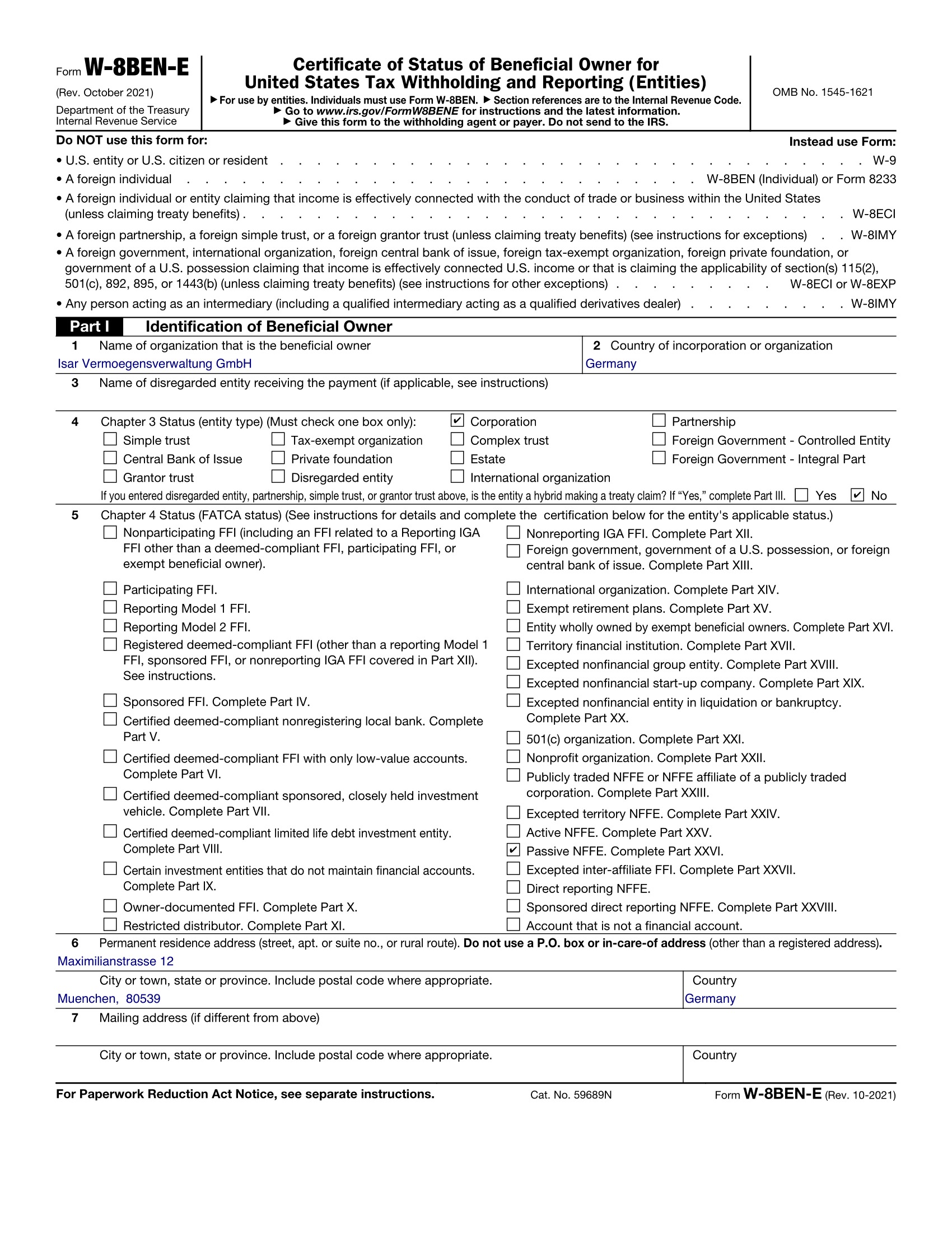
Beispiel. Die Isar Vermögensverwaltung GmbH, Maximilianstraße 12, 80539 München, ist fiktiv.
FAQ for German IBKR users
What tax applies to US dividends of a German GmbH?
15% with a valid W-8BEN-E under Article 10(2)(b) of the US–Germany treaty. Lines 14a and 14b are enough, so line 15 stays empty. 5% under Article 10(2)(a) for a direct holding of at least 10% of the voting stock may go on line 15. 0% under Article 10(3)(a) needs 80% of the voting power and one of aa)–dd). 0% under Article 10(3)(b) is a pension fund. A US RIC or a German Investmentvermögen does not get the company 5% under Article 10(2)(a) or the company 0% under Article 10(3)(a). They keep 15% under Article 10(2)(b), and a pension fund can still use Article 10(3)(b). A German Investmentvermögen also needs the 90% test of Article 28(6). A REIT never gets the company 5% or 0%. Article 10(2)(b) at 15% applies to a REIT only in one of three cases: an individual holding of not more than 10%; or a publicly traded class and a holding of not more than 5% of any class; or a holding of not more than 10% in a diversified REIT. Outside those cases the treaty sets no ceiling, so chapter 3 withholding is 30% even with a valid form. When Article 28(5) applies, the dividend is capped at 15% of the gross amount. 30% without a valid form. In Germany the 15% is credited against Körperschaftsteuer (§ 26 KStG).
Is an investment GmbH an Active or a Passive NFFE?
Passive, as a rule: Active NFFE requires less than 50% passive income and less than 50% passive assets. A GmbH living from dividends and gains is above both.
Which LOB box does an investment GmbH tick?
Usually “Company that meets the ownership and base erosion test” (Article 28(2)(f)), and only when both of its conditions are met. Article 28(4) does not cover making or managing investments for the resident’s own account, except banking, insurance, or securities dealing carried on by a bank, insurance company, or registered securities dealer.
Does the same form work at CapTrader?
Yes. CapTrader accounts are held at Interactive Brokers, so the W-8BEN-E is the same.
Which number goes on line 9b?
The GmbH's Steuernummer from the tax office, ideally converted to the 13-digit ELSTER format. Not the USt-IdNr.
Sources
Country-specific guides
Fill your W-8BEN-E for IBKR in minutes
Answer the questions on income, owners and the treaty, and get a completed W-8BEN-E for your GmbH's IBKR account.
Start Now ($30)