W-8BEN-E for YouTube & AdSense in Germany: Fill It Online
This article was created with AI assistance and has not been reviewed by a human editor. It is provided for general informational purposes only and does not constitute tax, legal, or financial advice.
German companies earning from YouTube and AdSense often discover tax documentation only after revenue starts scaling. If your channel is owned by a legal entity such as a GmbH or UG, Google usually asks for Form W-8BEN-E, not the individual W-8BEN form.
This page explains YouTube W-8BEN-E Germany in plain English, with practical context for company accounts, treaty claims, and withholding risk. You get a guided workflow, a clear step-by-step checklist, and a ready-to-sign PDF output that your team can review before submitting it in Google's tax tool.
Do German companies need a W-8BEN-E for YouTube?
Yes, in most company-owned channel setups. If YouTube or AdSense pays your German company, Google typically expects W-8BEN-E because it is the IRS certificate for non-US entities. W-8BEN is the individual version and usually applies when payout goes to a person directly.
Google requires tax information to document who receives income and how US withholding rules should be applied. The US-Germany tax treaty may reduce withholding in some situations when your company qualifies and your claim is coherent.
In simple terms: if your legal payee is a German company, W-8BEN-E is usually required to avoid avoidable withholding defaults and repeated profile review loops.
- Company payout profile: usually W-8BEN-E.
- Personal payout profile: usually W-8BEN.
- Treaty relief may reduce withholding, but only with correct classification and consistent form data.
Generate Your W-8BEN-E for YouTube (Germany)
Use the guided wizard to complete your W-8BEN-E with clear prompts instead of IRS-heavy language. The flow asks only what matters for your company profile, then generates a PDF in IRS layout.
No tax specialist background is needed to start. You receive your completed PDF instantly after checkout for a one-time $30 payment.
W-8BEN-E wizard (companies)
For an organization
For companies, funds, partnerships registered outside the USA.
Free to start. Payment is only required at the final step to download your completed PDF.
Loading...
How US tax applies to YouTube income in Germany
When German teams search youtube w8ben e germany or adsense steuer gmbh usa, they are usually trying to answer one operational question: how much US tax might be withheld before funds reach the company bank account. This is a withholding issue at payer level, not the full tax story of your business.
Google collects tax documentation from non-US payees because it must apply US withholding and reporting rules in a documented way. For entity payouts, W-8BEN-E is the standard certificate. It identifies your company, confirms foreign status, and supports treaty claims where relevant.
Google separates the two: YouTube Partner Program earnings are "Other Copyright Royalties", website AdSense is "Services or other business income". For a GmbH, YouTube earnings from US viewers go through the royalties line — 0% under Article 12 of the US–Germany treaty, if the company meets the limitation-on-benefits test of Article 28. When Article 28(5) applies, that royalty is capped at 15% of the gross amount, not at 0%. Other such income then follows United States domestic law. The paragraph does not apply to royalties for intangible property produced by that third-country permanent establishment, or to other income incidental to its active business, other than investments for its own account, except banking or securities dealing by a bank or a registered securities dealer. Website AdSense for work done in Germany isn't US-source and isn't withheld once the tax info is approved.
Germany and the United States have a tax treaty, and Article 12 sets 0% for copyright royalties.
A practical takeaway: W-8BEN-E is your company tax identity card for US withholding systems. If legal name, country, FATCA status, and treaty narrative align, review is usually smoother. If they conflict, default handling and delays become more likely.
This guide intentionally avoids guaranteed percentages. Exact treatment can vary by classification and payer implementation.
YouTube taxes in Germany (Steuer): what companies need to know
A major source of confusion in German searches is the word Steuer. Many founders ask whether W-8BEN-E replaces German tax obligations. It does not. The form is for US withholding documentation. German corporate taxation remains a separate track handled under German law.
Think of two layers running at the same time. Layer one is US withholding at source: Google may withhold on certain US-source payment categories based on your documentation and classification. Layer two is your domestic accounting and tax position in Germany: corporate income tax, trade tax, VAT treatment where applicable, and local filing obligations.
These layers interact economically but are not the same legal process. If your team mixes them, decisions become inconsistent. For example, a company may optimize domestic reporting language but still need a precise withholding classification in W-8BEN-E for platform compliance.
This is why German company users often feel stuck between tax advisors, online forum templates, and platform dashboards. One source talks domestic tax, another talks IRS forms, and neither explains how they fit operationally inside YouTube payouts.
The role of W-8BEN-E is narrow but important: it helps Google apply documented US withholding treatment instead of undocumented defaults. It does not calculate your full German tax liability, and it does not replace annual accounting work.
If you keep that separation clear, your team can move faster: submit coherent US documentation in Google, then handle German Steuer obligations through your normal accounting workflow.
W-8BEN-E for GmbH and UG companies on YouTube
Most German corporate creators and media businesses use either a GmbH or a UG (haftungsbeschraenkt). In YouTube payout workflows, both are company entities and generally require W-8BEN-E when income is paid to the legal entity.
A common mistake is assuming legal-form labels automatically map to one tax checkbox. W-8BEN-E uses US form classification logic, so your selection should reflect actual entity facts and business profile, not only naming similarity.
Many operating businesses select Active NFFE under FATCA, but this is not a universal default for all GmbH or UG structures. If your company has a passive profile or holding characteristics, another status may be more accurate.
YouTube income managed through a company structure also requires consistency across systems: legal name in Google Payments, registration details, signer authority, and treaty narrative should all match.
For agencies and studios, mixed business models can create ambiguity. Retainers, production fees, and monetization payouts can be described differently in contracts and platform data. The safest path is one coherent story across your W-8BEN-E entries and your payment setup.
Who this applies to in Germany
This page is built for company-owned YouTube and AdSense setups where payouts go to a legal entity in Germany, including:
- GmbH businesses monetizing YouTube channels in a company account.
- UG (haftungsbeschraenkt) companies with AdSense payouts to the entity.
- Content studios with multi-channel monetization under one legal company.
- Media companies centralizing rights and ad revenue in corporate structure.
- Agencies running YouTube monetization where the agency entity is the payee.
Why YouTube / Google asks for W-8BEN-E
Google asks for W-8BEN-E because it has payer-side US tax compliance responsibilities. Before applying reduced withholding treatment, Google needs standardized documentation that identifies the non-US entity and supports the withholding logic used in account systems.
For company users, W-8BEN-E includes legal entity details, Chapter 3 and FATCA status, treaty claims, and signer certification. It is far more than a simple country declaration.
Without a valid form, platforms often apply conservative defaults because undocumented claims cannot be relied on. Even when a company may qualify for treaty benefits, missing or inconsistent data can block practical access to that treatment.
The form also helps separate individual and entity profiles. If your channel economics are company-based, your documentation should be company-based too. Mixing personal and corporate identities is a frequent reason for repeated reviews.
In practical terms, Google is asking for a coherent compliance record, not perfect legal prose. Clear and consistent data usually matters more than complex wording.
How to fill W-8BEN-E as a German company for YouTube
Use this checklist before you answer the same questions in Google's tax tool (Payments › Payments info › Manage settings › United States tax info › Manage tax info). It helps align legal data, withholding classification, and treaty fields so your submission is defensible and easier to review.
Step 1: Enter your exact legal company name
Use the full registered legal name from company records and your Google payments profile. Avoid short forms or alternate spellings unless those are legally registered. Small mismatches can trigger manual checks.
Step 2: Set country of incorporation to Germany
Choose Germany as the country of incorporation for the entity receiving payouts. If your group has multiple entities, verify that the selected company is the real beneficial owner in this payout flow.
Step 3: Select FATCA status (Active NFFE is common)
Many operating companies choose Active NFFE, but this is not automatic. Confirm that your income mix and activity profile support the status you certify. Avoid selecting by popularity alone.
Step 4: Complete treaty claim details carefully
If claiming treaty benefits, align country, article reference, and income type with your actual payer context. For YouTube and AdSense, many teams evaluate royalty-style treatment, but claims must still match facts.
Step 5: Review LOB wording when applicable
Some treaty claims require limitation on benefits (LOB) statements. Ensure ownership and business facts support the wording. Weak or inconsistent LOB statements can reduce claim reliability.
Step 6: Sign as an authorized representative
The signer should be authorized to certify on behalf of the company. Check title, date, and declarations before final submission. Keep a signed copy and update it when key company facts change.
Common mistakes German YouTube companies make
Most filing issues come from inconsistent assumptions rather than difficult calculations. Frequent mistakes include:
- Treating payment context as services by default when payer-side withholding logic is royalty-oriented.
- Mixing up US withholding documentation with domestic German Steuer obligations.
- Using a treaty claim that does not match the selected income category or entity facts.
- Submitting the individual W-8BEN instead of W-8BEN-E for a company-owned channel.
Example of a completed W-8BEN-E (Germany)
This preview shows what a completed W-8BEN-E can look like for a German company before submitting it in Google's tax tool. Use it to align finance, operations, and founders on expected structure and signature fields. Your generated PDF is based on your own answers, including legal name, FATCA status, and treaty selections, so it matches your real company profile.
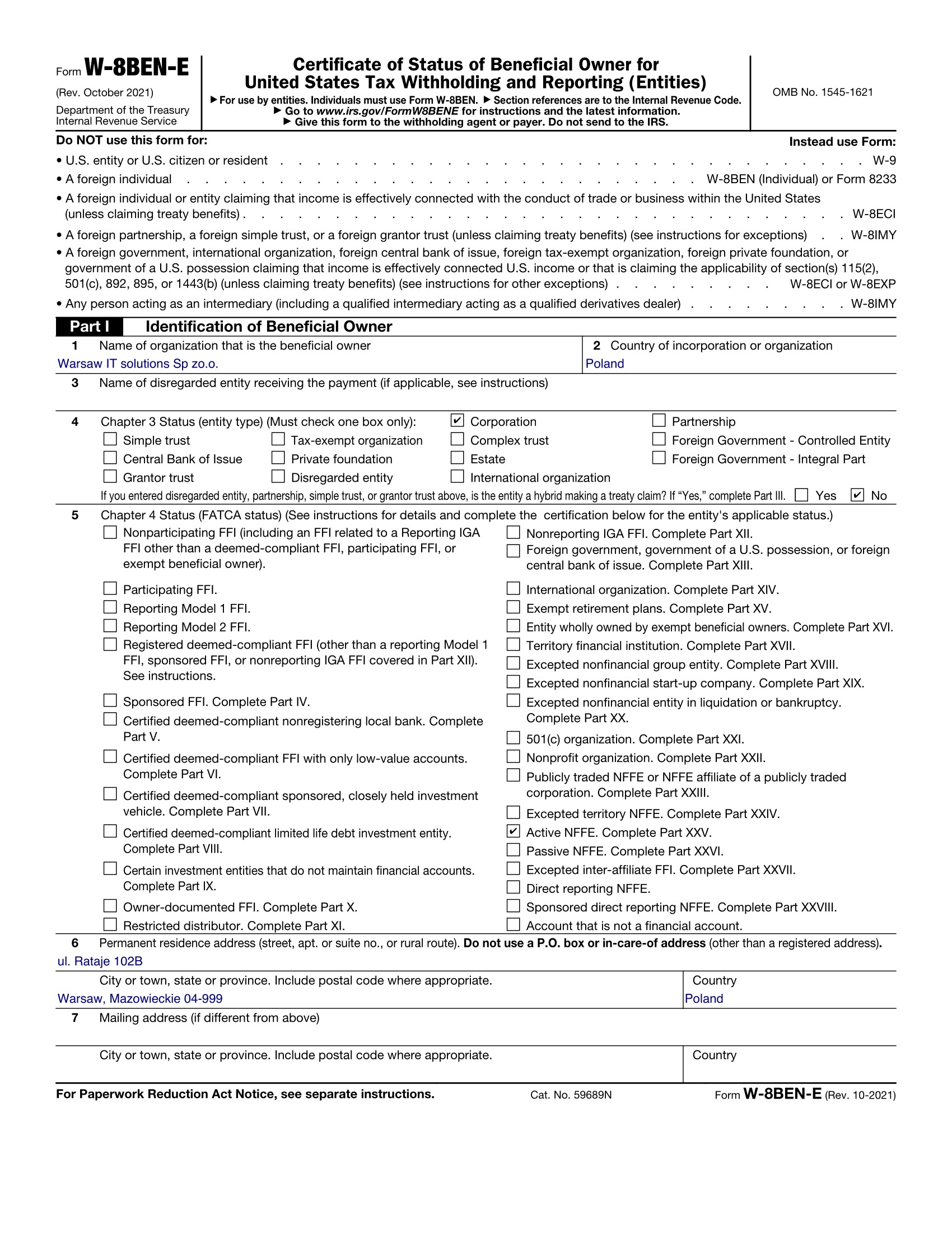
Example only. Always submit your own accurate company data.
FAQ for German YouTube companies
Do German companies pay US tax on YouTube income?
On earnings from US viewers, Google withholds at the rate your GmbH claims. The US–Germany treaty sets 0% for copyright royalties (Article 12) when Article 28(5) does not apply, so a GmbH with an approved W-8BEN-E that meets the limitation-on-benefits test of Article 28 has nothing withheld. When Article 28(5) applies, the royalty is capped at 15% of the gross amount. Without tax info on a business account, Google withholds 30% of US income.
Is AdSense income royalties?
Not for Google: its tax tool classes website AdSense as Services and YouTube Partner Program earnings as Other Copyright Royalties. For a GmbH, website AdSense is service income from work done in Germany, so no US withholding applies once the tax info is approved. Only YouTube earnings from US viewers go through the royalties line, at 0% under Article 12 unless Article 28(5) caps them at 15% of the gross amount.
Do I need W-8BEN-E?
If your YouTube payout profile belongs to a company such as a GmbH or UG, W-8BEN-E is usually the expected form. Individual W-8BEN is generally for personal payees, not entity profiles.
How does this relate to German taxes?
W-8BEN-E documents US withholding status for a payer. German domestic taxes remain separate obligations managed under German law. Most companies handle both tracks in parallel.
Related pages
Need broader context beyond this Germany-specific guide?
Fill your W-8BEN-E for YouTube in Germany
Complete your company W-8BEN-E with guided questions. The wizard gives you a completed W-8BEN-E PDF. Answer the same questions in Google's tax tool (Payments › Payments info › Manage settings › United States tax info › Manage tax info). Google generates the form for you to verify.
Start Now ($30)