W-8BEN-E for Amazon Sellers in the Netherlands: Fill It Online
If your Amazon payouts go to a Dutch company—a besloten vennootschap (BV) or another non-US entity—Seller Central and US payers typically ask for IRS Form W-8BEN-E, not the individual W-8BEN. This Amazon W-8BEN-E Netherlands guide explains who the legal recipient is, where the entity is organised, and how US withholding rules apply to US-source amounts.
Dutch sellers often arrive after searches such as amazon w8ben e netherlands or w8ben e dutch company amazon: without a complete entity certificate, automated checks can leave payments on stricter default withholding paths.
W-8BEN-E is how your company certifies status for US rules and, where your facts support it, claims treaty benefits so withholding is not left on the wrong default. We cover BV and holding structures and link to a guided flow that builds a ready-to-sign PDF. Download is a one-time $30 checkout.
Do Dutch companies need a W-8BEN-E for Amazon?
Yes, when Amazon pays your Dutch company—not you personally using W-8BEN—Amazon expects Form W-8BEN-E. It is the IRS certificate for foreign entities receiving US-source payments. Your BV certifies Chapter 3 withholding status, Chapter 4 / FATCA category, and any treaty position you rely on.
The United States and the Kingdom of the Netherlands have an income tax treaty. When your entity and income type qualify and certifications are complete (including limitation on benefits where required), payers can apply treaty-based treatment instead of the strictest backup path. We do not name one “Amazon rate” for every seller: the treaty sets categories and conditions; your certificate must match how Amazon classifies each stream and your real operations.
Without a valid W-8BEN-E, checks can delay disbursements. Teams search w8ben e netherlands bv or amazon tax netherlands company usa to align the US payer story with KvK data and Seller Central.
- Companies (BV and similar) paid in the entity name almost always use W-8BEN-E; individuals paid in their own name typically use W-8BEN instead.
- The US–Netherlands treaty is the framework that may reduce withholding on eligible income when your form is accurate; outcomes still depend on income type, treaty tests, and how the payer applies the rules.
- Treaty relief is not automatic from a Dutch corporate income tax return alone—you certify on the IRS form under penalties of perjury, and Amazon reconciles it against your account profile.
Generate Your W-8BEN-E for Amazon (Netherlands)
You do not need to decode IRS instructions on your own. The W8GetEasy wizard asks practical questions, walks through the sections that matter for a Dutch company, and produces a formatted W-8BEN-E PDF you can review, sign, and upload.
The flow matches our main W-8BEN-E product: guided answers, a clear preview, then download after a single $30 payment. It is built for founders and finance leads who want Amazon W-8BEN-E Netherlands documentation done without guessing FATCA labels or treaty lines from forum screenshots.
Because Amazon compares your certificate to the legal entity on the account, the wizard highlights consistency between your registered name, Dutch address, and the story you certify—small mismatches are a common reason uploads bounce.
How US tax applies to Dutch Amazon sellers
When people say “amazon tax netherlands company usa,” they usually mean US federal withholding at source on certain US-source payments—not a second Dutch corporate tax return that replaces Belastingdienst rules. Amazon, as part of a US-based payer ecosystem, has to document whether the payee is US or foreign and what withholding treatment applies before some disbursements can follow a reduced-treaty path.
The United States and the Kingdom of the Netherlands maintain a bilateral income tax treaty. Treaties allocate taxing rights and can provide reduced withholding or exemptions for defined categories of income when the beneficial owner meets eligibility tests. On W-8BEN-E, your company certifies whether it claims those benefits, cites the treaty articles that match the income types involved, and completes limitation-on-benefits disclosures when you elect treaty treatment.
Withholding is not one fixed percentage for every Dutch seller. Marketplace fees, retail margins, advertising flows, and amounts characterised as royalties, services, or other categories can be viewed differently for Chapter 3 purposes. Amazon’s classification of each payment type drives which rules attach. We do not guarantee any exact rate or outcome on this page: your form must reflect your facts, and payers apply their own checks.
Chapter 4 (FATCA—the US rules that ask foreign entities to self-certify financial vs non-financial status) sits alongside Chapter 3 in the same PDF. Many Dutch trading companies that are not banks or brokers certify as active non-financial foreign entities when their operations support that category; passive holding companies or different structures may belong elsewhere. Mis-picking a Chapter 4 box can invalidate the certificate or trigger rework, so treat Chapter 4 as seriously as treaty lines.
This section explains mechanics, not personalised tax advice. If you have US branches, complex royalty stacks, or large related-party flows, involve a qualified adviser before you sign.
W-8BEN-E for Dutch BV and holding companies
Many Dutch groups use a BV as the operating company and another BV as a holding or IP owner. That pattern matters for searches such as w8ben e holding netherlands because the payer must match the certificate to the entity that actually receives the money.
If Seller Central pays the trading BV that sells inventory, that BV usually signs W-8BEN-E. If contracts were restructured so a holding company is the payee of record, the holding company may need its own certificate—uploading the wrong entity’s form is a frequent reason groups search w8ben e netherlands bv after a rejection.
Dividends, interest, and royalties have different treaty logic in the abstract; on Amazon, what matters is how the marketplace classifies your payout streams and whether your certifications match. Groups that mix brokerage or investment receipts with e-commerce should not assume one checkbox covers every leg.
Active trading BVs often fit active non-financial foreign entity (NFFE) paths for FATCA; passive holdings may not. Treaty lines in Part III must align with the income you certify. Discuss reorganisations or IP moves with your adviser; we help you produce a coherent PDF for the name Amazon sees.
Who this applies to in the Netherlands
Use this checklist if you are deciding whether the Amazon W-8BEN-E Netherlands path matches your account. It mirrors what we see from Dutch sellers onboarding in Seller Central—it is not legal advice:
- Besloten vennootschappen (BV) and other Dutch corporate entities that receive Amazon disbursements in the company’s legal name.
- Holding companies or group parents that are the contracting payee on US-source marketplace or services income—only when that same name appears on the payout path.
- E-commerce brands and Amazon sellers that use FBA or remote fulfilment while the Dutch entity remains the documented recipient on US flows.
- Founders who combine brokerage or investment-platform receipts with Amazon income and need one coherent entity story across multiple US payers.
How to fill W-8BEN-E as a Dutch company
Think of the form as a structured interview exported to PDF. Dutch filers move fastest when these points line up with KvK registration, bank KYC, and the legal profile Amazon already shows:
Company name and address
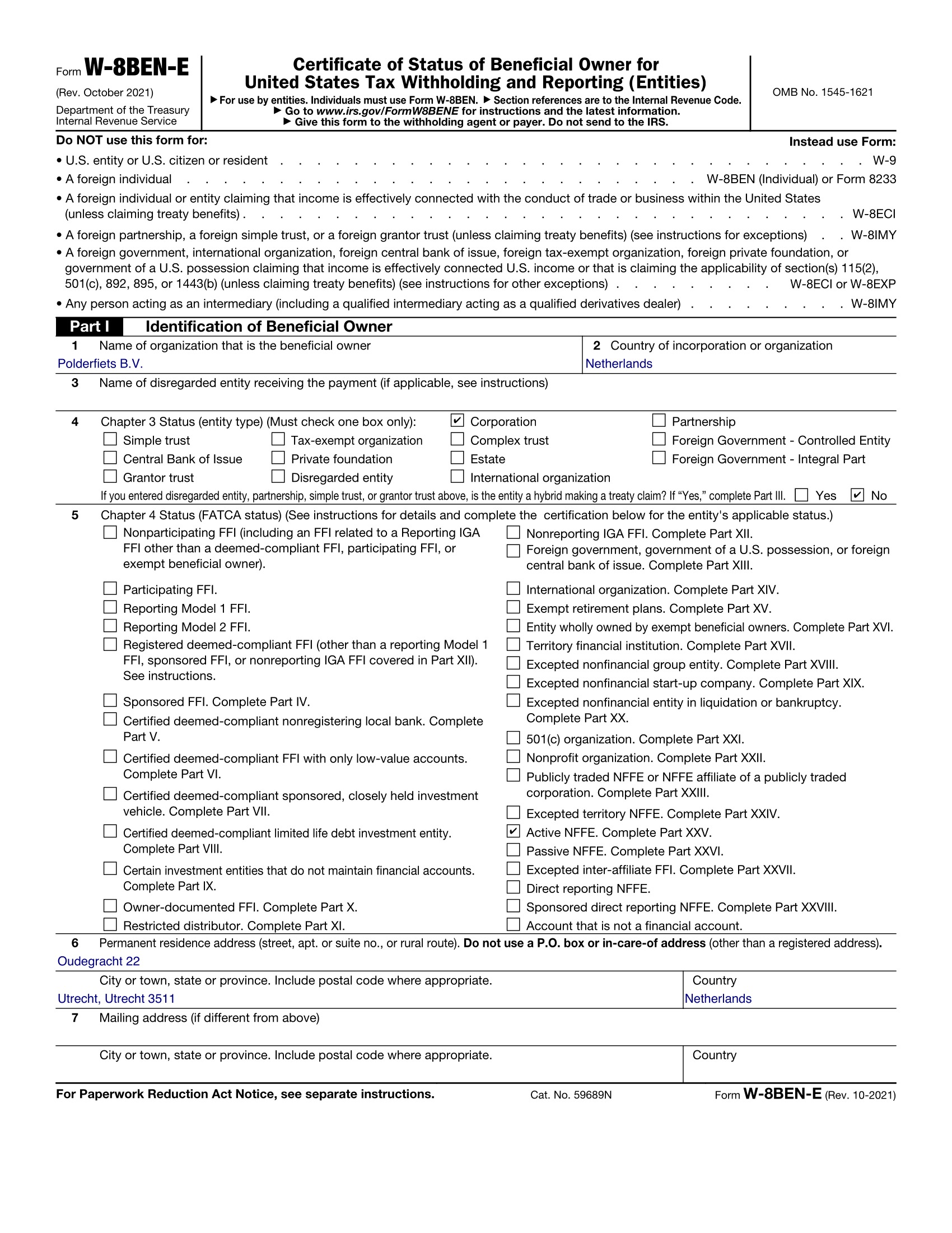
Enter the entity name exactly as it appears on your Dutch incorporation extract and on Amazon’s legal entity screen. Use the registered office or principal business address you can prove with official correspondence. Typos in house numbers, postal codes, or legal suffixes (for example “B.V.” spacing) are a frequent cause of rejection because payers match strings to their KYC data.
Country of incorporation: Netherlands
Select the Netherlands as the jurisdiction of formation. That choice connects to the US–Netherlands treaty module in Part III when you claim benefits. If you use a foreign parent or a stack of BVs, confirm with your adviser which entity is the beneficial owner of the Amazon payouts before you mismatch the treaty country.
Chapter 3 entity classification
Map your BV to the US Chapter 3 category that fits—often a corporation for many Dutch BVs, but not always. Do not assume “BV” automatically equals a specific US label. The wizard explains common paths; you remain responsible for accuracy.
FATCA status — Active NFFE is common, not universal
Many Dutch trading businesses that are not banks or brokers certify as active non-financial foreign entities (Active NFFE) when they meet the active trade or business tests. Passive investment companies or entities with large passive income streams may need a different Chapter 4 category. Choose the line supported by operations, not the checkbox that sounded easiest in a video.
Treaty claim in Part III
If you claim benefits, identify the treaty country (Netherlands), the articles and paragraphs that align with your income type, and the limitation-on-benefits path you rely on. If you are not claiming treaty benefits, say so clearly instead of leaving ambiguous blanks that cause payers to disregard the form.
Signature and capacity
An authorised officer signs under penalties of perjury with authority to bind the company. Keep board resolutions or delegations consistent with the name and title in the signature block. Amazon’s risk models sometimes flag mismatches between signer titles and registry data.
Common mistakes Dutch companies make
These patterns show up in seller forums, accountant inboxes, and payer rejection logs. They are easy to avoid once you know what to double-check:
- Uploading Form W-8BEN (for individuals) after incorporating a BV because old habits carried over. Entity accounts need W-8BEN-E with FATCA sections completed.
- Picking a Chapter 3 or Chapter 4 classification because it worked for another seller without matching US definitions to your KvK governance and real activity.
- Misunderstanding holding structures: using the parent BV’s certificate when the Amazon payee is the operating BV (or the reverse) so the beneficial owner story does not match disbursements.
- Assuming Dutch corporate income tax or VAT outcomes decide US withholding. Domestic compliance matters, but US payers apply Chapter 3 and treaty text to US-source payments—keep both ledgers mentally separate.
- Claiming treaty articles that do not match how Amazon categorises your dominant payout streams, or copying treaty lines from a template meant for another country.
Example of a completed W-8BEN-E (Netherlands)
The preview below shows how a fictional Dutch BV might appear on page one of the certificate. Your downloaded PDF uses the same IRS layout but reflects your real name, addresses, Chapter 3 and Chapter 4 choices, and any treaty language from your answers. Use it to brief your finance team before you open Seller Central’s upload screen, then start the wizard when you are ready to generate your own file.
FAQ for Dutch Amazon sellers
Do Dutch companies pay US tax?
Most small and mid-sized Dutch Amazon sellers first encounter US rules as withholding at source on specific US-source payments and related reporting—not a full US corporate tax return on worldwide profit. Whether any US net income tax filing ever applies depends on facts such as permanent establishment, income characterisation, and treaty positions. Use this page for withholding context; ask a tax adviser for material amounts or complex groups.
What treaty applies?
The Convention between the United States of America and the Kingdom of the Netherlands for the avoidance of double taxation and the prevention of fiscal evasion with respect to taxes on income is the bilateral framework people mean when they discuss treaty treatment for a Dutch company. W-8BEN-E is where your entity certifies whether it claims benefits under that treaty, cites relevant articles for the income types involved, and completes limitation-on-benefits statements when required.
Do holding companies need W-8BEN-E?
If the holding company is the legal payee of record for US-source payments from Amazon—or another US payer asks for entity certification in that name—then that entity typically needs its own W-8BEN-E. If only the operating BV receives payouts, the holding company’s form is not a substitute. Match the certificate to the name and tax identification data on the disbursement path.
How does this relate to Dutch taxes?
Dutch corporate income tax, VAT, payroll, and KvK filings answer to the Netherlands. W-8BEN-E answers US payer questions: whether the recipient is foreign for US purposes, what withholding rate applies on documented US-source payments, and how FATCA classifies the entity. Cash flow after US withholding still lands in your Dutch accounts—but the forms and concepts are not interchangeable.
Is W-8BEN-E required for Amazon?
Amazon’s tax workflow for non-US entities generally points companies toward W-8BEN-E because it is the IRS form designed for foreign corporations and other entities receiving US-source payments. If disbursements and the legal profile are in a BV name, that path is expected rather than the individual W-8BEN. Amazon can still reject uploads that are incomplete, unsigned, or inconsistent with account data.
Is Amazon W-8BEN-E Netherlands the same as W-8BEN?
No. W-8BEN is for individuals. W-8BEN-E is for entities such as a BV. Seller Central routes company accounts to the entity certificate. Using the wrong form is one of the most common reasons sellers search w8ben e netherlands bv after a rejection.
When should we upload or renew the form?
Upload when Seller Central or your US payer requests it, and renew before expiry dates shown in the console. Many certificates last three years but rules and payer prompts vary. Treat renewal as a data-quality exercise, not a copy-paste of an old PDF if your structure or address changed.
Can withholding ever be zero?
Sometimes, for certain income types and facts, treaty treatment can reduce withholding to zero or exempt amounts. It is never guaranteed by this website. Outcomes depend on eligibility, payer classification, and complete certifications—including LOB when treaty benefits are claimed.
Continue on W8GetEasy
Want the general Amazon marketplace guide or the main W-8BEN-E landing?
Fill your W-8BEN-E for Amazon in the Netherlands
Stop piecing together PDF fields from outdated threads. Answer guided questions for foreign companies, preview the certificate, then download a formatted W-8BEN-E to sign and upload. Checkout is one $30 payment—for Dutch teams that need w8ben e dutch company amazon documentation aligned with Amazon the first time.
Start Now ($30)