W-8BEN-E for a German company selling on Amazon.com
This article was created with AI assistance and has not been reviewed by a human editor. It is provided for general informational purposes only and does not constitute tax, legal, or financial advice.
A GmbH or UG selling on Amazon.com answers Amazon’s US tax interview as a foreign corporation. This page names the German lines: entity type, Steuernummer, and Article 7.
Three lines that are German, not generic
- Line 4: Corporation for a GmbH or UG. An AG is Corporation because it is on the per se list.
- Line 9b: the company’s Steuernummer, or its W-IdNr. Not the manager’s Steuer-IdNr.
- Leave line 15 blank for product sales. Product sales have no US withholding. If Amazon asks for an article, do not enter Article 7(1) and 0%. Article 7 is the article for profits the United States may tax. If there is a permanent establishment, Article 7(1) does not give 0% on that establishment’s profits.
How Amazon collects the form
The Tax Information Interview builds and e-signs the W-8. Upload or mail a signed PDF only if Amazon asks. A valid W-8 keeps the GmbH off 1099-K; without it Amazon suspends selling privileges until the interview is done. Product sales carry no US withholding either way. It lasts through 31 December of the third year, then Amazon asks again. Status: Provided and Pending Validation. Our PDF lists fields. See the Amazon W-8BEN-E page.
Lines a Hamburg or Munich company actually fills
The rest of the certificate follows the legal name and the registered seat. These seven lines are the ones that change because the company is German.
| Line | German entry |
|---|---|
| Line 1 | The name in the Handelsregister, Latin letters, including “GmbH” or “UG (haftungsbeschränkt)”. |
| Line 4 | Corporation. A GmbH and a UG default to corporation because the owners have limited liability. An AG is always Corporation: Germany, Aktiengesellschaft, is per se under Treas. Reg. §301.7701-2(b)(8). |
| Line 5 | Active NFFE when less than half of the income and assets are passive. A holding GmbH that only owns shares is usually Passive NFFE. |
| Line 9b | The company's Steuernummer in the 13-digit nationwide ELSTER format, e.g. 2248071203659. The tax assessment shows it in your state's format, e.g. 48/712/03659 in Hamburg; convert it before entering. Or the W-IdNr. (Wirtschafts-Identifikationsnummer). |
| Line 14a | Germany, if the company is resident there and claims the treaty. |
| Line 14b | Limitation on benefits under Article 28. An operating GmbH usually meets the active-trade-or-business test. |
| Line 15 | Leave blank for product sales. Product sales have no US withholding. Do not enter Article 7(1) and 0% even if Amazon asks. Article 7 covers profits the United States may tax, and it does not zero a permanent establishment’s profits. |
Which German vehicle goes on line 4
US classification follows liability and the per se list, not the German label “Kapitalgesellschaft” by itself.
- GmbH and UG (haftungsbeschränkt). Corporation by default. Members are not personally liable, so the entity is not a partnership.
- AG. Always Corporation. Aktiengesellschaft is listed as a per se corporation for Germany.
- GmbH & Co. KG. A partnership for US purposes. The IRS instructions say a foreign partnership files Form W-8IMY, not W-8BEN-E. The partners document themselves.
A sole trader (Einzelunternehmen) is a person, so the form is W-8BEN. Selling as a sole trader? Use W-8BEN
Numbers that do not belong on line 9b
USt-IdNr.
DE plus nine digits is the VAT identification number. It is for VAT and does not go on line 9b; enter the Steuernummer or the W-IdNr.
Steuer-IdNr.
Eleven digits starting with a person. That is the manager’s identification number, not the GmbH’s.
HRB
The Handelsregisternummer identifies the register entry. It is not a tax number and does not go on line 9b.
Stock in a US fulfilment centre
A GmbH that ships camping gear into Amazon’s US buildings is using those buildings for storage, display and delivery. Article 5(4)(a) and (b) of the US–Germany treaty say that keeping goods or merchandise for storage, display or delivery, and keeping a stock for delivery, does not by itself make a permanent establishment.
The exception stops if the company opens its own warehouse, stations employees in the United States, or gives an agent authority to conclude contracts in its name. Those facts can be a permanent establishment, and Article 7 then allows the United States to tax the profits attributable to it. Ordinary FBA, with no staff and no dependent agent, stays on the German side of that line.
Leave line 15 blank. Product sales have no US withholding. Do not enter Article 7(1) and 0% even if Amazon asks for an article. Article 7 remains the article for profits the United States may tax. If there is a permanent establishment, Article 7(1) does not give 0% on that establishment’s profits.
What the Finanzamt still taxes
Profit from Amazon.com is part of the GmbH’s worldwide profit. It goes on the Körperschaftsteuer return, with Solidaritätszuschlag on that corporate tax, and Gewerbesteuer at the rate of the municipality where the business is carried on. A US certificate does not remove those German taxes.
Selling fees that a US Amazon company invoices to the GmbH for amazon.com are services from abroad. The GmbH accounts for German VAT itself under the reverse-charge rule in § 13b UStG, instead of treating that US invoice as German VAT. The Gewerbesteuer multiplier is set by the municipality of the registered seat, so Hamburg and Munich do not use the same rate.
Kranich Outdoor GmbH, Hamburg
Kranich Outdoor GmbH sells hiking kit. It started on Amazon.de with merchant-fulfilled orders, then turned on FBA for Amazon.com and sent tents to fulfilment centres in the United States. There is no German office in America and no employee who can sign contracts there.
In the tax interview Lena Krüger, the managing director, answered Corporation on line 4, put Steuernummer 48/712/03659 from its tax assessment, entered on line 9b as 2248071203659, ticked the active-trade limitation-on-benefits test under Article 28, and left line 15 blank, because product sales have no US withholding. She did not enter Article 7(1) and 0% even though Amazon asked for an article. The PDF our wizard produces shows those same answers; Amazon builds its own copy from the interview unless it asks for a signed file.
Article 5(4)(a) and (b) are why the US stock does not create a permanent establishment: Amazon holds the tents only to store and ship them. The year’s margin is declared in Hamburg with corporation tax, the solidarity surcharge and trade tax. Names, the street and the Steuernummer in the sample are invented.
Sample: Kranich Outdoor GmbH
Line 9b shows a fictional Steuernummer in ELSTER format. Line 15 stays blank because product sales have no US withholding.
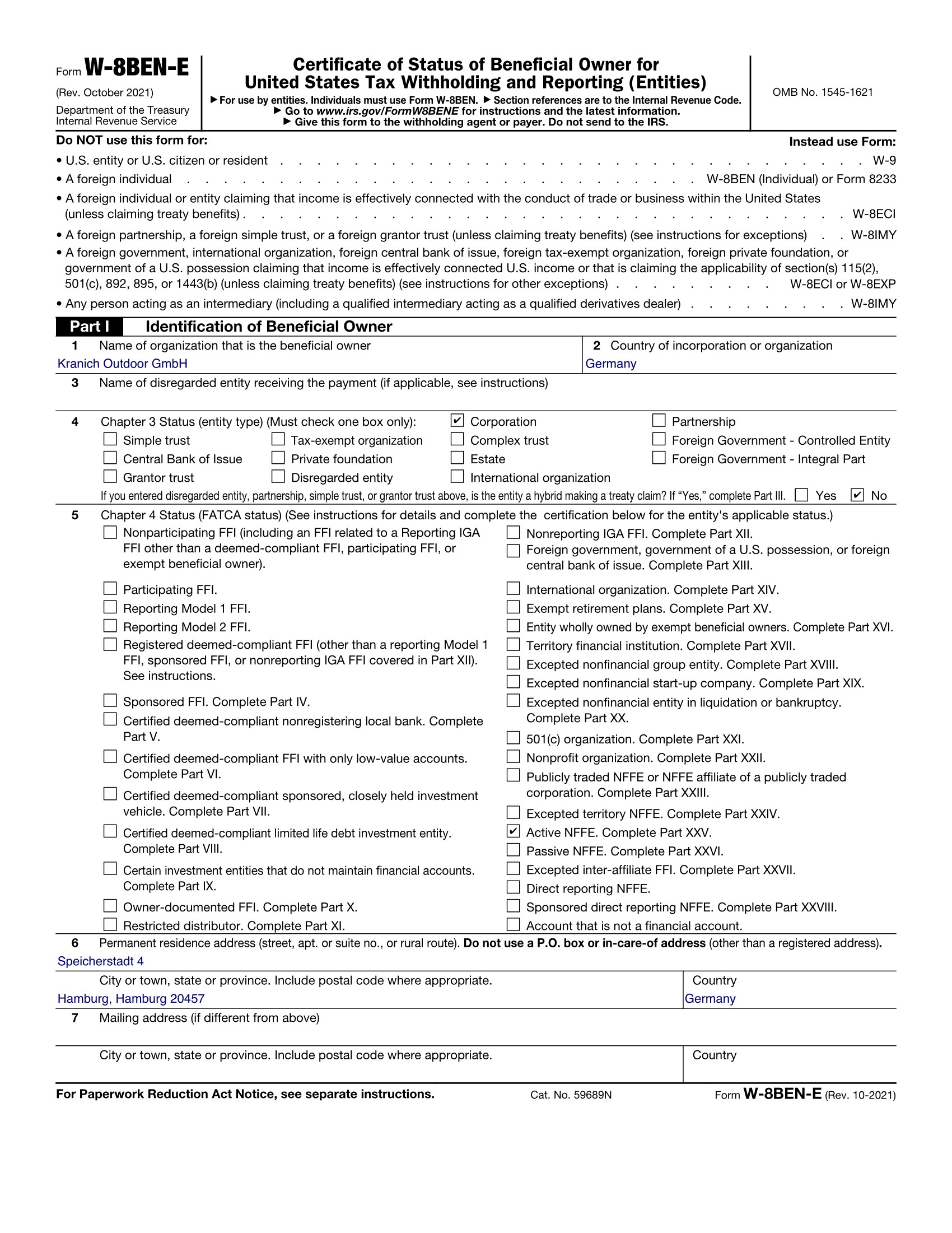
Example only. Kranich Outdoor GmbH, Hamburg, is fictional.
Same answers, ready to copy into the interview
Build the German W-8BEN-EFor an organization
For companies, funds, partnerships registered outside the USA.
Free to start. Payment is only required at the final step to download your completed PDF.
Loading...
Questions German sellers actually ask
UG or GmbH — what goes on line 4?
Corporation for both. A UG (haftungsbeschränkt) has the same limited liability as a GmbH, so the US default is a corporation. The legal name on line 1 still has to match the register, including the UG suffix.
Our seller is a GmbH & Co. KG. Which form?
Form W-8IMY, not W-8BEN-E. The IRS instructions for W-8BEN-E tell a foreign partnership not to use that form. A KG is a partnership for US tax even when the general partner is a GmbH. The partners give their own certificates. See the IRS instructions for Form W-8BEN-E.
Does FBA mean we need an EIN?
No. Line 8 stays empty when the GmbH has no US office, staff or dependent agent. The number on line 9b is the German Steuernummer or W-IdNr. An EIN is a US employer number, and stock sitting in Amazon’s building does not create one.
We already sell on Amazon.de. Is the US interview separate?
Yes. Amazon.de does not complete US income reporting. When the account sells on Amazon.com, Amazon still runs the Tax Information Interview, builds the W-8 from those answers and signs it electronically. The European VAT profile is a different file.
We converted the UG into a GmbH. What changes?
Line 4 stays Corporation. The legal name usually changes, so the interview has to be completed again under the GmbH name or Amazon’s records will not match the certificate. Use the Steuernummer that belongs to the company after the conversion, which may be the same number or a new one from the tax office.
Sources
Last checked: 7 October 2026