App Developer W-8BEN-E for Studios — $30, Guided PDF
This article was created with AI assistance and has not been reviewed by a human editor. It is provided for general informational purposes only and does not constitute tax, legal, or financial advice.
Foreign game studios and app companies that receive App Store, Google Play, Steam, Unity Asset Store, or Unreal Marketplace payouts in a legal entity name need US tax documentation so stores can apply withholding and reporting correctly. Apple, Google, Valve, and other US-context payers request entity certificates—not individual forms—when the developer account is registered to a company.
If your App Store Connect legal entity, Play Console account, Steamworks payee profile, and bank settlement all align to a foreign corporation or partnership, the form you usually certify is IRS Form W-8BEN-E (Certificate of Status of Beneficial Owner for United States Tax Withholding and Reporting (Entity)). W-8BEN is for foreign individuals. Solo indie devs billing in their own name belong on our individual landing; this page is for studios, publishers, and app companies.
This page is for non-US game studios, mobile app publishers, SaaS products sold through app stores, asset-store sellers, and holding companies that searched App Store W-8BEN-E, Google Play tax form company, app developer W-8BEN-E, game studio US tax, App Store Connect tax foreign company, or Steam W-8BEN-E. You get a quick answer, the guided wizard near the top, a withholding explainer without fake guarantees, common mistakes teams repeat, and an FAQ aligned with visible questions for schema.
Outcomes depend on your facts and how the store classifies your revenue. Treaty rates can change—verify against current IRS treaty tables. For complex multi-title structures, consult a qualified tax adviser.
 AI-generated image
Do app studios need W-8BEN-E?
Yes, in most cases where app store payouts settle to a foreign legal entity—not a person billing in their own name. Apple App Store Connect, Google Play Console, Steam (Valve), Unity Asset Store, Unreal Marketplace, and Microsoft Store act as US-context withholding agents or payers for many foreign developers. They request tax forms so US-source portions of your sales can be documented for Chapter 3 withholding and Chapter 4 (FATCA) reporting.
Individual indie developers operating as natural persons typically use Form W-8BEN instead. The split is about the legal layer on your developer account and who receives settlements—not whether you ship games or apps.
If your store dashboards, contracts, and bank records all reference the same non-US company, treat app developer W-8BEN-E as the default path unless a qualified professional tells you a different form applies to your facts.
- Apple App Store Connect accounts registered to a foreign corporation or partnership generally require W-8BEN-E—not W-8BEN for individuals.
- Google Play Console developer accounts paying a foreign legal entity typically certify at the company layer through tax settings or payment profile workflows.
- Steamworks and Valve payouts to a foreign studio payee profile usually need an entity certificate matching the legal name on the account.
- Unity Asset Store, Unreal Marketplace, and Microsoft Store sellers receiving US-context payouts in a company name generally file W-8BEN-E when the store requests entity tax documentation.
Generate Your W-8BEN-E for App Stores (Step-by-Step)
You do not need to memorize IRS instructions or guess which Chapter 4 (FATCA) checkbox applies. The W8GetEasy wizard asks plain-language questions, shows the sections that matter for your entity, and builds a formatted PDF you can review, sign, and upload to App Store Connect, Play Console, Steamworks, or wherever your store requests tax forms.
The flow covers company details, country of formation, Chapter 3 classification, FATCA Chapter 4 status, treaty claims when relevant—with emphasis on royalty vs business-profits analysis for app revenue—and signature. Finance and ops leads can answer how to fill W-8BEN-E for app stores without starting from a blank IRS PDF.
Form generation is a $30 one-time payment, including your downloadable PDF. You remain responsible for accuracy: the wizard formats your answers, but your certifications must match formation documents, your store legal entity profiles, and how you actually earn. Outcomes depend on your facts; treaty positions should be checked against current IRS treaty tables.
W-8BEN-E wizard (companies)
For an organization
For companies, funds, partnerships registered outside the USA.
Free to start. Payment is only required at the final step to download your completed PDF.
Loading...
What is the W-8BEN-E form for app and game studios?
Form W-8BEN-E is the IRS certificate foreign entities provide to US withholding agents and payers. It states who the beneficial owner is, where the entity is organized, and how it should be treated for Chapter 3 withholding on certain US-source payments.
It also includes Chapter 4 (FATCA) status so payers can meet information-reporting rules. App and game stores—Apple, Google, Valve, Unity, Epic, Microsoft—collect tax forms because they distribute software to US customers and often function as US payers or withholding agents for royalty-like app revenue.
A key point for studios: app and game store revenue is frequently treated as royalties (treaty Article 12) because the store licenses your software to end users rather than buying inventory outright—but classification can vary. Some flows look like services or business profits (Article 7) depending on facts, contracts, and how revenue is characterized. Apple and Google apply treaty rates to US-sourced sales when a valid form is on file; your Part III treaty claim must match the income type you certify.
For companies, the certificate closes the loop between your App Store Connect / Play Console legal entity, W-8BEN-E PDF, and how stores withhold on US sales. Automated checks compare entity type to form type; uploading W-8BEN when the developer account is a company is a frequent mismatch that stalls tax setup.
This page explains common patterns in plain language. It is not legal or tax advice. Use professionals when you have US subsidiaries, multi-entity publishing structures, or uncertain income characterization across titles and stores.
Who needs to submit W-8BEN-E for app store payouts?
If payouts settle to a foreign legal entity and your store’s tax workflow asks for an entity certificate, you are usually in W-8BEN-E territory. Typical profiles include:
- Game studios publishing on Steam, Apple App Store, Google Play, or console storefronts where the developer account is a foreign corporation or partnership.
- Mobile app companies earning from paid apps, in-app purchases, or subscriptions through App Store Connect or Play Console in the entity name.
- SaaS mobile products billing customers through app stores where settlements go to a non-US company—not the founder personally.
- Asset creators selling on Unity Asset Store or Unreal Marketplace where payouts and tax profiles reference a foreign legal entity.
- Software and game licensing companies receiving US distributor or platform royalties in a company name.
- Publishing and holding companies consolidating multi-title app or game revenue through one foreign entity across several stores.
Worked example: a UK indie studio receiving App Store royalties
Ember Peak Games Ltd, an indie game studio in Cardiff, publishes a mobile puzzle game on the App Store and receives quarterly payouts of $15,000 from US sales. Apple licenses the game to end users rather than buying inventory outright, so this revenue is classified as royalty income under Article 12(1) of the US–UK tax treaty—not business profits under Article 7.
Before a W-8BEN-E was on file, Apple applied the default 30% withholding on payments classified as US-source royalty income—$4,500 held back from a $15,000 quarter before the rest reached the company account. After filing Form W-8BEN-E—citing the UK as country of residence and Article 12(1) for the app royalty income—Apple applies 0% US withholding on the same payments. Ember Peak's UK Corporation Tax position is unaffected.
- Without W-8BEN-E on file: 30% withheld on US-source royalty payments—$4,500 on a $15,000 quarter.
- With W-8BEN-E filed (UK, Article 12(1)): 0% US withholding—the full $15,000 reaches the account, still reportable to HMRC as normal.
What this means for your UK Corporation Tax filing—and mixed income streams
A W-8BEN-E only affects US withholding—it does not change your UK Corporation Tax obligations. App Store royalty revenue must still be reported to HMRC and included in your normal Corporation Tax return, regardless of what the US withheld.
If Ember Peak also earns US-sourced income from contract development or consulting work—not just licensed app sales—that portion is business profits under Article 7, not royalties under Article 12(1). The two articles are not interchangeable: citing Article 12 for a consulting invoice, or Article 7 for a licensing payout, is a common Part III mistake that can invalidate the treaty claim on that specific payment.
- Keep your signed W-8BEN-E and any Form 1042-S from your app stores with your company records.
- Report all app store royalty revenue through your normal UK Corporation Tax return, independent of US withholding treatment.
- If you also invoice for services separately from licensed app sales, match each income stream to the correct treaty article—Article 7 for services, Article 12(1) for royalties.
How does US withholding apply to app store revenue?
US rules often start from a 30% default on certain US-source amounts when documentation is missing or inconsistent—which is why finance teams search Google Play Console withholding or App Store Connect tax before scaling US sales.
Apple and Google generally withhold US tax on the US-sales portion of your earnings unless a valid W-8BEN-E supports a treaty rate. Many income-tax treaties reduce royalty withholding to 0% (Spain, Japan, Netherlands) or 10% (Poland, Ukraine), but the applicable article and rate depend on how the store and IRS characterize your revenue—not on “app income” as a single label.
App store revenue is often analyzed as royalties because stores license your software to customers; some arrangements may instead look like business profits or services. Your W-8BEN-E documents entity status and any treaty position you certify; Apple specifically applies treaty rates per the form’s Part III when processing App Store Connect tax settings.
What you actually see depends on store classification, entity type, treaty position, and whether your legal name matches across dashboards and the PDF. Two studios in the same country can see different treatment if they certify different income types or operate through different entity structures.
This site cannot promise a rate or outcome for your account. Outcomes depend on your facts and how the store classifies your revenue. Treaty rates can change—verify against current IRS treaty tables. Treat withholding questions as fact-specific and involve a tax adviser when revenue mixes royalties, services, or licensing across many titles.
- Royalty-classified app sales often map to treaty Article 12; business-profits or services flows may instead rely on Article 7—your Part III claim must match the income type you certify.
- Chapter 3 entity classification and any treaty claim must align with your store legal entity profile; Chapter 4 FATCA status must not contradict Chapter 3 selections.
- Missing or stale W-8BEN-E documentation can leave US sales on default withholding until a valid signed form is on file in App Store Connect, Play Console, or Steamworks.
- If legal name, address, classification, treaty claims, or FATCA status changes after a studio restructure, submit an updated form before the store applies outdated treaty rates.
How to fill out W-8BEN-E for app stores
Use this sequence as a checklist before you upload to App Store Connect, Play Console, Steamworks, or another marketplace. Ops and finance leads use it to keep the story consistent across store profiles and the PDF.
Confirm entity status (not individual)
Before you open the IRS PDF, verify that your developer account is registered to a foreign legal entity—not a personal account used informally for a studio. Check App Store Connect Agreements, Tax, and Banking; Google Play Console payment profile; and Steamworks payee details. If contracts, tax IDs, and bank KYC all reference a foreign corporation or partnership, W-8BEN-E is usually the right certificate. Solo developers billing in their own name on individual accounts typically use W-8BEN instead. Mismatch between store entity type and form type is a top reason tax setup stalls or defaults to conservative withholding.
Legal name and country matching store profiles
Enter the exact legal entity name, mailing address, and foreign tax identification numbers to match formation documents, App Store Connect legal entity settings, Play Console account details, Steamworks payee records, and bank statements. Select the jurisdiction where the entity was formed—this anchors treaty availability and confirms you are certifying as a foreign entity. Stores compare uploaded forms to dashboard legal names character by character; “close enough” branding after a rebrand is a frequent rejection trigger that leaves US sales on default rates until corrected.
Chapter 3 entity classification
Choose the Chapter 3 status that reflects your formation documents—corporation, partnership, disregarded entity treated as owned by a foreign person, or another listed category. This selection drives which withholding rules apply and which treaty boxes are available. Game studios are often corporations or LLCs treated as corporations for US tax purposes; pick the box that matches your actual structure, not a generic default. Wrong Chapter 3 selections can invalidate treaty claims stores try to apply automatically from Part III.
FATCA Chapter 4 status
Declare the FATCA category that reflects real operations—active NFFE, passive NFFE, participating FFI, exempt beneficial owner, or another appropriate path. Chapter 4 answers information-reporting questions separate from Chapter 3 withholding; they must harmonize with entity type and income facts. A studio with mostly active licensing revenue may differ from a passive holding company collecting app royalties across subsidiaries—choose the status that matches substance, not convenience.
Treaty claim for app royalties or business profits
If you qualify for reduced withholding, identify the treaty country, relevant articles, income type, and claimed rate. When app sales are royalty-classified, cite the royalties article (often Article 12) and the rate your treaty provides—verify against current IRS treaty tables. If your facts support business profits or services treatment instead, Article 7 may apply. Do not copy forum examples without naming the treaty country, article, income type, and rate that match your operations. Include limitation-on-benefits (LOB) statements when the form requires them.
Signature and submission to app stores
An authorized officer signs under penalties of perjury, confirms capacity to bind the entity, and dates the form. Export a signed PDF and upload it where each store exposes tax settings—App Store Connect Tax Forms, Google Play tax information, Steamworks tax documentation, or marketplace equivalents. Wording moves over time, but the goal is consistent: a certificate that matches your legal entity profile on that store. Store the dated copy with compliance records and refresh when circumstances change or a store prompts for renewal.
Common mistakes when filling W-8BEN-E for app stores
These errors show up often because store tax screens compress complex IRS concepts into short prompts. Fixing them early saves revenue stuck on default withholding.
- Using W-8BEN instead of W-8BEN-E when the developer account belongs to a company—wrong form type stalls App Store Connect and Play Console tax verification.
- Mismatched legal name between W-8BEN-E and App Store Connect / Play Console legal entity settings—common after rebrands or entity migrations across titles.
- Claiming the wrong treaty article—royalties (Article 12) vs business profits (Article 7)—without matching how the store and your facts characterize app revenue.
- Missing treaty claim entirely so US sales default to statutory withholding until Part III is completed correctly on a valid W-8BEN-E.
- Stale forms signed years ago while legal name, ownership, or studio structure changed—IRS validity rules and store refresh prompts both matter.
- Wrong Chapter 4 NFFE status that contradicts passive royalty income or active publishing operations—manual review or conservative treatment can follow.
Example of a completed W-8BEN-E for app studios
The preview below shows a realistic first-page layout with sample data for a fictional non-US game studio. Your generated app developer W-8BEN-E PDF follows the same IRS structure but reflects your legal name, addresses, Chapter 3 and Chapter 4 selections, and any treaty language produced from your answers. Use it to brief executives who have never seen the form: it demonstrates field placement and certification density—then open the wizard when you are ready to answer for your real entity.
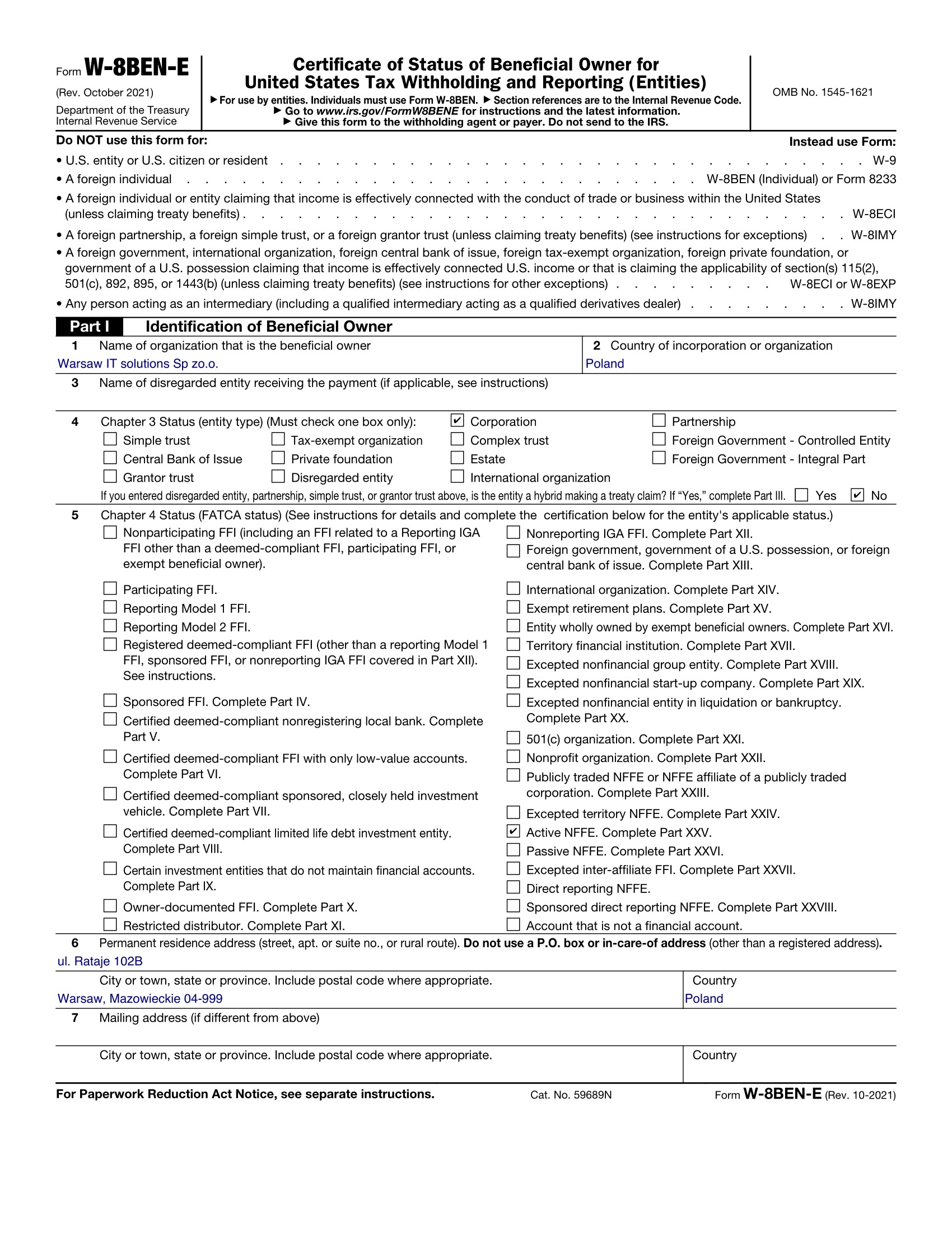
Illustration only—replace with your real data before signing or uploading to app stores.
FAQ
Do app studios need W-8BEN-E for the App Store?
Yes, when App Store Connect pays a foreign legal entity—not an individual developer—and requests US tax documentation. W-8BEN-E is the standard IRS certificate for foreign entities. Apple uses it to establish foreign status, apply treaty rates from Part III to US-sourced sales where applicable, and meet Chapter 4 reporting expectations. Solo indie devs on personal accounts typically use W-8BEN instead.
Is app store revenue royalties or business profits?
Often royalties because stores license your app or game to end users, which maps to treaty Article 12 in many analyses—but classification can vary. Some arrangements may look like business profits or services (Article 7) depending on contracts, store terms, and facts. Outcomes depend on your facts and how the store classifies your revenue; verify treaty positions against current IRS tables rather than assuming one label fits every title.
How does Apple apply treaty rates from W-8BEN-E?
When a valid W-8BEN-E is on file in App Store Connect, Apple generally applies treaty withholding rates you certify in Part III to US-sourced sales, subject to Apple’s tax processing rules and the income type claimed. Missing, inconsistent, or expired forms can leave US sales on default withholding. Your legal entity name and treaty claim must match what you certified on the signed PDF.
Does Google Play withhold US tax on my company's apps?
Google Play may withhold US tax on the US-sales portion of earnings when tax documentation is missing or does not support a reduced treaty rate. A valid W-8BEN-E with an appropriate Part III claim can document foreign entity status and treaty benefits where applicable. Withholding depends on classification, entity type, and whether your Play Console legal profile matches the certificate—this page does not guarantee a specific rate.
Can one W-8BEN-E cover App Store, Google Play, and Steam?
Generally yes—the form certifies the entity, not a single store. You can upload the same signed W-8BEN-E to App Store Connect, Play Console, Steamworks, and other marketplaces if the legal entity, address, classification, and treaty claims remain accurate for each payer. Refresh copies when facts change or when any store requests an updated certificate.
How long is the form valid in App Store Connect?
IRS rules generally treat a signed W-8BEN-E as valid until the last day of the third calendar year after signing unless a change in circumstances makes it incorrect earlier. App Store Connect may prompt for refresh independent of that window when legal name, treaty claims, or FATCA status changes. Submit a new form when your studio restructures or store profiles no longer match the certificate.
What treaty article applies to app royalties?
Royalties from app and game licensing often fall under the royalties article in your country’s income-tax treaty with the US—commonly Article 12—but the correct article depends on characterization and treaty text. Business-profits or services income may instead use Article 7. There is no single “App Store article.” Verify against current IRS treaty tables and match Part III to the income type you certify.
My studio is a single-member LLC — which form?
If the LLC is a foreign entity treated as a corporation or partnership for US withholding purposes and app stores pay the LLC in the entity name, W-8BEN-E is usually required. If you operate as an individual sole proprietor and stores pay you personally, W-8BEN is typically correct. US and local law treatment of single-member LLCs varies—consult a qualified tax adviser when App Store Connect, Play Console, and formation documents disagree on entity type.
Related links
Need the full W-8BEN-E overview without the app-store framing? Open our main entity landing for deeper context on Chapter 3, Chapter 4 (FATCA), and withholding mechanics.
Not running a company developer account? Use the individual W-8BEN path for solo app developers. Asset-marketplace creators also selling themes or templates may find our Envato W-8BEN page useful—the audiences overlap.
Fill your W-8BEN-E for app stores in minutes
Answer guided questions tailored to foreign studios and app companies, preview the output, then download a formatted W-8BEN-E you can sign and upload to App Store Connect, Play Console, Steam, or other marketplaces. Plain language, clear checkpoints, and a single $30 checkout for PDF generation.
Start Now ($30)