AdSense W-8BEN-E for Media Companies — $30, Guided PDF
This article was created with AI assistance and has not been reviewed by a human editor. It is provided for general informational purposes only and does not constitute tax, legal, or financial advice.
Google AdSense pays foreign publishers when display ads run on websites, blogs, and apps registered to a company—not a solo blogger billing in their own name. When the payee is a foreign legal entity, Google’s tax information section typically asks for IRS Form W-8BEN-E (Certificate of Status of Beneficial Owner for United States Tax Withholding and Reporting (Entity)).
That certificate tells Google who the entity is, where it is organized, and how US withholding and FATCA reporting should apply. It is also where you may claim a reduced treaty rate on the US-viewer portion of AdSense earnings when your facts support one.
This page is for media and publishing companies, blog networks, news portals, AdMob app publishers, and multi-site holding companies that searched AdSense W-8BEN-E, Google AdSense tax form company, media company AdSense tax, publisher W-8BEN-E, AdSense foreign company tax, or AdMob W-8BEN-E. It is not for solo bloggers (see our individual W-8BEN page) or YouTube channel entities (see our YouTube W-8BEN-E page).
You get a quick answer, the guided wizard near the top, withholding context without fake guarantees, common mistakes teams repeat, and an FAQ aligned with visible questions for schema.
Outcomes depend on your facts and viewer geography. Treaty rates can change—verify against current IRS treaty tables. For multi-entity or large structures, consult a qualified tax adviser.
 AI-generated image
Does an AdSense publisher company need W-8BEN-E?
Yes, in most cases where Google AdSense or AdMob pays a foreign company or other entity—not an individual blogger in their own name. Media companies, blog networks, and corporate AdSense accounts that receive payouts in a legal entity name generally complete W-8BEN-E so Google can document foreign status, Chapter 3 withholding positions where applicable, and Chapter 4 (FATCA) reporting categories.
Individual publishers and sole proprietors who operate as natural persons typically use Form W-8BEN instead. The split is about the legal layer receiving funds and listed on your Google Publisher tax profile—not how large the editorial team feels.
Google’s AdSense tax information section requests entity tax certification for foreign companies. If your payee profile, bank settlement, and formation documents all align to a non-US entity, treat AdSense W-8BEN-E as the default path unless a qualified professional tells you a different form applies to your facts.
- Website and blog AdSense accounts where disbursements go to a foreign corporation, partnership, or other entity name—not a personal publisher profile—usually file W-8BEN-E.
- AdMob app publishers receiving in-app ad revenue at company level when the Google payments profile lists a foreign legal entity should match the certificate type to that entity.
- Multi-site blog networks and content portals that consolidate ad revenue under one corporate payee typically certify once at the entity layer that receives Google Publisher payments.
- Google Publisher payments and the AdSense tax information workflow expect W-8BEN-E when the beneficial owner receiving display-ad earnings is a foreign organization, not an individual.
Generate Your W-8BEN-E for AdSense (Step-by-Step)
You do not need to memorize IRS instructions or guess which Chapter 4 (FATCA) checkbox applies to a publishing company. The W8GetEasy wizard asks plain-language questions, shows the sections that matter for your entity, and builds a formatted PDF you can review, sign, and upload in Google AdSense or AdMob tax settings.
The flow covers company details, country of formation, Chapter 3 classification, FATCA Chapter 4 status, treaty claims when relevant—including royalties-style positions when your facts support them—and signature. Form generation is a $30 one-time payment, including your downloadable PDF.
You remain responsible for accuracy: the wizard formats your answers, but your certifications must match formation documents, your Google Publisher payee profile, and how you actually earn ad revenue. Outcomes depend on your facts and viewer geography; treaty positions should be checked against current IRS treaty tables.
W-8BEN-E wizard (companies)
For an organization
For companies, funds, partnerships registered outside the USA.
Free to start. Payment is only required at the final step to download your completed PDF.
Loading...
What is the W-8BEN-E form for AdSense publisher companies?
Form W-8BEN-E is the IRS certificate foreign entities provide to US withholding agents and payers. It states who the beneficial owner is, where the entity is organized, and how it should be treated for Chapter 3 withholding on certain US-source payments.
It also includes Chapter 4 (FATCA) status so payers can meet information-reporting rules. Google acts as the US withholding agent for AdSense and AdMob: it must document whether recipients are US or foreign persons and what rate applies before money moves in covered situations.
For website and display AdSense revenue, much of the income is frequently analyzed as US-source royalties (Article 12) because you license ad space on your copyrighted content to Google. Treaty rates can reduce withholding on the US-viewer portion of earnings when your entity and income type qualify—but treaties are not automatic zero.
W-8BEN-E is not a business registration and not a substitute for local corporate tax filings. It is a withholding certificate that closes the loop between your Google Publisher profile, the PDF you upload, and how Google classifies payments. This page is guidance, not legal advice; use professionals when structures involve US subsidiaries, complex IP holding companies, or uncertain income characterization.
Who needs to submit W-8BEN-E for AdSense?
If AdSense or AdMob pays a foreign legal entity and Google’s tax workflow asks for an entity certificate, you are usually in W-8BEN-E territory. Typical profiles include:
- Media and publishing companies running content websites monetized through corporate AdSense accounts.
- Blog networks and content portals operated as entities that receive display-ad payouts in the company name.
- News sites and niche-site companies monetizing editorial properties via Google AdSense at entity level.
- App publishers using AdMob (Google’s in-app AdSense) when payments settle to a foreign company developer account.
- Holding companies consolidating multi-site ad revenue under one legal payee on Google Publisher records.
- Foreign entities (Sp. z o.o., GmbH, LTD, LLC, BV, SARL, etc.) with AdSense earnings paid to the company bank account.
Worked example: spinning off a site portfolio meant Google no longer recognized the payee
Northfield Media Holdings Ltd runs a group of UK content sites monetized through one consolidated Google AdSense account, with a valid W-8BEN-E on file claiming the UK treaty rate under Article 12(1) on royalty-style ad revenue. In 2025 the group spun off three of its lower-traffic sites into a new subsidiary, Northfield Regional Media Ltd, for liability and future-investment reasons — a routine corporate restructuring that didn't change ownership, control, or treaty facts.
Google's Publisher records don't automatically extend a parent's certificate to a newly separated legal entity. Once the subsidiary's sites were reassigned to their own payee profile, AdSense began withholding the standard 30% on those payouts, because no W-8BEN-E existed for Northfield Regional Media Ltd specifically — even though it was 100% owned by the same certified parent with an identical treaty position. Harriet Nolan, the group's finance director, caught it when the subsidiary's first quarterly payout came in well below the historical run rate for those sites.
- Parent company payouts: continued at the UK treaty rate — Northfield Media Holdings Ltd's existing W-8BEN-E was still valid and unaffected.
- Subsidiary payouts: withheld at the default 30% — Google had no certificate on file for Northfield Regional Media Ltd as a distinct legal entity.
A 0% US treaty rate doesn't mean the AdSense income disappears from your UK tax return
A valid W-8BEN-E claiming Article 12(1) typically reduces US withholding on the US-viewer share of AdSense royalty income to 0% for a UK company — but that only settles the US side. Northfield Media Holdings Ltd still has to include the same income in its worldwide profits on its Corporation Tax return filed with HMRC, the same as any other revenue stream.
Because the US rate under the treaty is already 0%, there is no US tax withheld to credit against UK Corporation Tax — the income is simply taxed in the UK at the normal rate, with double taxation relief (DTR) becoming relevant mainly for group entities in countries where the US rate is positive rather than zero.
- Report AdSense royalty income as part of worldwide profits on your Corporation Tax return, regardless of the US withholding rate that applied.
- Keep the dated W-8BEN-E and Google's withholding statements on file as evidence for HMRC if the treaty position is ever queried.
- If a subsidiary in your group later becomes liable for the standard 30% because no certificate is on file for it, that's a US withholding gap to fix — not a UK reporting question.
Does Google withhold tax on AdSense earnings for foreign companies?
US rules often describe a 30% statutory withholding rate on certain fixed, determinable, annual, or periodical (FDAP) US-source payments to foreign persons when a valid reduced rate is not documented. Google applies those concepts through its AdSense and AdMob compliance systems, withholding on the US-viewer share of ad revenue unless a valid W-8BEN-E supports a treaty rate you claim.
For display and website AdSense, teams often analyze royalty-style treaty articles because you license ad inventory on copyrighted content—similar to YouTube AdSense mechanics but for site-based display ads rather than video channels. Many treaties reduce royalty withholding to 0% (Spain, Japan, Netherlands) or 10% (Poland, Ukraine) for eligible entities; others allow partial relief or none at all.
What you actually see depends on payment classification, entity type, treaty position, viewer geography, and whether your payee profile matches the certificate. Two publishers in the same country can still see different treatment if their entity stories or treaty claims differ.
This site cannot promise a rate or outcome for your account. Outcomes depend on your facts and viewer geography. Treaty rates can change—verify against current IRS treaty tables. Treat withholding questions as fact-specific: align your W-8BEN-E with real operations, keep copies with signature dates, and involve a tax adviser when revenue mixes display ads, AdMob, affiliate, or pass-through flows.
- Default path without documented relief: expect conservative withholding on the US-viewer portion of AdSense revenue—often discussed as up to 30% when no valid treaty claim is on file.
- Royalties classification: website AdSense documentation often discusses royalty-style FDAP; your treaty article should match the income type you certify, not a generic services template.
- Treaty claims: reduced rates require truthful eligibility; citing the wrong article or mixing “business profits” and “royalties” narratives is a common reason certificates fail review.
- If Google prompts for refresh or additional verification, respond with updated forms when legal name, address, classification, treaty claims, or FATCA status changes.
How to fill out W-8BEN-E for AdSense
Use this sequence as a checklist before you upload to Google AdSense or AdMob tax settings. Finance and ops leads use it to keep the story consistent across the Publisher payee profile, bank KYC, and the PDF.
Confirm entity status on your AdSense account
Before you open the IRS PDF, verify that your Google AdSense or AdMob account is set up as a company payee—not a personal publisher profile. If contracts, invoices, and bank KYC all reference a foreign legal entity, W-8BEN-E is usually the right certificate. Solo bloggers billing in their own name on a personal account typically use W-8BEN instead. Mismatch between the Google Publisher payee type and form type is a top reason tax information uploads bounce or leave accounts on default withholding while teams reopen support tickets.
Legal name and country matching the AdSense payee profile
Enter the exact legal entity name, mailing address, and foreign tax identification numbers to match formation documents, your Google Publisher payments profile, and bank records. Select the jurisdiction where the entity was formed—this anchors treaty availability and confirms you are certifying as a foreign entity rather than a US domestic corporation. If you recently reorganized or rebranded sites under a new parent, align the form with the current payee Google expects—not an old shelf company story that no longer receives disbursements.
Chapter 3 entity classification
Choose the Chapter 3 status that reflects your formation documents—corporation, partnership, disregarded entity treated as owned by a foreign person, government, central bank, or another listed category. This selection drives which withholding rules apply and which treaty boxes are available. Picking a generic corporation box without matching your actual structure can invalidate the narrative Google’s systems expect when cross-checking AdSense tax information against uploaded certificates.
FATCA Chapter 4 status
Declare the FATCA category that reflects real operations—active NFFE, passive NFFE, participating FFI, exempt beneficial owner, or another appropriate path. Chapter 4 answers information-reporting questions; they must harmonize with Chapter 3 entity type. Contradictions between “active NFFE” and passive ad-revenue facts are a common manual-review trigger on Google Publisher accounts, especially when finance teams label everything as “media services” while the form tells a different FATCA story.
Treaty claim (royalties article for ad revenue)
If you qualify for reduced withholding, identify the treaty country, relevant articles—often Article 12 (royalties) when display AdSense revenue is characterized as licensing ad space on copyrighted content—income type, and claimed rate. If you are not claiming treaty benefits, certify that clearly instead of copying unrelated examples from forums. Include limitation-on-benefits (LOB) statements when the form requires them. Verify rates against current IRS treaty tables; outcomes depend on your facts and the US-viewer share of earnings.
Signature and upload to Google AdSense
An authorized officer signs under penalties of perjury, confirms capacity to bind the entity, and dates the form. Export a signed PDF and upload it in the tax information section Google exposes for AdSense or AdMob—wording moves over time, but the workflow is consistent: a certificate that matches your legal payee profile. Store the dated copy with your compliance records and refresh when legal name, address, classification, treaty claims, or FATCA status changes. Google may also prompt for refresh independent of the IRS validity window.
Common mistakes when filling W-8BEN-E for AdSense
These errors show up often because the form is long and Google dashboards compress complex tax ideas into short prompts. Fixing them early saves support loops and unexpected withholding on the US-viewer share.
- Using W-8BEN instead of W-8BEN-E when the AdSense account belongs to a company—wrong form type stalls verification because automated checks compare payee entity type to the certificate.
- Mismatched payee name between the W-8BEN-E and AdSense tax information profile or bank KYC—finance teams see this when publishers rebrand sites but forget to refresh tax forms.
- Claiming the wrong treaty article—citing Article 7 business profits for display ad revenue when your facts and Google’s characterization support Article 12 royalties, or the reverse.
- Missing treaty claim entirely, leaving Google to apply the 30% default on the US-viewer portion when your entity could have documented a reduced rate.
- Stale forms signed years ago while legal name, FATCA status, ownership, or payee structure changed—IRS validity rules and Google refresh prompts both matter.
- Confusing website AdSense with YouTube AdSense—they share Google’s publisher stack but use different account contexts; upload the certificate to the tax settings for the product that actually pays your entity.
Example of a completed W-8BEN-E for AdSense
The preview below shows a realistic first-page layout with sample data for a fictional non-US media company. Your generated AdSense W-8BEN-E PDF follows the same IRS structure but reflects your legal name, addresses, Chapter 3 and Chapter 4 selections, and any treaty language produced from your answers. Use it to brief executives who have never seen the form: it demonstrates field placement and certification density—then open the wizard when you are ready to answer for your real entity.
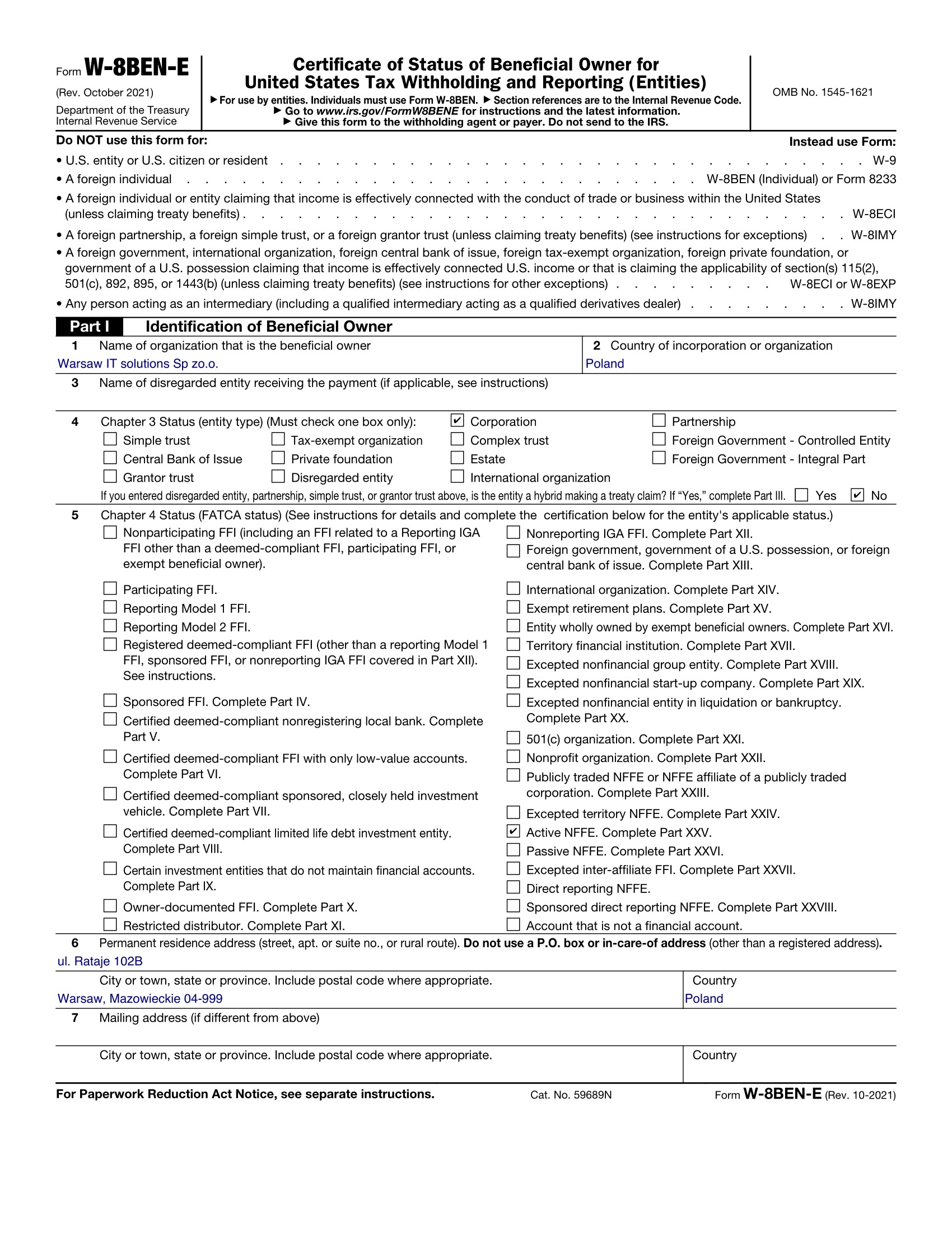
Illustration only—replace with your real data before signing or uploading to Google AdSense.
FAQ
Does an AdSense publisher company need W-8BEN-E?
Usually yes when Google AdSense or AdMob pays a foreign legal entity rather than an individual operating in their own name. Corporate publisher accounts that receive display-ad payouts in a company name typically need W-8BEN-E so Google can document entity status, Chapter 3 positions, and Chapter 4 (FATCA) categories. Compare your Google Publisher payee profile to formation documents—the certificate type should match the entity layer receiving payouts.
Is AdSense revenue royalties or business profits?
For website and display AdSense, teams often analyze royalty-style treatment (Article 12) because you license ad space on copyrighted content to Google—but classification depends on your facts, treaty text, and how Google characterizes the payment streams you receive. Outcomes depend on your facts and viewer geography; verify against current IRS treaty tables rather than forum anecdotes. Consult a qualified tax adviser when income mixes display ads, affiliate, subscriptions, or services.
How does Google apply treaty rates from W-8BEN-E?
Google reads the treaty country, articles, income type, and rate you certify on a valid W-8BEN-E and applies reduced withholding on the US-viewer portion of AdSense earnings when your documentation supports it. If the form is missing, inconsistent with your payee profile, or claims benefits you cannot support, Google may default to statutory withholding on amounts where rules require a certificate. Exact messages depend on account region and product surface.
Does Google withhold tax on my company’s AdSense earnings?
Google can withhold US tax on the US-viewer share of AdSense and AdMob revenue unless a valid W-8BEN-E supports a documented treaty rate. Without correct documentation, conservative withholding—often discussed as up to 30% on covered amounts—can apply. This page does not guarantee a specific rate for your account; outcomes depend on entity type, viewer geography, treaty position, and payment classification.
Is the W-8BEN-E the same for AdSense and YouTube?
The IRS form is the same, but account context differs. Website AdSense and YouTube AdSense use different Google Publisher surfaces even though both may analyze royalty-style income. Upload your signed W-8BEN-E to the tax settings for the product that pays your entity—do not assume one upload covers every Google monetization account without checking your dashboard.
How long is the form valid in AdSense tax info?
Generally, a signed W-8BEN-E remains valid until the last day of the third calendar year after signing unless a change in circumstances makes it incorrect earlier. Submit a new form when legal name, address, classification, treaty claims, or FATCA status changes. Google may also prompt for refresh independent of the IRS validity window.
What treaty article applies to AdSense ad revenue?
Many teams focus on Article 12 (royalties) for display and website AdSense when that matches Google’s payment characterization and their facts—but eligibility depends on entity type, treaty text, limitation-on-benefits rules, and whether you have a permanent establishment in the United States. Outcomes depend on your facts; verify against current IRS treaty tables rather than copying templates from other platforms.
We run multiple sites under one company — one form or many?
When one foreign legal entity is the payee on Google Publisher records and receives consolidated AdSense disbursements, you typically certify once at that entity level—not once per domain. If different legal entities own different site portfolios and Google pays them separately, each payee entity generally needs its own W-8BEN-E. For multi-entity or large structures, consult a qualified tax adviser.
Related links
Need the full W-8BEN-E overview without the AdSense framing? Open our main entity landing for deeper context on Chapter 3, Chapter 4 (FATCA), and withholding mechanics.
Not running a company publisher account? Use the individual W-8BEN path for solo bloggers. YouTube channel entities paid through Google may prefer our YouTube W-8BEN-E page. Our creator-economy blog post covers overlapping AdSense and YouTube tax topics in more depth.
Fill your W-8BEN-E for AdSense in minutes
Answer guided questions tailored to foreign media and publishing companies, preview the output, then download a formatted W-8BEN-E you can sign and upload to Google AdSense or AdMob. Plain language, clear checkpoints, and a single $30 checkout for PDF generation—built for publishers that need compliance shipped without turning finance into part-time tax counsel.
Start Now ($30)