W-8BEN-E for Stripe Accounts in the Netherlands: Fill It Online
This article was created with AI assistance and has not been reviewed by a human editor. It is provided for general informational purposes only and does not constitute tax, legal, or financial advice.
If your Dutch company uses Stripe to collect SaaS subscriptions, process software invoices, or manage investment-related payment flows, Stripe may ask for Form W-8BEN-E before your tax profile is fully documented as a foreign entity. For most teams in the Netherlands, this is an operational compliance step: you show non-US company status, clarify key tax fields, and reduce avoidable withholding friction.
This page is built for founders and finance teams searching Stripe W-8BEN-E Netherlands, w8ben e netherlands bv stripe, stripe tax netherlands company usa, w8ben e dutch company stripe, or stripe withholding tax netherlands. You can complete the form online, generate a ready-to-sign PDF, and upload with confidence.
Do Dutch companies need a W-8BEN-E for Stripe?
In most Stripe company-account cases, yes. If payouts are made to a Dutch legal entity such as a BV or holding company, Stripe usually expects Form W-8BEN-E instead of the individual W-8BEN. The goal is to certify that the beneficial owner is a non-US entity and give Stripe structured data for US tax workflow checks.
Think of W-8BEN-E as your company-level tax identity file for US-facing platform payments. It tells Stripe who receives the income, where the company is incorporated, which FATCA category may apply, and whether treaty benefits are being claimed.
Without a complete and consistent submission, Stripe may continue requesting tax details or apply conservative handling for covered payment categories until your documentation is clear.
- Dutch BV and holding structures on Stripe typically need W-8BEN-E as the entity certificate.
- The form supports non-US status confirmation and withholding logic based on documented facts.
- Submitting accurate details early helps reduce repeated compliance follow-ups as revenue grows.
Generate Your W-8BEN-E for Stripe (Netherlands)
Use our guided flow to complete your Stripe W-8BEN-E Netherlands form without translating IRS language on your own. You answer practical questions, follow a structured sequence, and instantly receive a ready-to-sign PDF.
No tax-specialist background is required. The process covers the sections most Dutch Stripe users need, including entity details, country, FATCA classification, treaty fields if applicable, and signature.
One-time $30 payment. Instant PDF output.
W-8BEN-E wizard (companies)
For an organization
For companies, funds, partnerships registered outside the USA.
Free to start. Payment is only required at the final step to download your completed PDF.
Loading...
How US tax applies to Dutch companies using Stripe
Stripe is primarily a payment processor, but for tax documentation it also acts as a compliance checkpoint. When payment flows can involve US-source withholding rules, Stripe needs reliable information about the receiving entity. W-8BEN-E is the standard IRS form foreign companies use to provide that information.
This does not mean Stripe determines your full global tax position. Instead, Stripe needs enough standardized data to apply account-level withholding and reporting workflows correctly where relevant. For a Dutch company, that often starts with confirming non-US status and, when appropriate, adding treaty-related claims under the US-Netherlands tax treaty.
Treaty claims can reduce withholding in some circumstances, but outcomes are never automatic. They depend on legal facts, income characterization, contract structure, and how payments are routed and labeled in platform systems. The same headline business model can still produce different treatment when underlying payment facts differ.
A practical framework is to separate three layers: what your company contractually provides, how Stripe records the payment flow, and how that flow may be categorized for withholding purposes. These layers often align, but not always perfectly.
For Dutch businesses, this matters in mixed revenue models where services, software access, licensing components, and marketplace activity can overlap. Use this page as practical guidance, not as a guaranteed outcome document or a replacement for professional advice on complex cases.
W-8BEN-E for Dutch BV and holding companies using Stripe
In the Netherlands, the BV is the most common legal structure for operating companies using Stripe. Holding structures are also common, especially where founders separate operating activity, IP ownership, and investment participation. That combination creates real-world complexity for tax documentation, even when day-to-day payments feel straightforward.
For Stripe workflows, what matters first is which legal entity is the beneficial owner of the income. If the operating BV receives subscription and client payments directly, that company usually completes W-8BEN-E with its own facts. If a holding company is involved in income flows, classification and treaty fields may require extra care so documentation matches economic reality.
This is especially relevant for SaaS + holding combinations. A Dutch group may invoice through an operating BV, own software rights in a holding layer, and receive mixed payment types from US customers. Even when all entities are Dutch, Stripe still needs one coherent certificate path for the entity receiving each payout stream.
Investment-led cases also appear frequently: portfolio entities, management fee structures, or special-purpose companies can use Stripe in limited but meaningful ways. In those scenarios, assuming "we are Dutch, so one default setting works" is risky. Entity role, activity profile, and payment nature should drive the form choices.
For many active operating BVs, Active NFFE can be a common FATCA status, but it is not universal. Holding-heavy or passive-income profiles may require different treatment. The key is consistency between legal structure, payment reality, and what the form certifies. That consistency is often more important than speed when high-value Stripe accounts are involved.
Who this applies to in the Netherlands
This Netherlands Stripe W-8BEN-E guide is designed for non-US entities receiving Stripe payouts under Dutch company structures, especially where cross-border and recurring revenue are central to the business model.
- Dutch BV companies processing client or subscription payments in Stripe.
- Holding companies involved in ownership, IP, or centralized revenue structures.
- SaaS startups charging US users via subscriptions, usage billing, or annual plans.
- Agencies and digital service firms invoicing US clients through Stripe.
- Subscription and recurring-revenue businesses that need predictable compliance operations.
Why Stripe asks for W-8BEN-E
Stripe asks for W-8BEN-E as part of US tax compliance for non-US entities in relevant payment contexts. The request is not random paperwork; it is a structured requirement so platform systems can apply withholding and reporting logic based on certified entity data instead of assumptions.
When Stripe classifies an account as foreign, it still needs a recognized certificate that captures identity, classification, and treaty-claim details in one consistent format. W-8BEN-E is that format for company entities.
Without valid documentation, platforms often use conservative defaults because undocumented tax positions carry risk. For a Dutch finance team, that can create uncertainty in payout planning, internal reporting, and reconciliation.
The form also helps internal governance. Founders, accounting teams, and advisors can reference one signed record rather than fragmented assumptions. This becomes more important as your Stripe volume grows, legal structures evolve, or signer roles change.
Stripe and the IRS do different jobs. IRS rules define the legal framework. Stripe applies platform-side compliance processes in real operational systems. A complete W-8BEN-E helps keep those layers aligned and reduces avoidable friction.
How to fill W-8BEN-E as a Dutch company using Stripe
Use this practical sequence before upload. Keep your KvK details, legal entity records, and signer authorization ready so each form field matches your Stripe profile and corporate documents in one clean pass.
1) Enter legal entity name and country details exactly
Use the full registered company name that appears in KvK records and in your Stripe account. Set country of incorporation to Netherlands. Avoid shortcuts, brand-only names, or entity-name variants that do not match official records.
2) Confirm the beneficial owner entity for Stripe payouts
In BV + holding structures, verify which legal entity actually receives the Stripe income. The entity that receives the income should provide coherent form data. Mismatching operating and holding information is a common reason for review delays.
3) Choose FATCA classification (Active NFFE is common, not automatic)
Many active Dutch operating companies fit Active NFFE, especially SaaS and service businesses with active revenue. But this is not a default for every case. If activity is mainly passive or investment-focused, another status may be more accurate.
4) Complete treaty claim fields carefully when claiming benefits
If you claim treaty benefits, fill treaty country, article, paragraph, and income type consistently with your payment reality. If you do not claim treaty benefits, make that explicit so the form stays internally consistent and easier for platform review.
5) Verify signature authority and finalize PDF
The signer should be authorized to certify on behalf of the Dutch entity. Check title, date, and declaration details before finalizing. Keep a signed copy for internal controls and future recertification or account updates.
Common mistakes Dutch Stripe users make
Most Stripe W-8BEN-E problems in the Netherlands come from structure confusion and inconsistent assumptions, not from difficult calculations. These issues are especially common in high-growth SaaS and holding-led groups:
- Mixing up operating BV and holding company roles when deciding which entity should certify beneficial ownership.
- Using broad income labels that do not reflect how Stripe payments are actually categorized in contracts and systems.
- Assuming treaty outcomes are automatic for all payouts instead of fact-dependent and claim-specific.
- Treating Stripe and IRS as the same authority instead of separate layers that both need consistent documentation.
Example of a completed W-8BEN-E (Netherlands)
The preview below shows what a completed W-8BEN-E layout can look like for a Dutch company using Stripe. It helps your team understand field order and section flow before preparing your own signed version. Use it as a practical visual checklist for company details, classification areas, treaty fields when relevant, and signer declaration. Then generate your own PDF with real entity data in the wizard.
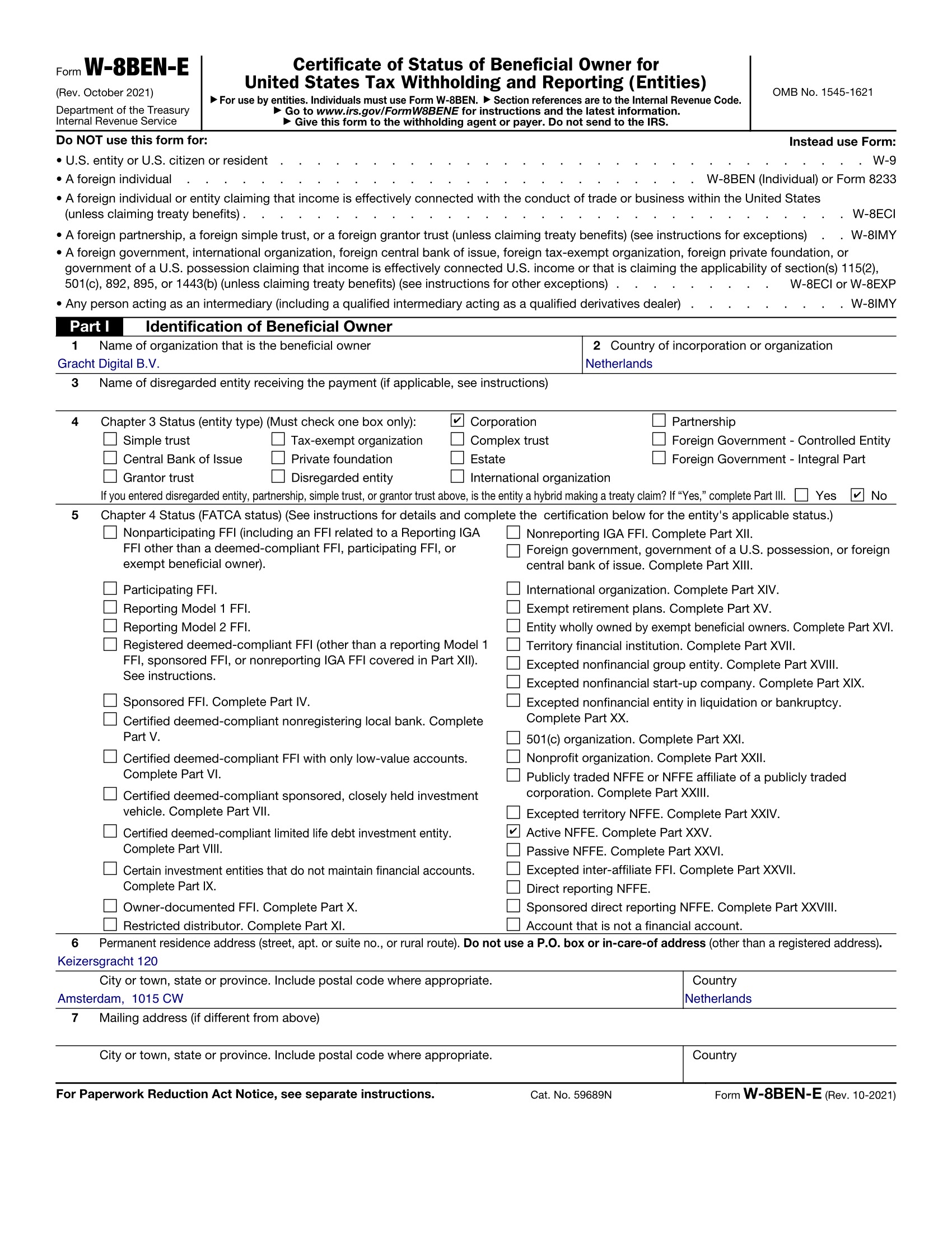
Example only. Always use real company details before signing.
FAQ for Dutch Stripe users
Do Dutch companies pay US tax via Stripe?
Stripe is not your full annual tax filing. The immediate issue is usually withholding treatment on certain US-source payment categories when documentation is missing or inconsistent. Broader tax obligations depend on your specific legal and commercial facts.
Does Stripe withhold tax?
Not on your B.V.'s own sales: card payments Stripe settles for you are your revenue from customers, not US-source income paid by Stripe. The W-8BEN-E matters when a US platform pays the B.V. through Stripe Connect and collects the form in Stripe's onboarding. Note the Dutch numbering: copyright royalties are Article 13 of the US–Netherlands treaty (0% under Article 13(1); motion pictures and radio/TV works are business profits under Article 7(1), 0% at source without a US permanent establishment, not Article 13), and the limitation-on-benefits test is Article 26.
Do holding companies need W-8BEN-E?
If a Dutch holding entity is the beneficial owner receiving Stripe-related income, W-8BEN-E is usually the relevant company form. The key is identifying the correct legal entity and ensuring documentation aligns with real payment flows.
How does this relate to Dutch taxes?
W-8BEN-E is a US payer-side documentation form, not a Dutch domestic tax return. Dutch corporate tax, VAT, and other local obligations remain separate and continue under Dutch rules.
Related Stripe and form resources
Need broader guidance beyond this Netherlands-specific page?
Fill your W-8BEN-E for Stripe in the Netherlands
Complete your entity certificate with a guided flow, download a ready-to-sign PDF, and submit to Stripe with confidence. Built for Dutch BV and holding-company teams that want practical compliance steps in plain language.
Start Now ($30)