W-8BEN-E for Stripe Accounts in Germany: Fill It Online
This article was created with AI assistance and has not been reviewed by a human editor. It is provided for general informational purposes only and does not constitute tax, legal, or financial advice.
If your German company uses Stripe to bill US clients, run SaaS subscriptions, collect agency retainers, or process B2B card payments, Stripe may request IRS Form W-8BEN-E before your tax profile is treated as fully documented for foreign-entity purposes. For most teams this is not about legal theory. It is an operational compliance step that confirms non-US status, aligns your account with US withholding rules, and reduces avoidable friction when volumes increase.
This page is built for GmbH and UG companies that searched stripe w8ben e germany, w8ben e stripe gmbh, stripe tax germany company usa, w8ben e german company stripe, or stripe withholding tax germany and want practical guidance in plain language. You get a step-by-step flow, a guided wizard, and a ready-to-sign PDF output.
Do German companies need a W-8BEN-E for Stripe?
In most cases, yes. If Stripe pays a German legal entity, the expected IRS certificate is usually W-8BEN-E, not the individual W-8BEN. Stripe needs this entity form to document that the beneficial owner is a non-US company and to apply withholding and reporting logic based on documented facts rather than undocumented defaults.
Think of it as your company tax identity certificate for US-facing platform payments. It tells Stripe who receives the funds, where the company is organized, which FATCA category applies, and whether treaty benefits are being claimed.
Without a valid and coherent submission, Stripe may continue requesting tax data, keep conservative handling on covered payment types, or leave your account in an incomplete compliance state. Submitting an accurate W-8BEN-E early often saves far more time than fixing avoidable inconsistencies later.
- For company-owned Stripe accounts in Germany, W-8BEN-E is typically the form Stripe expects for entity tax documentation.
- The form supports foreign-status certification and provides the basis for withholding treatment where US-source rules apply.
- Incomplete or inconsistent entries can trigger repeated review loops and delayed compliance clearance in platform workflows.
Generate Your W-8BEN-E for Stripe (Germany)
Use our guided wizard to complete W-8BEN-E without decoding IRS instructions line by line. You answer practical questions, follow a structured sequence, and receive a formatted PDF ready for signature and upload.
No specialist tax background is required to start. The flow covers the sections Stripe users most often need: legal entity details, country of incorporation, FATCA status, treaty fields if applicable, and signer declaration.
Price is a one-time $30 payment with instant PDF generation.
W-8BEN-E wizard (companies)
For an organization
For companies, funds, partnerships registered outside the USA.
Free to start. Payment is only required at the final step to download your completed PDF.
Loading...
How US tax applies to German companies using Stripe
Stripe is primarily a payment processor, but in tax-documentation terms it is also a compliance checkpoint. When US-source payment rules can apply, Stripe needs reliable tax status data for the receiving entity before applying reduced treatment. W-8BEN-E is the standard IRS certificate that provides this documentation for foreign entities.
A useful way to frame this: Stripe does not define your entire global tax position, but it must classify your account correctly for US withholding and reporting workflows. For a German company, that often means documenting non-US status and, where relevant, a treaty claim under the US-Germany treaty.
Treaty benefits may reduce withholding in some categories when eligibility conditions are met and properly certified. That does not mean every Stripe payout automatically receives a reduced rate. Outcomes can differ by income characterization, contract structure, and how payment streams are recorded in platform systems.
Services, software subscriptions, licensing-style payments, and mixed settlements can be analyzed differently. Two German companies with similar revenue can still see different treatment if their legal facts, treaty eligibility, or payment labeling differs.
It helps to separate three layers in practice: (1) what your company contractually provides, (2) how Stripe routes and labels the payment, and (3) how that payment may be categorized for withholding purposes. Those layers often overlap but are not always identical.
This page provides educational guidance for operational clarity. It does not guarantee tax outcomes and should not replace professional advice for complex structures.
W-8BEN-E for GmbH and UG companies using Stripe
Most German businesses using Stripe are organized as either a GmbH or a UG (haftungsbeschraenkt), especially in SaaS, digital services, agencies, and early-stage B2B products. From Stripe's perspective, both are company entities that generally require W-8BEN-E when payouts and account ownership are in the corporate name.
A common source of confusion is language overlap. Because German legal terms describe limited liability structures, founders sometimes assume any "limited" company maps to a single US checkbox. In reality, W-8BEN-E classifications follow US tax form logic, not informal naming similarities. Your chapter selections must reflect factual entity status, not translation shortcuts.
For many operating businesses, FATCA status may be Active NFFE, but this is not automatic for every GmbH or UG. If the company has a more passive profile, holding activities, or unusual income composition, another classification may be more accurate. Selecting a category because "it is common" without verifying real facts can create downstream inconsistencies.
GmbH and UG teams using Stripe for subscriptions often also manage invoicing, VAT, and revenue recognition in separate systems. W-8BEN-E adds a US documentation layer on top of that stack. The most reliable approach is consistency: legal name, registered address, signer authority, and treaty statements should match what Stripe and your official records already show.
For agencies, the risk point is often income type description. Service retainers, performance fees, license components, and bundled offers may be represented differently in contracts and in platform reporting. For SaaS companies, recurring software revenue can still require careful description where treaty claims are involved.
In short, GmbH and UG businesses are not edge cases here; they are the core profile this page is designed for. Correct classification and coherent certification are usually more important than speed-clicking through the form.
Who this applies to in Germany
This Germany-focused Stripe W-8BEN-E guide is intended for non-US companies receiving or planning to receive Stripe payouts in an entity name:
- GmbH businesses processing client or subscription payments through Stripe.
- UG (haftungsbeschraenkt) companies using Stripe for growth-stage B2B operations.
- SaaS companies charging monthly or annual plans to US customers.
- Digital agencies billing US clients via Stripe checkout or invoices.
- Startups incorporated in Germany that rely on Stripe from day one.
- Subscription and recurring-revenue businesses scaling cross-border payments.
Why Stripe asks for W-8BEN-E
Stripe asks for W-8BEN-E to meet US tax compliance obligations tied to account documentation. The request is not random administration. It is part of Stripe's responsibility to verify payee status before relying on withholding and reporting positions for covered payment flows.
When an account is marked as a foreign entity, Stripe still needs a standardized certificate it can store and reference during compliance checks. W-8BEN-E provides that structure. It captures entity identity, chapter classifications, and treaty statements in a format that payment and risk systems can process consistently.
Without a valid entity certificate, platforms often default to conservative handling because they cannot rely on undocumented claims. That can create uncertainty for finance teams trying to forecast payout behavior or explain differences in net receipts over time.
The form also protects internal governance. If your accounting team, founders, and external advisers all review the same signed certificate, it is easier to maintain one coherent tax-documentation story as the company grows. This matters when legal entities change, officers rotate, or international revenue expands.
Another practical reason is scalability. Stripe runs global systems, so documentation workflows must be standardized across thousands of entities and jurisdictions. W-8BEN-E is one of the standard mechanisms that lets a foreign company fit into that system without case-by-case manual interpretation.
Stripe does not replace the IRS, and IRS rules do not eliminate Stripe's workflow requirements. The two layers interact. Submitting a complete and accurate W-8BEN-E helps those layers stay aligned and reduces avoidable operational friction.
How to fill W-8BEN-E as a German company using Stripe
Use this sequence as a practical checklist before upload. Keep your Handelsregister details, company address records, and signer authorization information available while you complete the flow so each section matches your live Stripe profile in one pass.
1) Enter your legal company name exactly
Use the full legal name shown in registration documents and in your Stripe business profile. Do not replace the legal entity with a brand name unless that is formally how the account is registered. Small naming mismatches are a frequent cause of review delays.
2) Set country of incorporation to Germany
Choose Germany as the jurisdiction where the entity is organized. This anchors foreign status and treaty context. If your group has multiple entities, confirm which one is the beneficial owner receiving Stripe payouts before certification.
3) Choose FATCA status (Active NFFE is common for operating firms)
Many active operating companies use Active NFFE, but not all structures qualify. If your company has predominantly passive income or a holding profile, another FATCA category may be appropriate. Select based on actual business activity and ownership facts.
4) Complete treaty claim fields only when applicable
If you claim treaty benefits, provide treaty country, relevant article and paragraph, income type, and any required LOB wording. If you are not claiming treaty benefits, make that explicit so the form remains internally consistent and reviewable.
5) Verify signer authority and sign
The signatory should be authorized to certify on behalf of the company. Confirm title, date, and signature details before finalizing the PDF. Keep a copy for internal records and future re-certification cycles.
Common mistakes German Stripe users make
Most problems come from inconsistent assumptions, not from difficult technical rules. These issues appear repeatedly in real Stripe onboarding and maintenance flows:
- Selecting the wrong entity classification because the legal form label sounded similar, without confirming how the W-8BEN-E category should be mapped.
- Assuming Stripe and IRS have the same role. Stripe implements platform compliance workflows; IRS defines broader tax rules. Your submission must satisfy both contexts appropriately.
- Using a generic income label that does not match how payments are actually structured and reported in Stripe.
- Treating treaty outcomes as automatic for all payments instead of claim-specific and fact-dependent.
Example of a completed W-8BEN-E (Germany)
The preview below shows how a completed W-8BEN-E layout can look for a German non-US company. It helps teams understand field order and structure before preparing their own signed version. Use it as a visual checklist for entity details, classification sections, treaty area, and signature block. Then generate your own PDF in the wizard with your real company facts.
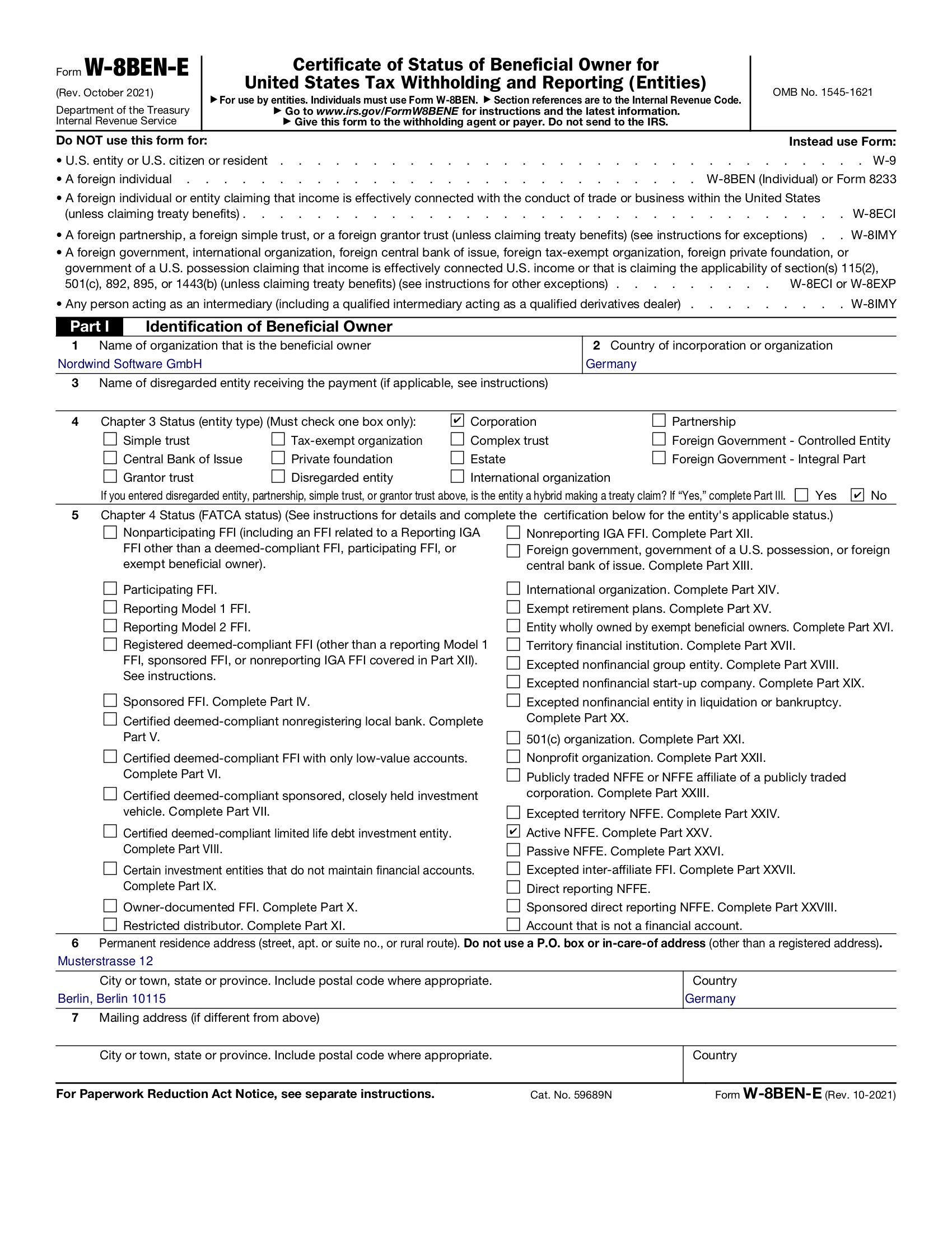
Example only. Always use real company details before signing.
FAQ for German Stripe users
Do German companies pay US tax via Stripe?
Stripe is not your full annual tax return. The immediate issue is usually withholding handling on specific US-source payment categories when documentation is incomplete or inconsistent. Broader tax obligations depend on your company facts and structure.
Does Stripe withhold tax?
Not on your GmbH's own sales: card payments Stripe settles for you are your revenue from customers, not US-source income paid by Stripe. A W-8BEN-E comes up when a US platform pays the GmbH through Stripe Connect — the platform collects it in Stripe's onboarding to decide on 1099 reporting. If that platform pays royalties, the US–Germany treaty (Article 12) sets 0%, provided the GmbH meets the limitation-on-benefits test in Article 28 and Article 28(5) does not apply. When Article 28(5) applies, the royalty is capped at 15% of the gross amount, not at 0%.
Do I need W-8BEN-E?
If Stripe payouts go to your German company rather than to you personally, W-8BEN-E is usually the required entity form. It certifies foreign status and supports correct withholding and reporting workflow alignment.
How is this related to German taxes?
W-8BEN-E is not a German domestic tax form. It addresses US payer documentation requirements. German tax obligations such as corporate tax and VAT remain separate and continue under German rules.
Related Stripe and form resources
Need broader guidance beyond the Germany-specific page?
Fill your W-8BEN-E for Stripe in Germany
Complete your entity certificate with a guided flow, generate a ready-to-sign PDF, and upload to Stripe with confidence. Built for German GmbH and UG teams who need practical compliance steps without unnecessary jargon.
Start Now ($30)