W-8BEN-E for a Singapore Company: Pte Ltd, Public Ltd, or Sole Proprietorship — No US Tax Treaty, Line-by-Line, and a Sample PDF
This article was created with AI assistance and has not been reviewed by a human editor. It is provided for general informational purposes only and does not constitute tax, legal, or financial advice.
Verified against the IRS "United States Income Tax Treaties - A to Z" list (last checked September 2026): the United States and Singapore have no comprehensive income tax treaty in force. The only bilateral tax agreement between the two countries covers shipping and aircraft income and does not apply to ordinary business, freelance, or investment income. Every withholding figure on this page reflects ordinary US statutory rules, not a treaty.
 AI-generated image
If a US company, marketplace, or broker has asked your Singapore Pte Ltd for a completed Form W-8BEN-E, the form itself looks the same as the one an Irish or Canadian company would fill out — but one section works completely differently for you: Part III (Lines 14–15), the treaty benefits claim, stays blank. Singapore does not have a tax treaty with the United States, so there is no treaty article to name and no reduced withholding rate to claim.
This guide walks through the form the way it actually applies to a Singapore entity: which box to check for a Private Limited Company versus a Public Limited Company versus a sole proprietorship, why Part III is left empty, what real difference that makes to your withholding, and what your Unique Entity Number (UEN) does and does not do on this form. A full sample PDF is included further down.
If you are an individual — a freelancer or sole proprietor operating under your own name or a registered business name with ACRA — you almost certainly need Form W-8BEN, not this one, even if ACRA has issued your sole proprietorship its own UEN: start the W-8BEN wizard. This page is for incorporated companies (Pte Ltd, Public Ltd) and other separate entities.
If you prefer to skip the reading, you can start the W-8BEN-E wizard now — it already knows there is no US-Singapore treaty and, by default, leaves Part III (Lines 14–15) blank. In a few minutes you have a signature-ready PDF for $30.
Blank form or already filled in?
You can download the official, blank form from the IRS and complete it yourself — or get the same file already filled in correctly by our wizard in a few minutes.
- Blank official W-8BEN-E (IRS, free): Download W-8BEN-E as a PDF directly from the IRS — for Pte Ltd and Public Ltd companies.
- Blank official W-8BEN (IRS, free): Download W-8BEN as a PDF directly from the IRS — for sole proprietors and freelancers.
- Already filled in (5–10 minutes): W-8BEN-E for Singapore companies ($30) or W-8BEN for sole proprietors ($5) — the wizard already knows there is no US-Singapore treaty and, by default, leaves Part III (Lines 14–15) blank.
- IRS treaty list: United States Income Tax Treaties - A to Z — Singapore does not appear on this list.
Which Singapore business type are you actually dealing with?
ACRA (the Accounting and Corporate Regulatory Authority) registers several different business structures, and only some of them are separate legal entities for US tax purposes:
- Private Limited Company (Pte Ltd): The most common structure for Singapore SMEs and agencies. Not on the IRS per-se corporation list, but defaults to Corporation classification for US tax purposes because its shareholders have limited liability under the Singapore Companies Act (Cap. 50). It can instead elect partnership or disregarded-entity treatment by filing Form 8832, though almost none do.
- Public Limited Company (Ltd): Typically an SGX-listed or larger company. This IS on the IRS per-se corporation list ("Singapore, Public Limited Company") — always a Corporation for US tax purposes, with no election available.
- Sole proprietorship: Registered with ACRA and issued its own UEN, but it is NOT a separate legal entity — legally, it is just you. The individual owner files Form W-8BEN, not W-8BEN-E, regardless of the UEN.
- Limited Liability Partnership (LLP): A separate legal entity under the Singapore LLP Act. Every partner has limited liability, and an LLP is not on the IRS per-se corporation list, so Treas. Reg. 301.7701-3(b)(2) defaults it to Corporation — check box "Corporation" in Part I, line 4, not "Partnership." Partnership or disregarded-entity treatment requires an affirmative Form 8832 election.
- General or limited partnership: A general partnership (unlimited liability) or limited partnership is typically taxed as a partnership — check box "Partnership" in Part I, line 4, not "Corporation." Do not treat a Singapore LLP as this category just because the name contains "Partnership."
The trap worth calling out explicitly: a UEN alone does not tell you which box to check. ACRA issues a UEN to a sole proprietorship exactly the same way it issues one to a Pte Ltd — the presence of a UEN is not evidence of a separate legal entity. Many freelancers register a sole proprietorship purely to invoice under a business name or register for GST, then assume that registration created a "company." It did not. Check your entity type directly on your ACRA BizFile profile: it will say "Sole Proprietorship," "Private Company Limited by Shares," "Public Company Limited by Shares," or "Limited Liability Partnership" in plain language.
Because there is no US-Singapore tax treaty, this distinction matters less than it would for, say, a UK or Irish company claiming a reduced treaty rate — but it still determines which form you file (W-8BEN vs. W-8BEN-E) and how Chapter 4 (FATCA) status is reported.
Who actually needs to submit this form?
In short, any Singapore Pte Ltd or Public Ltd that receives payments from a US business and wants to document that it is not a US person. Common situations:
- Invoicing US clients directly: Your Pte Ltd or Public Ltd bills a US company, marketplace, or platform for consulting, SaaS, referral, or affiliate payouts.
- US payment platforms: Payouts from Stripe, Amazon, YouTube/AdSense, or similar US-headquartered platforms.
- US brokerage or investment accounts: A US-based broker that serves Singapore residents (for example Interactive Brokers or Charles Schwab International) typically requires a valid W-8 before it will treat the account as a foreign entity.
- Interest or royalties from a US source: Without a treaty, the statutory 30% rate still applies to genuine US-source interest and royalties — the form documents foreign status, it does not reduce that rate (see the rates section below).
What actually happens without a valid form — and why Singapore is a special case
Without a submitted W-8BEN-E, the US payer generally withholds 30% of the gross payment under the Chapter 3 nonresident-alien presumption rules — not because it treats you as a US person. For a Singapore entity that does not change the next point: having the form on file does not unlock a reduced treaty rate, because there is no treaty.
For income that is genuinely foreign-source — the common case of a Singapore Pte Ltd invoicing a US client for consulting or software services performed from Singapore — US withholding tax does not apply at all, with or without a treaty, because the source-of-income rules look at where the work was performed, not where the payer is based. A W-8BEN-E in this case mainly documents your foreign status and Chapter 4 (FATCA) classification so the payer does not withhold by mistake. For genuinely US-source income — dividends on US stock, interest on most US-issued instruments, royalties on US-registered IP — the statutory 30% withholding rate applies in full, because there is no treaty to reduce it. One extra point specific to brokerage accounts: without ANY valid W-8 on file, a US broker applies backup withholding at 24% on the entire gross proceeds of a securities sale — not just the dividend or interest — which can be far more painful than the standard 30% NRA rate on dividends alone. Keeping the form current avoids this even though it cannot get you a reduced treaty rate.
Form W-8BEN-E, line by line, for a Singapore Pte Ltd or Public Ltd
The line numbers below match the current form (Rev. October 2021) for the standard case: an operating Pte Ltd or Public Ltd, Active NFFE, with no treaty-benefits claim (because no treaty exists). Holding structures and financial institutions follow different rules on some lines — our wizard identifies that from your answers.
| Line | What you enter |
|---|---|
| Line 1 | Your entity's legal name exactly as it appears on your ACRA Certificate of Incorporation / BizFile profile (e.g., "Merlion Pte Ltd"). |
| Line 2 | Country of incorporation: Singapore. |
| Line 3 | Leave blank unless you are a single-shareholder Pte Ltd that has filed Form 8832 to elect disregarded status (uncommon). |
| Line 4 | "Corporation" for a Pte Ltd (default), a Public Ltd (always), and a Singapore LLP (default under Treas. Reg. 301.7701-3(b)(2) because every partner has limited liability). "Partnership" only for a general or limited partnership, or for an LLP that has filed Form 8832. Never check "Corporation" for a sole proprietorship — that entity type files Form W-8BEN, not this form. The hybrid-entity follow-up is usually "No" for an ordinary Pte Ltd or Public Ltd. |
| Line 5 | Chapter 4 (FATCA) status — almost always "Active NFFE" for an ordinary trading or services company. Consult an accountant if your entity primarily holds investments. |
| Line 6 | Your registered office address exactly as on ACRA BizFile — not a virtual mailbox or nominee address if a physical registered office exists. |
| Line 7 | Leave blank if it matches line 6. |
| Line 8 | Leave blank unless your entity has actually applied for and received a US EIN (uncommon for a services company with no US presence). |
| Line 9a | Leave blank unless your entity is itself a Foreign Financial Institution. |
| Line 9b | Your entity's UEN (Unique Entity Number) — 10 characters, e.g. "202312345A." This is a different number and format from an individual's NRIC or FIN — see the dedicated note below. |
| Line 9c | In practice this is never checked for a registered Pte Ltd or Public Ltd — ACRA already issued the UEN at registration. |
| Line 10 | Leave blank unless the withholding agent specifically asked for one. |
| Part II (Lines 11-13) | Not completed for an ordinary Pte Ltd or Public Ltd — this section is only for a disregarded entity or a branch receiving the payment. |
| Line 14a | LEAVE BLANK. There is no US-Singapore tax treaty, so there is no treaty country to cite. |
| Line 14b | LEAVE BLANK. Without a treaty there is no Limitation on Benefits test to certify. |
| Line 15 | LEAVE BLANK. There is no article, paragraph, or reduced rate to cite. Do not let a template invent an article number. |
| Line 39 (Part XXV) | Check the "Active NFFE" certification, matching Line 5. |
| Part XXX | Signed by a director or authorized signatory, with their capacity stated (e.g., "Director"). |
This reflects the Rev. October 2021 revision of Form W-8BEN-E. Always cross-check against the current version linked above before submitting.
Every field in the table above is filled in automatically by our guided W-8BEN-E wizard based on your answers — including the correct decision to leave Part III (Lines 14–15) blank.
The UEN trap: why a business registration number is not proof of a separate entity
This is the single most common Singapore-specific mistake on this form — ACRA issues a UEN to almost every registered business, including sole proprietorships.
| Point | What it means |
|---|---|
| Why this comes up | ACRA assigns a UEN to every registered business in Singapore, including sole proprietorships, exactly as it does for Pte Ltd and Public Ltd companies. A UEN by itself does not indicate a separate legal entity. |
| What it means in practice | A sole proprietor with a UEN and a registered business name is still, legally, an individual. They complete Form W-8BEN using their personal NRIC or FIN as the foreign TIN — never the UEN. |
| How to check your own status | Look up your entity on ACRA BizFile: it will state the entity type directly as "Sole Proprietorship," "Private Company Limited by Shares," "Public Company Limited by Shares," or "Limited Liability Partnership." |
| The election angle | A Pte Ltd or a Singapore LLP can change its default Corporation classification via Form 8832. A sole proprietorship cannot make this election at all — there is no entity to reclassify in the first place. |
| UEN vs NRIC vs FIN on Line 9b | UEN is a 10-character entity number (registration year + 5 digits + a check letter), e.g. 202312345A. NRIC is a 9-character number for Singapore citizens and permanent residents. FIN is a 9-character number for foreign residents. Only the UEN goes on Form W-8BEN-E; NRIC/FIN go on the individual Form W-8BEN. |
Confirm the UEN on your ACRA BizFile profile before filling Line 9b — it should be 10 characters, not the 9-character NRIC or FIN of a director.
Sample: completed W-8BEN-E for a Singapore Pte Ltd
A filled example for a fictional Singapore Private Limited Company with no US permanent establishment, Active NFFE status, and Part III correctly left blank because no treaty exists. This is the same signature-ready PDF our wizard produces from the same inputs.
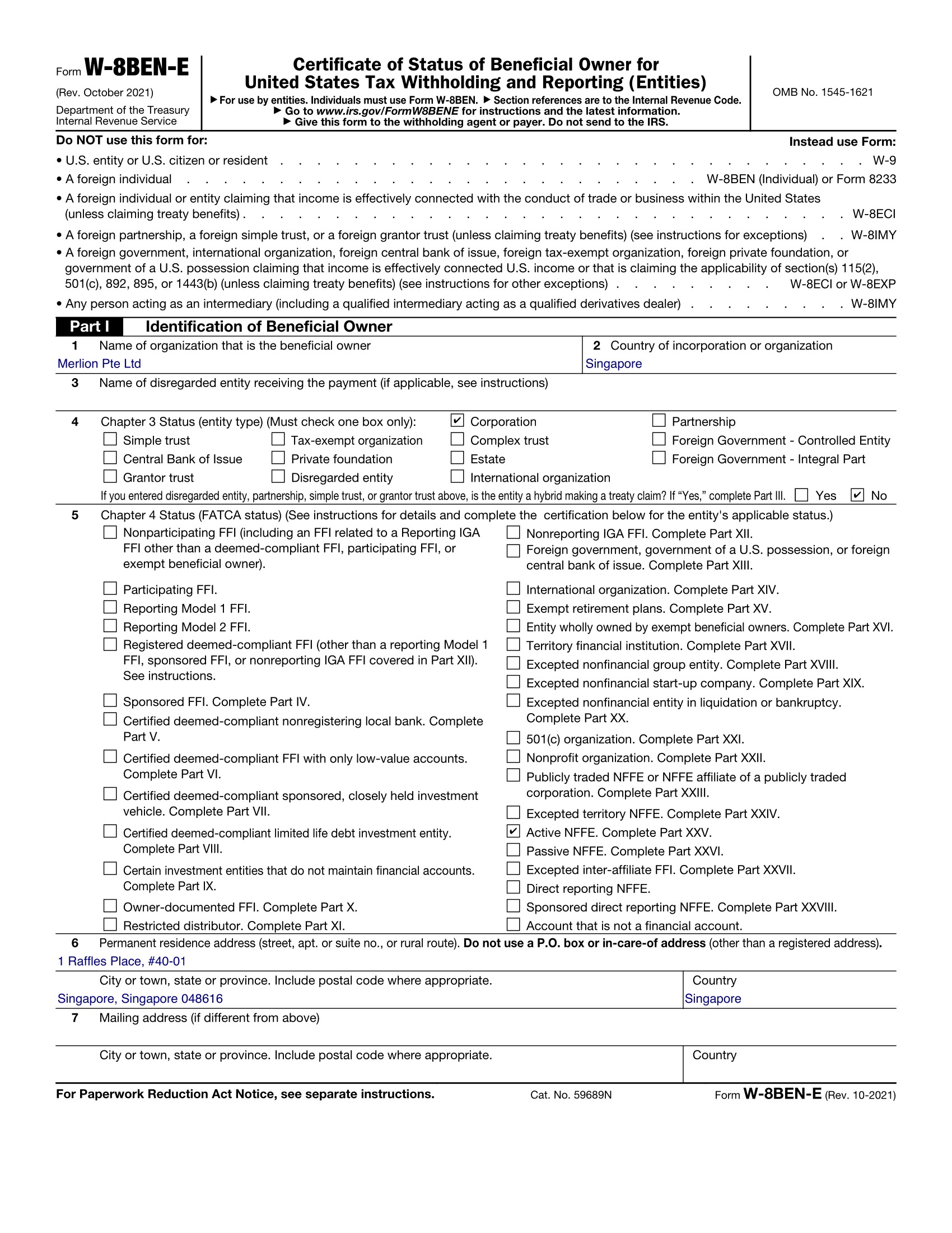
Sample only — uses a fictional company for illustration. Example: Merlion Pte Ltd, 1 Raffles Place, #40-01, Singapore 048616, UEN 202312345A, Chapter 3 Corporation, FATCA Active NFFE, Part III blank (no US-Singapore tax treaty).
US withholding without a treaty: what actually applies to a Singapore entity
Because there is no US-Singapore income tax treaty, there is no reduced-rate table by article — but that does not mean everything is withheld at 30%. What matters is the source of the income:
| Income type | US withholding | Note |
|---|---|---|
| Services performed outside the US | 0% (not US-source income at all) | The form documents foreign status; it does not reduce a rate. Exemption comes from the source-of-income rules, not a treaty. |
| Dividends on US stock | 30% | Flat statutory rate — no treaty reduction available. |
| Interest on most US-issued instruments | 30% | Unless the separate, non-treaty portfolio interest exemption applies (ask an accountant — this is a statutory exemption, not a treaty benefit). |
| Royalties on US-registered IP | 30% | No treaty reduction available. |
| Any of the above with no valid W-8 on file at a US broker | 24% backup withholding on the entire gross sale proceeds | Broader than the 30% rate on dividends alone — a strong reason to keep the form current even though it cannot unlock a treaty rate. |
For a Singapore entity, Form W-8BEN-E does not unlock a reduced rate the way it does for a UK, Irish, or German company — its real job is establishing your foreign status and FATCA classification, and avoiding the harsher 24% backup withholding that applies with no form on file at all.
Checklist vs. a ready-made PDF
Most generic W-8 guides assume a treaty exists and walk you through inventing an article for Line 15. That is exactly the wrong path for Singapore. Our wizard asks the right questions once and hands you the signature-ready PDF.
| Criterion | Published guides | Our wizard |
|---|---|---|
| What you get | A general explanation that often still talks about treaty articles | The completed, signature-ready PDF, with Part III left blank by default |
| Confirm entity type from ACRA BizFile (not assumed from having a UEN) | Manual lookup required — easy to file the wrong form | A guided question in plain language that routes a sole proprietor to W-8BEN |
| Correct Chapter 3 status box (Corporation vs. Partnership) | Risk of treating a Singapore LLP as a partnership because of the name | Selected from your entity type, with Singapore-specific hints that default an LLP to Corporation unless Form 8832 was filed |
| Part III left blank (no treaty) | Risk of a template inventing a treaty article | Knows there is no US-Singapore treaty and, by default, leaves Part III blank |
| Correct Foreign TIN format (UEN vs. NRIC/FIN) | Easy to enter the 9-character individual format on an entity form | Asks for the 10-character UEN on W-8BEN-E |
Start the wizard now and get your finished PDF in minutes.
Frequently asked questions
Common questions from Singapore Pte Ltd owners and freelancers filling out this form.
Does Singapore have any tax treaty with the United States?
No comprehensive income tax treaty. The only bilateral tax agreement covers shipping and aircraft income and does not apply to ordinary business, consulting, or investment income. That is why Part III of Form W-8BEN-E (Lines 14–15) stays blank for a Singapore entity. Part II (Lines 11–13) is a different section — disregarded entity or branch — and also stays blank for an ordinary Pte Ltd.
If there is no treaty, does that mean everything is withheld at 30%?
Not necessarily. Income from services performed outside the United States is generally not US-source income and is not subject to US withholding, treaty or no treaty. Dividends, ordinary interest, and royalties from US sources still are withheld at 30%, because there is no treaty to reduce that rate.
My sole proprietorship has a UEN — do I still file the individual form?
Yes. A UEN does not make a sole proprietorship a separate legal entity. File Form W-8BEN using your personal NRIC or FIN, not Form W-8BEN-E.
What is the difference between a UEN and an NRIC or FIN?
UEN is a 10-character entity number issued by ACRA to registered businesses (companies, LLPs, and sole proprietorships alike). NRIC is a 9-character number for Singapore citizens and permanent residents. FIN is a 9-character number for foreign residents. Only the UEN goes on Form W-8BEN-E; NRIC/FIN go on the individual Form W-8BEN.
Can I claim a reduced withholding rate on Part III?
No. Leave Lines 14a, 14b, and 15 entirely blank. There is no US-Singapore treaty article to cite, and inventing one is a compliance risk, not a shortcut.
Does my Pte Ltd have to pay 30% on everything it invoices a US client for?
No. If the services were performed outside the United States, that income is foreign-source and is not subject to US withholding at all, treaty or no treaty. The 30% rate applies only to genuinely US-source income like US dividends, US-source interest, or US royalties.
Is a Pte Ltd treated as a Corporation automatically?
Yes, by default. Because its shareholders have limited liability under the Singapore Companies Act, a Pte Ltd is treated as a Corporation for US tax purposes unless it has filed Form 8832 to elect a different classification. A Public Ltd is always a Corporation (it is on the US per se corporation list).
Is a Singapore LLP treated as a Partnership on Line 4?
No, not by default. Every partner has limited liability under the Singapore LLP Act, and an LLP is not on the IRS per-se list, so Treas. Reg. 301.7701-3(b)(2) defaults it to Corporation. Check "Partnership" only after filing Form 8832. A general partnership (unlimited liability) is the category that defaults to Partnership.
What is Chapter 4 / Active NFFE?
It is a separate FATCA classification from your entity type. A normal trading company with under 50% passive income and assets is usually "Active NFFE."
How long is the form valid?
Generally until the end of the third calendar year after signing — a form signed in 2026 is valid through 31 December 2029, unless your circumstances change sooner (entity type, address, or Chapter 4 status).
Do I send this form to IRAS or to the US IRS?
Neither directly — you give it to the US withholding agent (the platform, broker, or company paying you). It is not filed with any tax authority; it is retained by the payer as documentation.
Do I need an accountant to complete this?
Not necessarily for the standard case — an ordinary trading Pte Ltd, Active NFFE, services performed from Singapore. If you think the portfolio interest exemption (IRC §871(h)/881(c)) might apply, ask an accountant first.
What does it cost to get W-8BEN-E right?
With our guided wizard, $30 per finished, signature-ready PDF for companies (or $5 for sole proprietors) — no subscription.
Where to go next
For more detail on specific parts of the form:
- Fill out your W-8BEN-E in the guided wizard: Start the W-8BEN-E wizard ($30)
- Are you an individual or sole proprietor?: Use the W-8BEN vs W-8BEN-E guide or the W-8BEN wizard ($5)
- General W-8BEN-E line-by-line guide: Form W-8BEN-E complete guide
- How withholding works without a valid W-8: US withholding tax guide
Common mistakes to avoid
- Assuming Singapore has a tax treaty with the US because it is a major financial hub: it does not. Part III (Lines 14–15) stays blank.
- Treating a sole proprietorship's UEN as proof it is a separate entity: and filing W-8BEN-E instead of the correct individual W-8BEN.
- Checking "Partnership" on Line 4 for a Singapore LLP because the name contains "Partnership": limited liability defaults the LLP to Corporation unless Form 8832 elects otherwise. A general partnership is the different case.
- Filling in Part III or line 15 with a treaty article or rate: none exists for Singapore.
- Entering an NRIC or FIN (individual format) in the Foreign TIN field of an entity's W-8BEN-E: use the 10-character UEN, not a 9-character personal number.
- Forgetting that a lapsed or missing form triggers 24% backup withholding: on the full gross proceeds of a securities sale at a US broker, not just on dividends.
A note on Singapore's own tax system
Singapore taxes companies on a territorial basis with a headline corporate tax rate of 17%, and offers a partial tax exemption for qualifying new start-ups on their first chargeable income. None of this affects what goes on Form W-8BEN-E — that form only concerns US withholding at the source of US-connected payments.
If your Pte Ltd receives significant US-source income (not just services income), it is worth asking a Singapore-qualified accountant how that interacts with your local corporate tax filing, since this page focuses only on the US side.
- IRAS territorial tax system: generally, only Singapore-sourced income (and foreign income remitted to Singapore, with exceptions) is taxed locally.
- Start-up Tax Exemption scheme: partial exemption on qualifying income for a company's first three years of assessment, subject to conditions.
- None of the above: changes anything about the US W-8BEN-E form itself.
Ready to get your Singapore Pte Ltd's W-8BEN-E right the first time?
The guided wizard asks the same questions covered on this page — and already knows there is no US-Singapore treaty, so by default it leaves Part III blank, without filling in an article.