W-8BEN-E for Your Company: Certify Status and Reduce U.S. Withholding
This article was created with AI assistance and has not been reviewed by a human editor. It is provided for general informational purposes only and does not constitute tax, legal, or financial advice.
 AI-generated image
You are here because a U.S. customer, marketplace, or payroll platform asked your company to submit IRS Form W-8BEN-E before they can pay you. That request is normal: under U.S. tax rules, a withholding agent (the payer) must document who you are, whether you are a U.S. entity, and whether a reduced treaty rate applies. Without a valid certificate, many payers withhold 30% at source on U.S.-source income.
Form W-8BEN-E is the entity version of the famous W-8BEN used by individuals. It is longer—about eight pages and 30 parts—because it covers both your Chapter 3 entity classification (who you are) and your Chapter 4 FATCA status (how your company relates to financial reporting). The form is not a tax return; you give it to the payer, not to the IRS.
This guide explains what the form does, who must file it, how U.S. withholding works on business payments, how to choose Active vs Passive NFFE, how treaty claims look for real countries, and where teams most often go wrong. Outcomes depend on your facts and country of residence—treat this as mechanics, not individualized tax advice.
Ready to answer the IRS fields without starting from a blank PDF? Start the W-8BEN-E wizard on W8GetEasy ($30, downloadable PDF after guided questions).
What is Form W-8BEN-E?
Form W-8BEN-E (Certificate of Status of Beneficial Owner for United States Tax Withholding and Reporting, Entities) is an IRS form completed by foreign legal entities—corporations, LLCs, partnerships, trusts, and similar organizations—to certify their non-U.S. tax status and, when applicable, claim benefits under an income tax treaty.
- Confirm you are not a U.S. person: You declare that the entity is foreign for U.S. tax purposes and provide identity, address, and tax identification details.
- Establish Chapter 3 status: You select the entity type the IRS uses for withholding rules—for example Corporation or Partnership.
- Establish Chapter 4 (FATCA) status: You explain how your company fits under FATCA (often Active NFFE or Passive NFFE for operating businesses).
- Claim treaty benefits (optional Part III): If income is eligible, you cite the treaty article and rate so the payer may apply less than 30% withholding.
The IRS publishes official instructions with the form; see the IRS W-8BEN-E page for the current revision. Platforms such as Upwork (company accounts) and Stripe use the same certificate when onboarding non-U.S. businesses.
Do not confuse W-8BEN-E with Form W-8BEN for individuals. If invoices are issued by a company, the entity form is required—even when the founder signs.
Who needs to file W-8BEN-E?
Any foreign entity that receives U.S.-source income subject to withholding—or that opens accounts with U.S. financial institutions subject to FATCA documentation—may be asked for W-8BEN-E. Common situations include:
- A U.S. enterprise customer paying your company for software development, consulting, or marketing services.
- A marketplace or payment processor (Amazon Seller Central, Stripe, Upwork agency account) onboarding a non-U.S. legal entity.
- A U.S. affiliate or subsidiary requesting documentation before intercompany payments.
- A bank or broker asking for FATCA classification (related but separate from everyday service invoices).
- A foreign holding company receiving dividends or royalties from a U.S. subsidiary (often Passive NFFE—see our holding company W-8BEN-E guide in English).
How U.S. withholding works on payments to your company
By default, U.S. payers must withhold 30% on certain U.S.-source income paid to foreign persons unless a valid Form W-8 series certificate is on file and supports a lower rate. For entities, W-8BEN-E is the standard certificate. The payer acts as withholding agent—they remit withheld amounts to the IRS and rely on your form to justify a reduced rate.
Whether withholding applies, and at what rate, depends on the income type (services, royalties, dividends, interest), your Chapter 3 and Chapter 4 statuses, and whether an income tax treaty reduces the rate. A Polish dev agency paid for U.S. client services may cite business profits at 0% in Part III; a UK company paid U.S.-source royalties may cite a different article and rate. This page explains mechanics, not your final tax outcome—for complex structures or large amounts, consult a qualified tax adviser.
W-8BEN vs W-8BEN-E: Which form does your business use?
The names are similar, but the IRS treats them as different certificates. Choosing the wrong form can delay onboarding or trigger backup withholding.
- Form W-8BEN: For foreign individuals and sole proprietors treated as individuals. If you personally invoice U.S. clients as a freelancer, see our W-8BEN guide.
- Form W-8BEN-E: For legal entities and entities treated as persons (corporations, partnerships, trusts, foundations). If your contract says Ltd., GmbH, Sp. z o.o., LLC, or similar, use W-8BEN-E.
- Disregarded single-member LLC: May follow the owner’s form in some cases—see Disregarded Entity on W-8BEN-E when the LLC is ignored for U.S. tax purposes.
Chapter 3, Chapter 4, and FATCA: Why the form has 30 parts
The form collects two parallel stories. Chapter 3 (Part I, line 4) answers “What type of entity are you for withholding?”—corporation, partnership, trust, etc. Our Chapter 3 status guide walks through each checkbox.
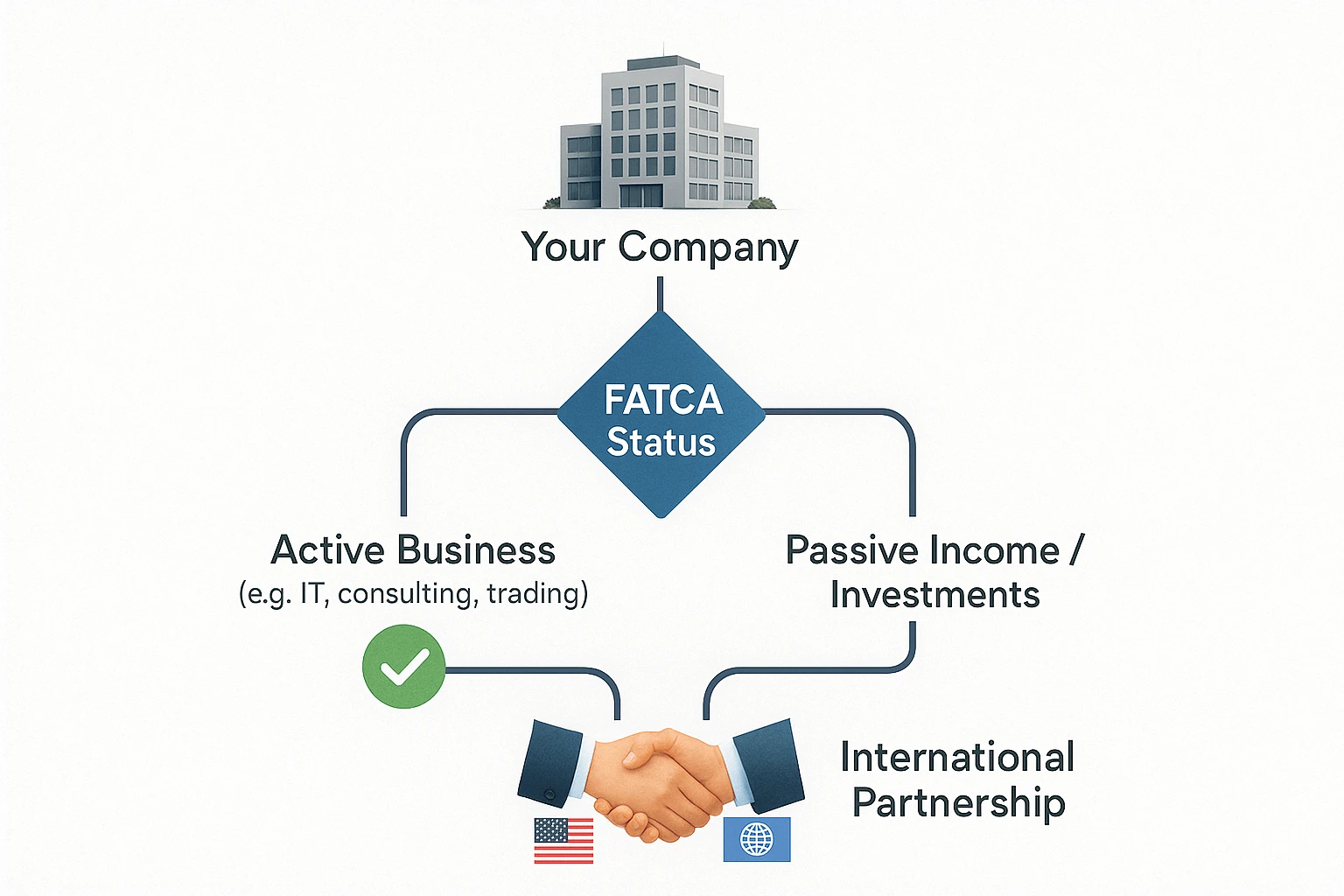
Chapter 4 (Part I, line 5) answers “What is your FATCA classification?” For most non-financial operating companies, the choice is between Active NFFE and Passive NFFE. Financial institutions and publicly traded groups have other paths.
- Active NFFE: Typically fits IT agencies, SaaS vendors, and consultancies where less than 50% of gross income is passive and less than 50% of assets are held to produce passive income. You usually complete Part XXV.
- Passive NFFE: Common for holding companies and IP shells where passive income dominates. You usually complete Part XXVI and may need to disclose substantial U.S. owners in Part XXIX.
Step-by-step: completing W-8BEN-E for a typical service company
Exact lines change with IRS revisions, but most non-U.S service exporters follow this sequence. Match your answers to formation documents and contracts.
- Step 1 — Identify the entity: Enter legal name, country of incorporation, and permanent address exactly as on your corporate registry. Mismatches with the payer’s vendor record are a top reason forms are rejected.
- Step 2 — U.S. TIN (if any): If the company has a U.S. Employer Identification Number, report it; otherwise follow the instructions for a foreign tax ID.
- Step 3 — Chapter 3 status: Select Corporation (or Partnership / disregarded entity as applicable). See W-8BEN-E for corporations for the usual corporation path.
- Step 4 — Chapter 4 status: For operating businesses, Active NFFE is common. Confirm the 50% income and asset tests before checking the box.
- Step 5 — Treaty claim (Part III): If you want a reduced rate, complete Part III with country of residence, article, paragraph, rate, and income type. Use IRS treaty tables for your country; treaty rates can change—verify before filing.
- Step 6 — Sign and deliver: An authorized officer signs (electronic signature is generally accepted). Send only to the withholding agent—not to the IRS. Keep a copy for your records.
Treaty benefit examples for business income (Part III)
Most non-U.S. service businesses land on the same answer regardless of country: under Article 7 (Business Profits) of nearly every U.S. tax treaty, profits from services are taxed only in your home country when your business has no permanent establishment in the U.S. — that means 0% U.S. withholding, and it doesn't depend on which country you're in. The country-specific part only shows up if the payer classifies your income as royalties instead of services (Article 12), where rates vary. Below: one worked example under Article 7, then a comparison table for royalty-classified income.
Netherlands
A Dutch BV invoicing U.S. B2B clients for software or consulting often claims business profits under Article 7 when no permanent establishment exists in the U.S. Royalty-classified payments may use a different article and rate.
- Country: Netherlands
- Article and paragraph to reference: Article 7 (business profits) or Article 12, paragraph 2 (royalties) depending on income type
- Typical rate on royalties: 0% per treaty table for many royalty types—confirm for your facts
- Type of income: Business profits (services) or royalties
Treaty rates and articles can change. Always confirm against the current IRS treaty tables and your payer's income classification before filing.
If your U.S. payer classifies the payment as a royalty (for example, a licensing or SaaS fee) rather than a service fee, the treaty rate depends on your country. These are general copyright-royalty withholding rates under each country's treaty with the U.S. (IRS Table 1) — confirm the payer's actual income classification before completing Part III.
| Country | Treaty rate (royalties) | Note |
|---|---|---|
| United Kingdom | 0% | Article 12(1). |
| Canada | 0% | 0% for copyrights, 10% specifically for film & TV royalties. |
| Australia | 5% | Applies broadly to copyrights, patents, and film & TV. |
| India | 15% | Same rate also covers certain 'fees for included services' under Article 12(4). |
| No valid treaty claim | 30% | Statutory default without a completed Part III. |
Worked example: an Ireland-based software agency
Clearpath Studio is a small software consultancy incorporated in Ireland, invoicing a U.S. enterprise client $8,000 a month for development work. With no U.S. office, employees, or dependent agents, this is business profits with no U.S. permanent establishment. Before filing W-8BEN-E, the client's finance team withheld the statutory 30% pending documentation — $2,400 held back on a $8,000 invoice.
After Clearpath filed W-8BEN-E, selected Corporation for Chapter 3, Active NFFE for Chapter 4, and cited Article 7 (business profits) in Part III with Ireland as country of residence, the client applied 0% withholding on the same invoice type. The full $8,000 is paid — the certificate only removes the U.S. withholding layer; Irish corporation tax on the income is unchanged.
- Without W-8BEN-E: 30% withheld — $2,400 on an $8,000 invoice.
- With W-8BEN-E + Part III (Article 7, no U.S. PE): 0% U.S. withholding — full $8,000 paid, still taxable at home.
Common mistakes companies make on W-8BEN-E
- Using W-8BEN instead of W-8BEN-E: Founders sometimes upload the individual form while the contract party is a company—platforms may reject it or apply the wrong rules.
- Wrong FATCA box: Marking Passive NFFE for an operating agency triggers extra owner disclosures and confusion. Review the 50% income and asset tests.
- Name or address drift: Legal name on the form must match the payer’s vendor profile and bank account. Even small punctuation differences can stall approval.
- Empty Part III when you need a treaty rate: Without a valid treaty claim, the payer may withhold 30%. See how Part II/III claims work on W-8BEN for the logic (similar for entities in Part III).
- Sending the form to the IRS: Deliver the signed PDF only to your withholding agent. The IRS does not accept unsolicited W-8 forms from foreign entities.
- Letting the certificate expire: Forms are generally valid for three calendar years after the year of signature. Renew sooner if status or ownership changes materially.
Foreign tax ID and residency certificates, wherever you're based
Part I of W-8BEN-E asks for a foreign tax identifying number — use whatever your country issues to registered businesses (a VAT/company registration number, a corporate tax number, or equivalent). Get the exact legal name and registration details from your incorporation documents, not a trading name — mismatches with the payer's vendor record are one of the most common reasons forms get rejected.
Some U.S. payers or banks ask for a certificate of tax residency to support a treaty claim in Part III, issued by your national tax authority. This isn't automatic — request it separately if asked. None of this replaces your normal corporate tax filing at home; W-8BEN-E only documents U.S. withholding, not your full tax position.
- Use your company's official registration/tax number for the foreign TIN field — not a trading name or informal ID.
- If a U.S. payer asks for a certificate of tax residency, request it from your national tax authority separately.
- Report this income under your normal domestic corporate tax rules regardless of U.S. withholding treatment.
Frequently asked questions about W-8BEN-E
Do I need W-8BEN-E if my company has no U.S. employees or offices?
Often yes. The form is about the payor’s obligation to document foreign status and withholding, not whether you have a U.S. office. A Polish or Indian company with only local staff can still receive a U.S. platform or client request for W-8BEN-E before first payout.
What happens if we do not submit the form?
The withholding agent may be required to withhold 30% on reportable U.S.-source payments until a valid certificate is on file. Some payers block onboarding entirely. The exact consequence depends on payment type and internal policy—this is why finance teams treat the form as a payment prerequisite.
How long is Form W-8BEN-E valid?
Generally three calendar years beginning the year after signature, unless a change in circumstances makes the certification incorrect. If your legal name, tax residence, Chapter 3/4 status, or treaty position changes, submit an updated form promptly.
Who should sign the form?
An individual authorized to certify on behalf of the entity—typically a director or officer listed in corporate records. Electronic signatures are widely accepted when they meet IRS requirements; check your payer’s portal instructions.
Can we claim 0% withholding on all U.S. income?
Not automatically. A reduced or zero rate applies only when the income type qualifies under the treaty and you complete Part III correctly. Service fees, royalties, dividends, and interest each have different articles. Outcomes depend on your facts and how the payer classifies the payment.
Is W-8BEN-E the same as a tax return?
No. It is a withholding certificate for the payer’s files. Your company may still owe tax or filing duties in your home country, and in some cases in the U.S., depending on activities and treaties.
Does our company need a U.S. EIN to complete W-8BEN-E?
Many foreign entities do not have a U.S. EIN and use a foreign tax identification number instead, as allowed by the instructions. If you have been assigned a U.S. EIN for payroll or other reasons, report it consistently across forms and payer records.
When should we choose Passive NFFE instead of Active NFFE?
Passive NFFE is appropriate when most income is passive (dividends, interest, rents, royalties) and most assets are passive. Operating consultancies and product companies usually qualify as Active NFFE if they meet the tests. Holding and IP-holding structures often land in Passive NFFE and may need owner disclosures.
Form W-8BEN-E is dense, but the logic is consistent: identify the entity, choose Chapter 3 and Chapter 4 statuses honestly, claim treaty benefits only when supported, and give the signed PDF to the payer. Getting those steps right keeps U.S. payments flowing and documents why withholding should be reduced.
Don't waste time on the wrong boxes: build your W-8BEN-E in minutes
W8GetEasy walks your team through Chapter 3, FATCA status, and Part III treaty fields with plain-language questions—then generates a formatted PDF for $30. Open the W-8BEN-E wizard when you are ready to file.