W-8BEN vs W-8BEN-E: How to Choose the Right Certificate for Your Situation
This article was created with AI assistance and has not been reviewed by a human editor. It is provided for general informational purposes only and does not constitute tax, legal, or financial advice.
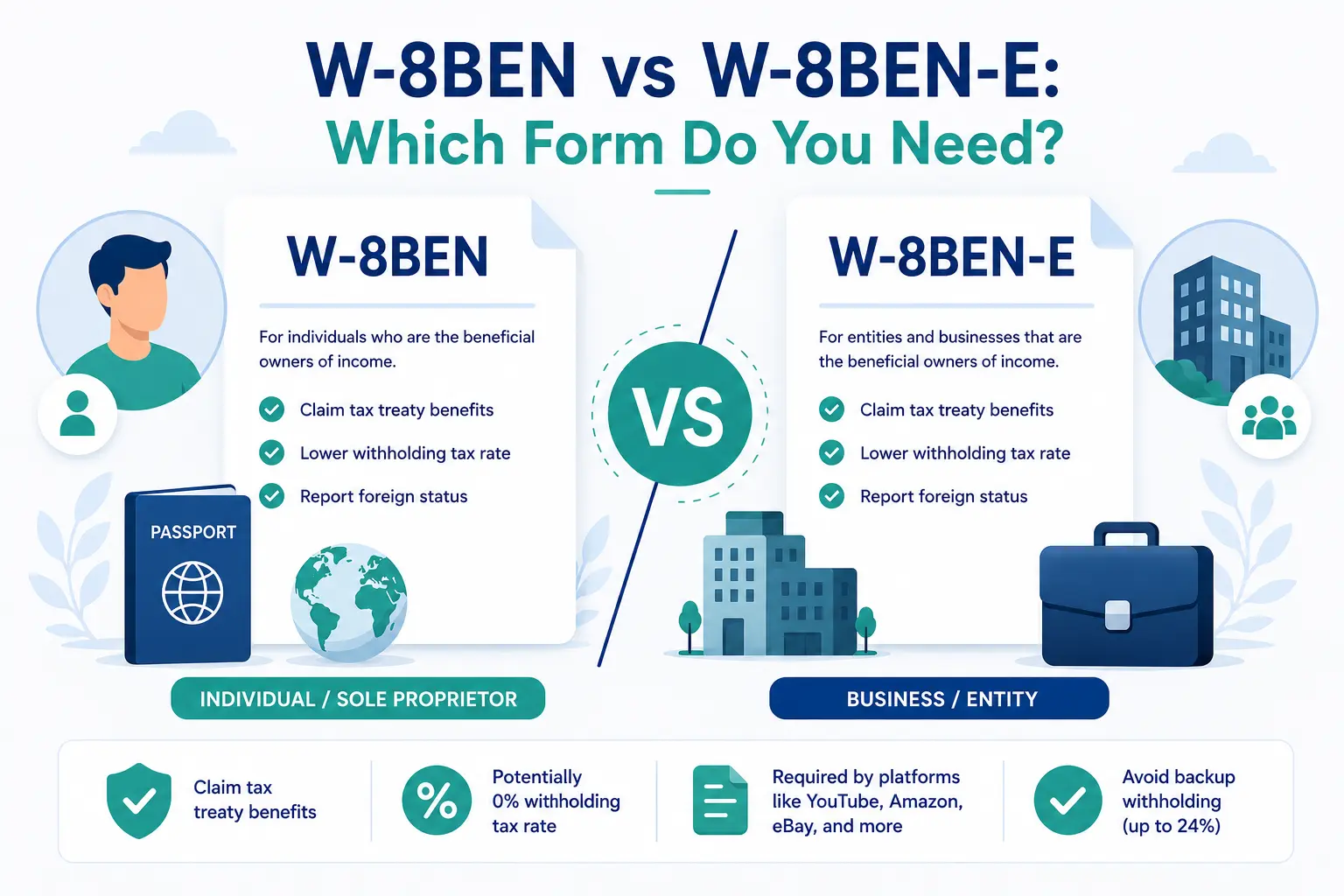 AI-generated image
You are here because a U.S. company, platform, or bank asked you to submit a W-8 form and you see two similar names: W-8BEN and W-8BEN-E. They look alike on a checklist, but the IRS treats them as different certificates. The wrong choice delays onboarding, triggers extra questions from compliance, or leaves backup withholding in place until you file again.
The practical rule is simple once you know who receives the payment. Form W-8BEN is for non-U.S. individuals—freelancers, creators, and investors acting in their own name. Form W-8BEN-E is for foreign legal entities—companies, LLCs, partnerships, trusts, and similar organizations. Payers such as Amazon, Stripe, YouTube, and Upwork usually tell you which certificate their tax settings expect; this guide explains why that matters and how to complete the right one.
Below we define each form, compare them side by side, walk through a decision checklist (including sole proprietors), list common mistakes, show how to finish either certificate online, and answer eight questions people search for. Outcomes depend on your facts and country of residence—this page explains mechanics, not individualized tax outcomes.
Ready to file? Start the W-8BEN wizard ($5) for individuals or start the W-8BEN-E wizard ($30) for companies and other entities.
What is Form W-8BEN?
Form W-8BEN (Certificate of Foreign Status of Beneficial Owner for United States Tax Withholding and Reporting, Individuals) is the IRS withholding certificate for foreign individuals. You certify that you are not a U.S. person, provide your legal name and permanent address outside the United States, and—when eligible—claim a reduced withholding rate under an income tax treaty in Part II.
- Who files it: Non-U.S. natural persons: freelancers, consultants, solo creators, and individual investors receiving U.S.-source payments in their personal name.
- What it does: Documents foreign status so the payer can apply the correct withholding (often lower than 30% when a treaty applies).
- Typical payers: U.S. clients, Upwork, Fiverr, Google AdSense, and personal brokerage accounts.
- Validity: Generally three calendar years after the year of signature unless facts change sooner.
- On W8GetEasy: Guided questions, treaty Part II help, instant PDF—$5. See fill out your W-8BEN online.
Official definitions and field instructions are on the IRS W-8BEN page. For freelancers, also read W-8BEN for freelancers; for AdSense-style royalties, see W-8BEN for YouTube AdSense.
You do not mail W-8BEN to the IRS. You deliver the signed PDF only to the withholding agent—the U.S. payer or platform that requested it.
What is Form W-8BEN-E?
Form W-8BEN-E (Certificate of Status of Beneficial Owner for United States Tax Withholding and Reporting, Entities) is the entity version of the same story. Foreign companies and organizations use it to certify status, complete Chapter 3 entity classification (Line 4), Chapter 4 FATCA status (Line 5), and optional treaty benefits in Part III.
- Who files it: Foreign corporations, partnerships, LLCs treated as entities, trusts, estates, and many nonprofits with U.S. payers.
- Why it is longer: Entities must answer FATCA (Chapter 4) questions individuals do not face on W-8BEN—Active NFFE, Passive NFFE, financial institution, and related labels.
- Typical payers: U.S. enterprise customers, Amazon Seller Central (entity accounts), Shopify, Stripe, Etsy, and Patreon (company accounts), banks, and vendor portals paying the company—not you personally.
- Validity: Same general three-year renewal window as W-8BEN when facts stay the same.
- On W8GetEasy: Chapter 3 and 4 wizard, AI treaty advisor, instant PDF—$30. See fill out your W-8BEN-E online.
Key differences between W-8BEN and W-8BEN-E at a glance
Both forms tell a U.S. withholding agent you are foreign and may qualify for treaty relief. The difference is who signs and how much certification the IRS requires. Individuals use a shorter certificate; entities document legal type and FATCA classification before any treaty rate can apply.
Use the table below when a portal offers both forms or when you are unsure which name matches your contract party. When in doubt, follow the payer's instructions—they are responsible for matching the certificate to how they pay you.
| Feature | W-8BEN | W-8BEN-E |
|---|---|---|
| Who uses it | Non-U.S. individuals (natural persons) | Foreign companies, LLCs, partnerships, trusts, and other entities |
| Complexity | Shorter; residency + optional Part II treaty claim | Longer; Chapter 3 (Line 4) + Chapter 4 FATCA (Line 5) + optional Part III |
| FATCA (Chapter 4) | Not applicable on the individual form | Required—entity FATCA status on Line 5 |
| Typical use | Freelancers, creators, individual sellers, personal investing | Corporations, holdings, agencies, entity marketplace accounts |
| Price on W8GetEasy | $5 | $30 |
How to decide which form you need
Ask one question first: who is the beneficial owner of the income—the person or the legal entity on the invoice and bank account?
- You are an individual (natural person): Use W-8BEN. Examples: you invoice as yourself, your YouTube channel is in your personal name, or your broker account is individual.
- You are a company, LLC, trust, or other entity: Use W-8BEN-E. Examples: your GmbH, Ltd., S.L., or Sp. z o.o. receives the payment; a partnership is the contracting party.
- The platform names the form: Amazon, Stripe, YouTube, and Upwork tax centers often label the exact certificate. Select what they request even if you think the other form looks similar.
- Sole proprietor edge case: In some countries you operate a business as an individual without a separate company. Many U.S. payers still want W-8BEN when you are the beneficial owner as a person—but some marketplaces treat a registered sole proprietorship differently. Follow the payer's classification; when amounts are large or structure is unclear, consult a qualified tax adviser.
Sole proprietors: W-8BEN or W-8BEN-E?
Sole proprietors confuse the two forms more than any other group. You may run a one-person business under a trade name, but for U.S. withholding the decisive factor is whether the legal recipient of income is you as an individual or a separate entity recognized under local law.
If contracts, tax IDs, and payouts are in your personal name, W-8BEN is usually correct. If a registered company (including a single-member LLC classified as an entity) is the payee, W-8BEN-E is usually correct—even when you are the only owner and signatory. Ukrainian individual entrepreneurs (ФОП) receiving payments personally often file W-8BEN; a Ukrainian TOV receiving the same stream files W-8BEN-E.
- Personal invoice + personal bank account → typically W-8BEN.
- Company invoice + company account → typically W-8BEN-E.
- Unclear in the portal → use the form name shown in tax settings; contact payer support if both appear.
- Never file W-8BEN-E as an individual pretending to be a corporation—that is a common rejection reason.
How to complete each form online with W8GetEasy
Both certificates can be prepared without starting from a blank IRS PDF. W8GetEasy asks plain-language questions and generates a formatted file you send to the withholding agent.
- W-8BEN (individuals) — about five minutes: Confirm citizenship and residence, enter tax ID, complete Part II when a treaty rate applies, sign, and download the PDF for $5 via the W-8BEN wizard.
- W-8BEN-E (entities) — guided Chapter 3 and 4: Select entity type on Line 4, FATCA status on Line 5, complete Parts II–IV when required, use the AI treaty advisor for Part III, sign, and download for $30 via the W-8BEN-E wizard.
- After download: Upload to the payer's portal or send to your U.S. client—do not mail to the IRS. Keep a copy and renew before expiry or when ownership or classification changes.
- Need both over time: Some people file W-8BEN for personal AdSense and W-8BEN-E for a production company—that is normal when two legal persons earn U.S. income.
Worked example: a UK freelancer's payments got blocked after incorporating
Freya Whitmore, a freelance UX designer in Leeds, filed W-8BEN in 2021 as a sole trader working with a US product agency, invoicing personally and receiving payments to a personal bank account. In 2024, she incorporated Whitmore Design Ltd and began invoicing and receiving payments through the company account — but never told the agency's finance team to update her tax documentation, assuming the personal W-8BEN 'still covered it.'
The agency's compliance system eventually flagged the mismatch — a business bank account receiving payments under a personal W-8BEN — and paused payouts until documentation matched the actual payee. Freya had to file a fresh W-8BEN-E for Whitmore Design Ltd (entity type on Line 4, FATCA status on Line 5, Article 7) before payments resumed; the personal W-8BEN on file no longer applied once the company became the contracting party.
- Personal W-8BEN on file, payments now routed to a limited company: payouts paused for about three weeks until documentation matched the beneficial owner.
- New W-8BEN-E filed for Whitmore Design Ltd, UK, Article 7, no US permanent establishment: payouts resumed, valid through 31 December 2027.
Where to go next
This comparison stays at the individual-vs-entity level. When you already know which certificate you need, use these deeper guides:
- W-8BEN for freelancers and solo consultants
- W-8BEN for Amazon sellers (individual accounts)
- W-8BEN-E for investors and portfolio entities
- W-8BEN-E for holding companies and group structures
- Complete W-8BEN-E guide for businesses
- W-8BEN for YouTube AdSense (individual creators)
Common mistakes when choosing the wrong form
- Individual files W-8BEN-E: Compliance may reject the certificate or ask for a corrected W-8BEN because entity classification fields do not apply to a natural person.
- Company files W-8BEN: The payer may reject the form or apply 30% backup withholding until a valid W-8BEN-E is on file—entity FATCA data is missing.
- Ignoring the platform's label: Stripe, YouTube, Amazon, and Upwork tax interviews map to specific form types. Pick the name they show, not the shorter form by habit.
- Using the owner's W-8BEN for company income: Paying your Ltd. but uploading your personal W-8BEN does not certify the entity. The contract party must match the certificate.
- Submitting both at once for the same payee: One beneficial owner per payment stream. File the form that matches who receives that stream; use a second certificate only for a different legal person.
- Assuming either form eliminates home-country tax: Both certificates affect U.S. withholding at source only. You may still owe tax where you live. For complex structures or large amounts, consult a qualified tax adviser.
Incorporating changes more than which W-8 form you file
The switch from filing W-8BEN personally to W-8BEN-E for a UK limited company reflects a real change in how your income is taxed at home, not just a US paperwork update. As a sole trader, profits are taxed as personal income via Self Assessment; once a limited company is the contracting party, profits are subject to UK Corporation Tax, and money you draw out personally — salary or dividends — is taxed again on top.
Whether incorporation makes sense should be decided on UK tax and liability grounds — limited liability, the Corporation Tax rate versus your marginal Income Tax rate, and how you plan to draw money out — not on which W-8 form looks simpler. Once you do incorporate, updating W-8 documentation with every US payer is simply a downstream step, not the reason for the decision itself.
- Sole trader → W-8BEN, profits taxed as personal income via Self Assessment.
- Limited company → W-8BEN-E, profits taxed under Corporation Tax, plus a second layer of tax when you extract salary or dividends personally.
- Get the incorporation decision right for UK tax reasons first — the correct W-8 form simply follows from whichever structure you choose.
Frequently asked questions: W-8BEN vs W-8BEN-E
What is the difference between W-8BEN and W-8BEN-E?
W-8BEN certifies foreign status for individuals; W-8BEN-E does the same for legal entities and adds Chapter 3 entity type and Chapter 4 FATCA status. The IRS publishes separate instructions for each form on irs.gov.
Can an individual use W-8BEN-E?
Generally no. W-8BEN-E is for entities. Individuals—including sole proprietors paid in their personal name—typically use W-8BEN. If a payer insists on W-8BEN-E for a personal account, contact their support; the mismatch is often a portal setting error.
Do sole proprietors file W-8BEN or W-8BEN-E?
Often W-8BEN when you are the beneficial owner as a natural person and the contract is in your name. If local law treats your sole proprietorship as a separate entity for tax purposes and the payer pays that entity, W-8BEN-E may be required. Follow the withholding agent's instructions.
Which form does Amazon, YouTube, Stripe, or Upwork require?
It depends on account type. Personal creator or freelancer accounts usually request W-8BEN; company or business accounts usually request W-8BEN-E. Each platform's tax center names the certificate—use that label. See our Amazon and YouTube guides linked above for examples.
Can I submit both W-8BEN and W-8BEN-E?
Yes, but for different legal persons—not as substitutes for the same payment. You might file W-8BEN for personal freelance income and W-8BEN-E for your company's U.S. royalties. Each certificate must match the beneficial owner of that income stream.
What happens if I submit the wrong form?
The payer may reject the upload, request a new certificate, or withhold at 30% until a valid form is on file. Fixing it early is faster than disputing withheld amounts later. Outcomes depend on payer systems and facts.
How long are W-8BEN and W-8BEN-E valid?
Under standard instructions, both generally remain valid through the end of the third calendar year after the year you signed—for example, a form signed in 2026 often expires December 31, 2029, unless a change in circumstances makes the certification incorrect sooner.
Do I need an ITIN for either form?
Not always. Many filers provide a foreign tax identification number from their country of residence. A U.S. TIN (including ITIN) is required only when the form instructions or payer rules say so for your situation. Check the current IRS form instructions before signing.
W-8BEN and W-8BEN-E are not interchangeable labels—they match different beneficial owners. Individuals start with W-8BEN; entities start with W-8BEN-E. Read the payer's tax prompt, align the certificate with who actually receives the money, renew before expiry, and use the guides linked above when you need platform- or country-specific detail.
Know which form you need? Generate the correct PDF in minutes
Individuals: Start W-8BEN ($5). Companies and entities: Start W-8BEN-E ($30). W8GetEasy walks you through the right fields for each certificate—no blank IRS PDF required.