W-8BEN-E for a Slovenian d.o.o. (and W-8BEN for an s.p.): US–Slovenia Treaty Guide (2026)
This article was created with AI assistance and has not been reviewed by a human editor. It is provided for general informational purposes only and does not constitute tax, legal, or financial advice.
 AI-generated image
Your US client or marketplace asked for a W-8BEN-E. For services, a Slovenian d.o.o. usually pays 0% US tax. For software licences it's 5%, not 0%. And the 5% dividend rate needs 25%, not 10%.
This guide is for a družba z omejeno odgovornostjo (d.o.o.) that invoices US clients, licenses software, or holds US shares. It covers which form an s.p. files, the 25% dividend threshold, Line 14b, and the davčna številka on Line 9b. A sample PDF is included further down.
If you are a samostojni podjetnik (s.p.), including a normiranec, you are not a separate legal entity. You file Form W-8BEN in your own name: start the W-8BEN wizard. Independent personal services are Article 14, not Article 7, and that article has no 183-day test.
If you prefer to skip the reading, you can start the W-8BEN-E wizard now. It already asks whether the d.o.o. owns at least 25% of the voting stock directly, and it notes that an active trade under Article 22(3) has to be carried on in Slovenia. In a few minutes you have a signature-ready PDF for $30.
Blank form or already filled in?
You can download the official, blank form from the IRS and complete it yourself — or get the same file already filled in by our wizard.
- Blank official W-8BEN-E (IRS, free): Download W-8BEN-E as a PDF directly from the IRS — for a d.o.o. or a d.d.
- Blank official W-8BEN (IRS, free): Download W-8BEN as a PDF directly from the IRS — for an s.p., including a normiranec.
- Already filled in (5–10 minutes): W-8BEN-E for Slovenian companies ($30) or W-8BEN for individuals ($5).
- The convention: US–Slovenia Income Tax Treaty PDF on IRS.gov — signed at Ljubljana on June 21, 1999, in force June 22, 2001. No protocol.
d.o.o., d.d., d.n.o., or an s.p.?
Slovenian company law uses more than one form, and US tax classification does not follow the local abbreviation one-for-one:
- Delniška družba (d.d.): 26 CFR 301.7701-2(b)(8)(i) lists "Slovenia, Delniska Druzba". A d.d. formed on or after October 7, 2004 is a per se corporation and cannot file Form 8832. A d.d. formed before October 7, 2004 becomes a per se corporation only from the date on which persons who were not owners of that d.d. as of October 7, 2004 own, in the aggregate, a 50 percent or greater interest in it. Until that date — including while interests move only among persons who were already owners as of October 7, 2004 — that d.d. remains an eligible entity and may file Form 8832.
- Družba z omejeno odgovornostjo (d.o.o.): The usual private company, including a single-member d.o.o. It is not on the per se list. It defaults to Corporation because its members have limited liability, and a different US classification is made on Form 8832. A single-member d.o.o. is not disregarded by default.
- Družba z neomejeno odgovornostjo (d.n.o.) or komanditna družba (k.d.): These default to Partnership when at least one partner has unlimited liability, under 26 CFR 301.7701-3(b)(2). Check Partnership in Part I, line 4, not Corporation.
- Samostojni podjetnik (s.p.), including a normiranec: A sole trader, not a company. That person files Form W-8BEN, not W-8BEN-E. Article 14, not Article 7.
The trap worth naming: many guides say a 10% holding gets the 5% dividend rate. The US–Slovenia treaty says 25%, held directly. At 15% ownership your rate is 15%, not 5%.
Chapter 3 still decides which form you file. Part III is where the article and the rate go.
Who actually needs to submit this form?
Any Slovenian d.o.o. or d.d. that receives payments from a US business and needs to document that it is not a US person:
- Services of a d.o.o. with no US permanent establishment: Article 7 at 0%.
- An s.p. or a freelancer: Not this form. Article 14 on Form W-8BEN, at 0% only if the individual has no fixed base regularly available in the United States. There is no 183-day test in Article 14.
- A software licence: Article 12 at 5%, not 0%. Equipment rental is not a royalty under this treaty. It is Article 7 at 0% if there is no US permanent establishment.
What the payer withholds, and what the treaty actually changes
Without a submitted W-8BEN-E, the US payer generally withholds 30% of the gross payment. Filing the form is how the payer knows the company is foreign and which article and rate to apply.
Services performed in Slovenia, with no permanent establishment in the United States, are business profits under Article 7. The US rate on the form is 0%. A software licence, a film, a patent, a trademark, or know-how is a royalty under Article 12 at 5%, and only the arm's-length amount between related persons is covered. Interest from an unrelated US debtor is Article 11 at 5%, not 0%. The 0% interest cases are a qualified governmental entity that does not control the payer, debt guaranteed or insured by a Slovenian qualified governmental entity, and interest on a deferred payment for personal property (movable property) or services. Interest on an installment purchase of equipment is in that last case. Contingent interest can be taxed at up to 15%.
Form W-8BEN-E, line by line, for a Slovenian d.o.o.
The line numbers below match the current form (Rev. October 2021) for an operating d.o.o., Active NFFE, claiming Article 7 at 0% on services performed in Slovenia.
| Line | What you enter |
|---|---|
| Line 1 | The legal name exactly as registered (e.g., "Triglav Software d.o.o."). |
| Line 2 | Country of incorporation: Slovenia. |
| Line 3 | Leave blank unless a single-member d.o.o. has filed Form 8832 to elect disregarded status. That is not the default. |
| Line 4 | Corporation (per se if the company is a d.d. formed on or after October 7, 2004; an older d.d. may still file Form 8832 until persons who were not owners as of October 7, 2004 together hold 50 percent or more). A d.o.o. checks Corporation by default. Partnership for a d.n.o. or a k.d. An s.p. does not use this form. |
| Line 5 | Chapter 4 (FATCA) status — almost always Active NFFE for an ordinary trading or services company. |
| Line 6 | The registered office in Slovenia, in Latin letters (e.g., Slovenska cesta 50, Ljubljana, 1000). |
| Line 9b | The davčna številka, 8 digits, for example 12345679. The same format is used for a company and for a person. Do not type the SI prefix. Do not enter the matična številka or the EMŠO. 12345678 fails the check digit. |
| Line 14a | Slovenia. |
| Line 14b | Ownership and base erosion only when Article 22(2)(f) is met: persons in 22(2)(a) through (e) own at least 50% of each class on at least half the days, and less than 50% of gross income is paid as deductible amounts to persons resident in neither State. A private US company, and a Slovenian holding company that is not itself such a person, do not count toward that 50%. Dividends usually do not count as base erosion. Or Active trade or business when the business is carried on in Slovenia. There is no derivative-benefits test. |
| Line 15 | For services with no US permanent establishment: Article 7, 0%, business profits (services); no US permanent establishment. |
| Part XXX | Signed by a director or other authorized person, with capacity stated. The sample uses Luka Novak. |
This reflects the Rev. October 2021 revision of Form W-8BEN-E. Cross-check the current IRS PDF before you submit.
Every field in the table above is filled in by our guided W-8BEN-E wizard.
Sample: completed W-8BEN-E for a Slovenian d.o.o.
A filled example for a fictional d.o.o. with no US permanent establishment, Active NFFE status, Ownership and base erosion on Line 14b, and Article 7 at 0%.
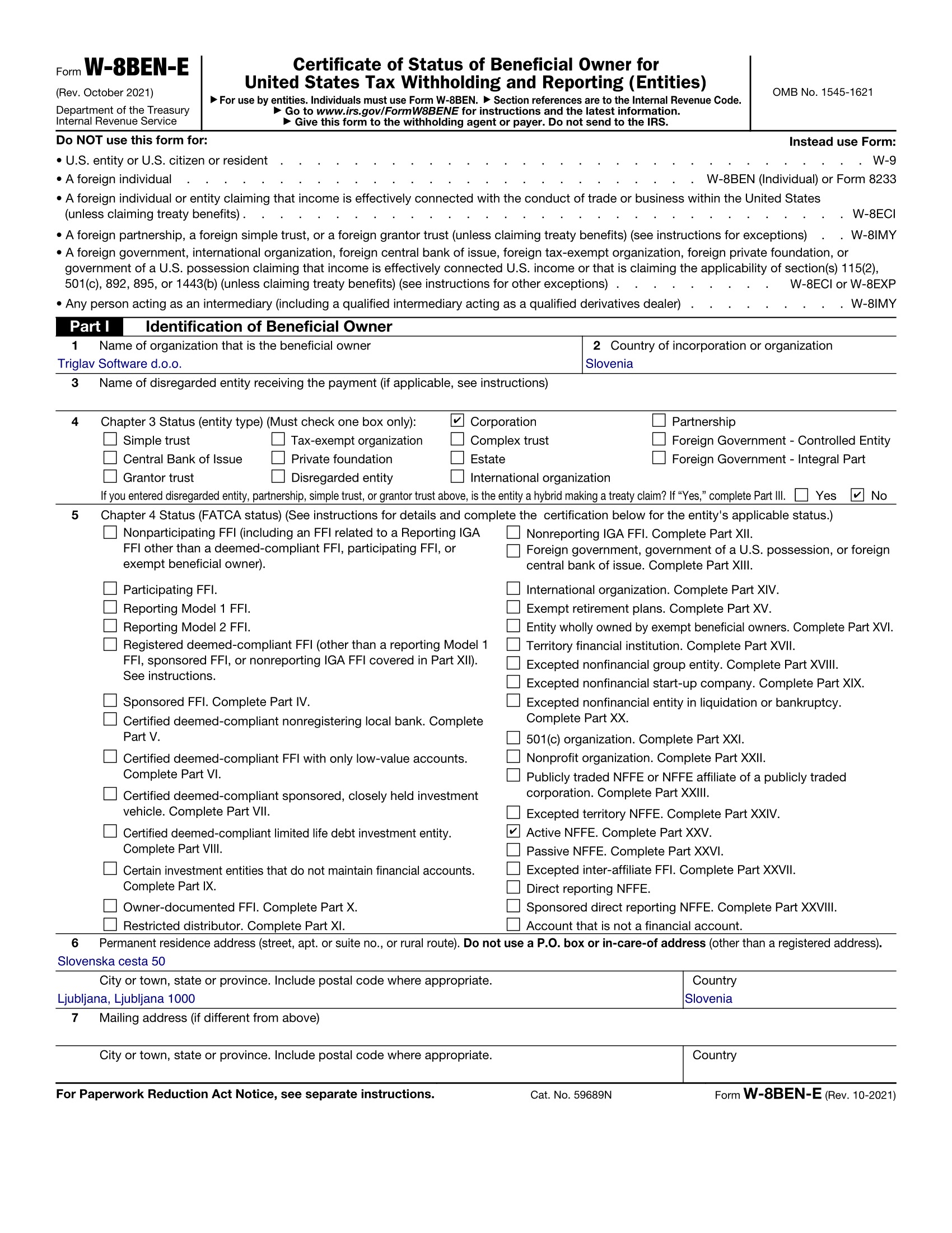
Sample only — uses a fictional company for illustration. Example: Triglav Software d.o.o., Slovenska cesta 50, Ljubljana 1000, Slovenia, davčna številka 12345679, Chapter 3 Corporation, FATCA Active NFFE, Article 7 at 0%.
The rates on Line 15
Each row states the condition. Do not copy a 0% royalty rate from another treaty, and do not apply 5% to dividends at a 10% holding.
| Income type | Article | Rate and condition |
|---|---|---|
| Services of a d.o.o. | Article 7 | 0% — only if the d.o.o. has no permanent establishment in the US |
| Services of an s.p. / freelancer | Article 14 | 0% — only if the individual has no fixed base regularly available in the US (no 183-day test) |
| Software licence, film, patent, trademark, know-how | Article 12 | 5% — never 0%; only on the arm's-length amount between related persons |
| Equipment rental | Article 7 | 0% if no US permanent establishment — not a royalty under this treaty |
| Interest | Article 11 | 5%; 0% only on a deferred payment for personal property (movable property) or services, including an installment purchase of equipment, on government-guaranteed debt, or to a qualified governmental entity; contingent interest up to 15% |
| Dividends — company owning directly at least 25% of the voting stock | Article 10(2)(a) | 5% — only at 25% or more of the voting stock, held directly; not for RIC or REIT dividends |
| Dividends — all other cases (including 10%–24%) | Article 10(2)(b) | 15% |
| REIT dividends | Article 10(3) | 15% only if: an individual holding not more than 10% of the REIT; or the dividend is paid on a publicly traded class and the owner holds not more than 5% of any class of the REIT’s stock; or a person holding not more than 10% of a diversified REIT. A 4% stake in a publicly traded class does not qualify when the same person holds more than 5% of another class. Otherwise 30% |
Many guides, and most US-model treaties, say 10%. The US–Slovenia treaty says 25%, held directly. At 15% ownership your rate is 15%, not 5%. RIC and REIT dividends never get 5%.
Line 14b and Article 22
Ownership and base erosion is Article 22(2)(f). On at least half the days of the year, persons described in Article 22(2)(a) through (e) must own at least 50% of each class, directly or indirectly. Those persons are an individual resident of either State, a qualified governmental entity, a company whose share classes representing more than 50% of the voting power and value are regularly traded on a recognized stock exchange, a company at least 50% of each class of which is owned by five or fewer such companies, an organization established exclusively for a religious, charitable, educational, scientific, or other similar purpose, as described in Article 4(1)(c)(i), which Article 22(2)(d) counts with no extra test of its participants, and a pension organization described in Article 4(1)(c)(ii) only when more than 50% of its beneficiaries, members, or participants are individuals resident in Slovenia or the United States. A pension fund whose participants are mostly residents of a third country does not count. An individual who is a resident of the United States counts. A private United States company does not count, and a Slovenian holding company that is not itself one of those persons does not count. In an indirect chain, each intermediate owner must itself be entitled to benefits under Article 22(2). The base-erosion half of the test is separate: less than 50% of gross income may be paid or accrued, as payments that are deductible in Slovenia, to persons who are not residents of either State. A payment to a resident of the United States is not base erosion. Dividends are usually not deductible and do not count. The other common choice is Active trade or business. Article 22(3) requires an active trade or business carried on in Slovenia, the US income connected with or incidental to it, and the Slovenian business substantial relative to the US activity. A Slovenian registered address with the work done from a third country does not qualify. Making or managing investments does not qualify unless it is banking, insurance, or securities activity. This treaty has no derivative-benefits test and no headquarters-company test. Do not cite either.
Questions people ask before they sign
Short answers for a d.o.o. or an s.p. A fund or a financial institution needs an accountant, not a blog page.
Is my s.p. a d.o.o. for the form?
No. An s.p., including a normiranec, is not a separate legal entity. The individual files Form W-8BEN, not W-8BEN-E, and cites Article 14. There is no 183-day test in that article.
Can I get 0% on software licence fees?
No. A software licence is a royalty under Article 12 at 5%, not 0%. Only the arm's-length amount between related persons is covered. Equipment rental is different: it is not a royalty under this treaty, so it is Article 7 at 0% if there is no US permanent establishment.
My d.o.o. owns 15% of a US company — is the dividend rate 5%?
No. The rate is 15% under Article 10(2)(b). Article 10(2)(a) gives 5% only when the company owns directly at least 25% of the voting stock. A holding from 10% to under 25%, or an indirect holding, does not qualify. RIC and REIT dividends never get 5%.
Do I need a US TIN?
For Article 7 or Article 14, when you already have a foreign TIN, the current form instructions treat that foreign TIN as enough for the treaty claim. A payer can still ask for a US TIN. If they do, that is a separate request, not a reason to leave Line 9b blank.
Our d.d. was founded in 1998 — can it still file Form 8832?
A d.d. formed on or after October 7, 2004 is a per se corporation and cannot file Form 8832. A d.d. formed before October 7, 2004 becomes a per se corporation only from the date on which persons who were not owners of that d.d. as of October 7, 2004 own, in the aggregate, a 50 percent or greater interest in it. Until that date — including while interests move only among persons who were already owners as of October 7, 2004 — that d.d. remains an eligible entity and may file Form 8832.
What to do next
- Fill out your W-8BEN-E in the guided wizard: Start the W-8BEN-E wizard ($30).
- Are you an s.p.?: Use the W-8BEN wizard ($5) and cite Article 14.
Mistakes that get the form sent back
- Claiming 0% on a software licence: Article 12 is 5%, not 0%.
- Claiming 5% on dividends at 10% to 24%: The 5% rate needs at least 25% of the voting stock, held directly.
- Typing SI before the davčna številka: Line 9b is 8 digits, for example 12345679. SI plus that number is the VAT ID. The matična številka and the EMŠO are not the TIN.
- Filing W-8BEN-E for an s.p.: An s.p., including a normiranec, files Form W-8BEN.
- Citing Article 7 for an s.p.: An individual uses Article 14. Article 14 has no 183-day test.
- Writing 183 days for an s.p.: Article 14 looks at a fixed base regularly available in the United States, not a day count.