Why Does a US Company Ask Non-US People for W-8BEN?
This article was created with AI assistance and has not been reviewed by a human editor. It is provided for general informational purposes only and does not constitute tax, legal, or financial advice.
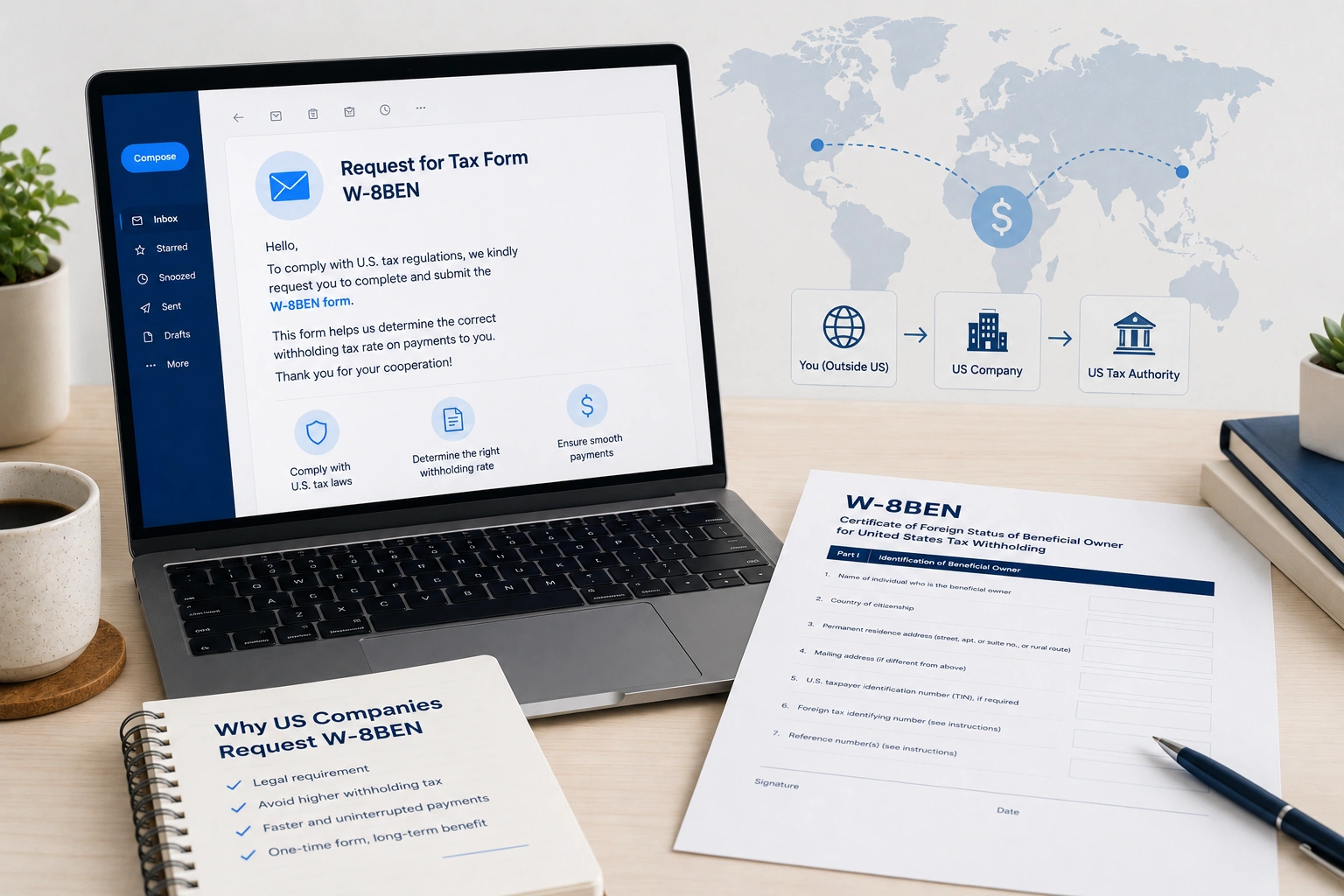 AI-generated image
You landed a U.S. client, joined a creator platform, or opened a marketplace account—and now someone wants Form W-8BEN before they pay you. If this is your first time seeing the name, it can feel alarming: a foreign tax form, a request for your tax ID, and a deadline before money moves.
Here is the reassuring part: a W-8BEN request is usually routine compliance, not a sign that something is wrong. U.S. law requires companies that pay non-U.S. persons to collect documentation before certain payments. The form confirms you are a foreign individual and—when you qualify—supports a reduced U.S. withholding rate under an income tax treaty instead of the default 30%.
This guide explains why a U.S. company asks for W-8BEN, what they do with it, what happens if you delay, whether sharing your tax ID is safe, which form applies to individuals versus companies, how long the certificate stays valid, and what to do next. It is general education on U.S. withholding paperwork—not individualized tax or legal advice.
Ready to answer the request without guessing field by field? Fill W-8BEN online with the W8GetEasy wizard ($5, payer-ready PDF in minutes).
The legal reason: US withholding tax and Chapter 3
U.S. federal tax law requires many payers to withhold tax on payments to foreign persons. When a U.S. company pays you interest, dividends, royalties, service fees, or other U.S.-source amounts, it may deduct tax at the source and remit it to the IRS. The payer acts as a withholding agent under Chapter 3 of the Internal Revenue Code.
- Default 30% without documentation: Without a valid IRS Form W series certificate on file, many payments to foreign persons face 30% withholding under IRC § 1441—not because the company wants to keep your money, but because the law sets that rate when documentation is missing.
- What W-8BEN certifies: Form W-8BEN is the standard certificate for foreign individuals. You certify that you are not a U.S. person, that you are the beneficial owner, and—when applicable in Part II—that a treaty reduces withholding on the payment type involved.
- Why the company must ask: Withholding agents face penalties if they pay foreign recipients without proper documentation. Requesting W-8BEN before the first payout protects both sides.
- Official background: Current form text is on the IRS W-8BEN page. Broader rules appear in IRS Publication 515.
Most freelancers, consultants, and creators abroad are foreign individuals—the group W-8BEN is designed for. If income is paid to a registered company rather than to you personally, a different form usually applies; see W-8BEN vs W-8BEN-E: which form do you need.
Receiving a W-8BEN request does not mean the IRS is auditing you. It means the payer is following rules that apply to millions of cross-border payments every year.
What the company does with your W-8BEN
Once you submit a signed W-8BEN, the U.S. company stores it in tax records and uses it to set withholding on each payment. They do not publish your form publicly, and they do not file your home-country tax return. Their job is U.S. source withholding compliance.
- Sets your withholding rate: Based on your certified status and any treaty claim in Part II, the payer applies 0%, a treaty rate, or 30%—whichever the form and IRS rules support.
- Keeps records for the IRS: Withholding agents must retain valid certificates and may report payments on forms such as 1042-S. Your W-8BEN is part of that audit trail.
- May request updates: If you change country of residence, legal name, or business structure—or when the certificate expires—the payer will ask for a new form.
What happens if you don't submit W-8BEN
Ignoring the request rarely makes it go away. Most U.S. payers will hold payments, apply maximum backup withholding, or block account features until valid documentation is on file. Pay without a certificate, and the payer risks 30% withholding or compliance penalties.
Delaying can cost real money. Thirty percent on gross payments adds up quickly on freelance fees or platform revenue. Even when a treaty would allow a lower rate, the payer cannot apply relief without a complete, signed certificate. Treat the request as part of onboarding—not an optional step after you have spent the income.
Is it safe to give a US company your tax ID?
W-8BEN asks for your foreign tax identification number on Line 6 and, in some cases, a U.S. TIN on Line 5. For legitimate U.S. clients and well-known platforms, providing accurate information is the standard step to receive payments at the correct withholding rate.
- Why they need a tax ID: The IRS requires payers to associate each certificate with a taxpayer identifier. Your home-country tax ID on Line 6 is usually sufficient for foreign individuals.
- Who sees your data: Your payer and their compliance team use the form internally. Verify you submit through the company's official tax portal—not an unverified email attachment.
- Line 5 vs Line 6: Most non-U.S. individuals leave Line 5 blank and enter their foreign TIN on Line 6. See How to fill W-8BEN Part I for field-by-field guidance.
- Red flags: Be cautious if someone asks for W-8BEN before any business relationship exists or requests banking passwords. A real payer wants documentation tied to payments they owe you.
Individual vs company: which form you need
Form W-8BEN is for foreign individuals paid in their personal name. If a U.S. client pays your personal bank account for freelance work, W-8BEN is typically correct. If they pay your Ltd., GmbH, or other registered entity, they usually need Form W-8BEN-E—the entity version with Chapter 3 and Chapter 4 (FATCA) status boxes.
Choosing the wrong form is a common rejection reason. When both names appear in a checklist, read W-8BEN vs W-8BEN-E before you start. Entity classification rules—not gut feeling—determine which form applies.
- Use W-8BEN when: You are a non-U.S. individual paid personally and you are the beneficial owner of the income.
- Use W-8BEN-E when: A company, partnership, trust, or other entity is the payee, or the platform pays your business account in the entity's name.
How long W-8BEN stays valid
A signed W-8BEN generally expires on the last day of the third calendar year after the year you signed—unless a change in circumstances makes it incorrect sooner.
- Three-year rule of thumb: If you signed in 2026, the certificate often remains valid through December 31, 2029, assuming your facts stay the same.
- Changes that require a new form: Moving countries, changing legal name, or switching from individual to entity payee require a new certification—even before the three-year period ends.
- Keep a signed copy: Save the PDF you submitted so renewal is faster when payers send reminders.
Worked example: a UK copywriter almost ignored the W-8BEN request as spam
Megan Foss, a freelance copywriter in Norwich, won her first project with a US content marketing agency: a £7,000 batch of website copy. A week later, an automated email arrived from the agency's finance system asking her to 'complete IRS Form W-8BEN' before the invoice could be paid. She had never heard of the IRS or the form, the sender address looked unfamiliar, and she set the email aside for nearly three weeks, assuming it was spam or irrelevant to a one-off freelance job.
When the invoice finally paid out, only £4,900 had arrived instead of £7,000 — the agency's payment system had applied the default 30% US withholding because no valid certificate was on file. Megan logged into the agency's official client portal directly (not the email link) to confirm the request was genuine, then completed W-8BEN citing the UK and Article 7 business profits with no US permanent establishment. The agency confirmed her next invoice would go out in full, with 0% withholding, going forward.
- No W-8BEN on file: 30% withheld on the first invoice — £2,100 held back on a £7,000 payment.
- W-8BEN filed through the agency's official portal, UK residence, Article 7, no US permanent establishment: 0% withholding on every invoice after that.
What to do next: fill out W-8BEN now
You do not need to become a tax expert overnight—you need an accurate, signed certificate delivered through the payer's official channel. Confirm whether you are an individual or entity payee, gather your foreign tax ID and permanent address, then complete Part I and Part II if a treaty rate applies.
- Confirm the right form: Individual paid personally? Use W-8BEN. Company on the contract? See W-8BEN vs W-8BEN-E first.
- Complete Part I: Name, address, and tax IDs must match your passport and home tax records. Our Part I guide walks through each line.
- Sign and submit to the payer: You generally do not mail W-8BEN to the IRS. Upload it in platform tax settings or send it to accounts payable as instructed.
- Use guided help: Fill W-8BEN online with W8GetEasy ($5) for guided questions and a formatted PDF ready for your payer.
Common mistakes people make when they first get a W-8BEN request
- Assuming it's a scam and ignoring it: Legitimate US clients, marketplaces, and platforms request W-8BEN routinely. Don't click links inside an unexpected email — instead, log in directly to the platform or contact the client through a known channel to confirm the request.
- Waiting until after the first payment: Submitting W-8BEN only after a payment already arrived short does not recover the amount already withheld and sent to the IRS — the form protects future payments, not past ones.
- Filling out the individual form when the contract is with your company: If a US client pays your Ltd., GmbH, or other registered business rather than you personally, they generally need Form W-8BEN-E, not W-8BEN.
- Sending the form by unofficial email instead of the payer's tax portal: Submit through the platform's tax settings or the process your client's accounts payable team specifies — not as a PDF attached to a reply email, unless that is explicitly how they collect it.
- Letting the certificate lapse without noticing: A signed W-8BEN generally expires at the end of the third calendar year after signature. Payers do not always send a clear reminder — set your own.
Does the W-8BEN request change anything about your UK taxes?
No. W-8BEN only tells the US payer how much to withhold at source — it is not reported to HMRC and does not replace your Self Assessment. You still owe UK tax on the full gross payment, calculated under normal Self Assessment rules, regardless of what a US company withheld or did not withhold.
If US tax was withheld before your W-8BEN was on file — or before a treaty rate applied — the UK/US tax treaty and UK foreign tax credit relief generally let you offset the US tax already paid against your UK liability on the same income, so it isn't taxed twice. This isn't automatic on your Self Assessment; check the foreign tax credit relief pages or ask an accountant rather than assuming HMRC applies it for you.
- The W-8BEN itself is not sent to HMRC — but the income it relates to still needs to appear on your Self Assessment as normal.
- Keep the signed W-8BEN and any statement showing US withholding — you'll want it as evidence if you claim foreign tax credit relief.
- Filing W-8BEN correctly with a treaty rate usually means there's nothing left to credit — the credit route mainly matters for tax withheld before your paperwork was in place.
Frequently asked questions: why US companies ask for W-8BEN
Why does a US company ask for W-8BEN?
U.S. law requires many payers to withhold tax on payments to foreign persons unless they have a valid withholding certificate. W-8BEN documents that you are a foreign individual and supports a treaty rate lower than 30% when you qualify.
What is W-8BEN used for?
It certifies your foreign status so a U.S. withholding agent can apply the correct rate on U.S.-source payments. It is compliance paperwork—not a visa, work permit, or U.S. tax return.
Do I send W-8BEN to the IRS?
Usually no. You give the signed form to the company or platform that pays you. They retain it for withholding and reporting.
What happens if I ignore the W-8BEN request?
The payer may withhold 30%, delay payouts, or block account features until documentation is complete.
Is it safe to share my tax ID on W-8BEN?
For legitimate U.S. clients and established platforms, yes—your foreign tax ID on Line 6 is standard. Verify you use the company's official tax portal.
Do I need a US Social Security Number or ITIN?
Most foreign individuals use a foreign tax ID on Line 6 and leave Line 5 blank unless they already hold a U.S. TIN.
W-8BEN vs W-8BEN-E — which one does my payer need?
Individuals paid personally use W-8BEN. Registered companies and most entities use W-8BEN-E. See W-8BEN vs W-8BEN-E for a comparison.
How long is W-8BEN valid?
Typically through the end of the third calendar year after you signed, unless your circumstances change sooner.
Can I fill out W-8BEN online?
Yes. W8GetEasy ($5) guides you through Part I and Part II and produces a signed PDF for your payer.
A U.S. company asks for W-8BEN because federal withholding rules require documentation before many cross-border payments—not because you did something wrong. Confirm individual versus entity form, enter accurate tax IDs, sign, and submit through the payer's official channel. This article is general information only and does not replace advice from a qualified tax professional.
Got a W-8BEN request and want it done correctly the first time?
Fill W-8BEN online — $5. W8GetEasy walks you through status certification, treaty fields, and delivers a payer-ready PDF.