W-8BEN-E for an Irish Company: LTD, DAC, PLC, or ULC — Line-by-Line Guide, the ULC Trap, and a Sample PDF
This article was created with AI assistance and has not been reviewed by a human editor. It is provided for general informational purposes only and does not constitute tax, legal, or financial advice.
Treaty articles and rates on this page are checked directly against the current US-Ireland Income Tax Convention (1997) — last verified September 2026.
 AI-generated image
Your Irish company just invoiced a US client for consulting, software development, or SaaS services — and the client's finance team is now asking for a completed W-8BEN-E before they'll release payment. That's the single most common reason Irish company owners end up on this page.
This guide walks through the actual IRS line numbers for that exact scenario, using the current 2021 revision of the form, shows a real filled example, and covers the one nuance almost every generic guide gets wrong: "Irish limited company" isn't a single answer on this form. Which of five common Irish company types you actually have changes the correct box to check.
If you're not incorporated — a sole trader operating under your own PPSN — the shorter W-8BEN applies instead: start the W-8BEN wizard. This page covers incorporated businesses: LTD, DAC, PLC, CLG, and ULC.
Or skip the reading and start the W-8BEN-E wizard — guided questions, an automatically suggested treaty article and rate, and a signature-ready PDF for $30.
Blank form or already filled in?
You can download the official, blank form from the IRS and complete it yourself — or get the same file already filled in correctly by our wizard in a few minutes.
- Blank official W-8BEN-E (IRS, free): Download W-8BEN-E as a PDF directly from the IRS — for LTD, DAC, PLC, CLG, and ULC companies.
- Blank official W-8BEN (IRS, free): Download W-8BEN as a PDF directly from the IRS — for sole traders.
- Already filled in (5–10 minutes): W-8BEN-E for Irish companies ($30) or W-8BEN for sole traders ($5) — treaty article and rate suggested automatically, ready to sign as a PDF.
Which Irish company type are you actually dealing with?
The answer depends on your company's legal form, not your revenue and not how many people work there:
- Sole trader: Not a separate legal entity — you're treated as an individual for US tax purposes. You use the shorter W-8BEN, with your PPSN, not W-8BEN-E.
- LTD (private company limited by shares): By far the most common Irish company type. Not on the US "per se corporation" list, but defaults to Corporation for US tax purposes anyway, because its shareholders have limited liability under Irish company law. Electing a different classification requires filing Form 8832.
- DAC (Designated Activity Company): Used for companies with a specific, restricted objects clause (common for regulated activities and joint ventures). Same reasoning as LTD (limited liability) — defaults to Corporation.
- PLC (Public Limited Company): The one Irish company type explicitly on the US "per se corporation" list — always Corporation, with no ability to elect a different classification via Form 8832.
- CLG (Company Limited by Guarantee): Typical structure for charities and nonprofits — members' liability is limited by guarantee rather than shares, which still counts as limited liability, so it also defaults to Corporation. In practice, though, a genuine charity's real Chapter 3 status is usually Tax-exempt organization rather than plain Corporation.
- ULC (Unlimited Company): The exception that runs the other way. Because its members have UNLIMITED liability, a ULC does NOT default to Corporation — see the dedicated section below.
That last one — the ULC — is worth pausing on, because it's the opposite of what most guides assume, and it isn't a rare edge case invented for this page: Irish law lets an unlimited company skip the requirement to file public financial statements with the CRO, which is exactly why some real, well-known companies choose this structure. Janssen Pharmaceutical, a Johnson & Johnson subsidiary, re-registered as an unlimited company in Ireland specifically to keep its accounts out of the public record.
A quick myth to clear up: it is NOT true that every Irish limited company defaults to Corporation for US tax purposes. LTD, DAC, PLC, and CLG do. A ULC does not — see the next section for exactly what applies instead.
Who actually needs to fill in W-8BEN-E?
In short, any Irish LTD, DAC, PLC, CLG, or ULC that receives payments from a US business and wants to document its non-US tax status. Common situations:
- Invoicing US clients directly: Your company bills a US-based business for consulting, development, design, or other services.
- US payment platforms: Payouts from Stripe, Amazon, YouTube/AdSense, or similar US-headquartered platforms.
- US shares and dividends via a broker: Your company holds US securities through an Irish broker (Davy Select, Goodbody, or similar) and receives dividends.
- Royalty or interest income: Your company receives royalty or interest payments from a US source — ordinary interest and royalties are typically 0% (see rates below for the contingent-interest and RIC/REIT caveats), but the form is still what documents that claim.
What happens without a valid form?
Without a submitted W-8BEN-E, the US payer generally withholds 30% of the gross payment — even if a lower rate (or 0%) would otherwise apply under the treaty. Services, ordinary interest, and royalties can be 0%; dividends stay 5%/15% (and RIC/REIT dividends are narrower still). Some US platforms and brokers pause payment entirely until a valid form is on file.
The form is never sent to Irish Revenue or the IRS — it stays with the US payer as their own compliance record. Your company still reports the US income as normal on its Irish corporation tax return; W-8BEN-E only affects US withholding at source.
W-8BEN-E line by line: what an Irish company actually enters
Below is the official IRS "Line X" numbering exactly as printed on the current form, for the standard case: an operating LTD, DAC, or PLC, Active NFFE, claiming treaty benefits under the US-Ireland treaty. A ULC follows different rules on Line 4 — covered in the dedicated section right after this table. Holding structures and financial institutions follow different rules on some lines — our wizard determines the right answer automatically from your answers.
| Line | What you enter |
|---|---|
| Line 1 | Your company's full legal name exactly as registered with the Companies Registration Office (CRO). |
| Line 2 | Country of incorporation: Ireland. |
| Line 3 | Leave blank — only applies if a disregarded entity is receiving the payment on behalf of its owner. |
| Line 4 | Check "Corporation" for a PLC (always), or an LTD, DAC, or CLG (by default, unless Form 8832 elected otherwise). A multi-member ULC checks "Partnership" instead — see the dedicated section below. The "hybrid entity" follow-up question is usually "No" for an ordinary LTD, DAC, PLC, or CLG. For an Irish-resident ULC claiming Part III as the company, that follow-up is typically "Yes". |
| Line 5 | Chapter 4 (FATCA) status — for a normal operating company with no financial activity, usually "Active NFFE". |
| Line 6 | Your company's actual registered office address (not a virtual mailbox provider's address used only for correspondence). |
| Line 7 | Only complete if your mailing address differs from Line 6. |
| Line 8 | Usually blank — a US TIN (EIN) is only required in specific cases your payer will tell you about. |
| Line 9a | Leave blank — a GIIN only applies to financial institutions. |
| Line 9b | Your company's Tax Reference Number, issued by Revenue when you registered for Corporation Tax (Form TR2), as "Foreign TIN". This is NOT the same number as an individual's PPSN, even though both typically look like 7 digits followed by a letter — see the dedicated note below. |
| Line 9c | In practice this is never checked for a registered LTD, DAC, PLC, or CLG — the Tax Reference Number is assigned during TR2 registration. |
| Line 10 | Usually blank — only completed at the payer's explicit request. |
| Part II (Lines 11–13) | Not completed for a normal LTD, DAC, or PLC — only applies to disregarded entities or branches (relevant to a single-member ULC — see below). |
| Line 14a | Country of residence for treaty purposes: Ireland. |
| Line 14b | Limitation on Benefits (LOB) category — Article 23 of the treaty exists, so "No LOB Article In Treaty" is not valid here. |
| Line 14c | Not normally checked — a narrow special case. |
| Line 15 | Treaty article, paragraph, rate, and income type (e.g. "Article 7(1)", 0%, "Services" for service income with no US permanent establishment). Suggested automatically by the wizard. |
| Line 39 (Part XXV) | Check the "Active NFFE" certification, matching Line 5. |
| Part XXX | Signature, printed name, date. Normally signed by a director or other authorised signatory. |
Line numbers match the form currently in force (Rev. October 2021). If the IRS issues a new revision, always defer to the numbering on the actual PDF you download.
Every field in the table above is filled in automatically by our guided W-8BEN-E wizard based on your answers — including the treaty article and rate on Line 15.
The ULC trap on Line 4: why an Unlimited Company isn't a Corporation by default
This is the single most common mistake for Irish companies specifically — and it runs in the opposite direction from the usual "small company defaults to Corporation" assumption.
| Point | What it means |
|---|---|
| Why it's different | US tax rules default a foreign company to Corporation only if ALL of its members have limited liability. An Irish LTD, DAC, PLC, or CLG passes that test. A ULC's members have UNLIMITED liability, so it fails it. |
| What applies instead | A ULC with two or more members defaults to Partnership. A ULC with a single member defaults to a disregarded entity — in that case, it's generally the OWNER's information (not the ULC's) that goes on the relevant W-8 form; see the disregarded entity guide linked at the end of this page for how that works. |
| Why this comes up at all | Irish company law lets an unlimited company skip the requirement to publicly file financial statements with the CRO. That's a real, still-used reason companies choose this structure — Johnson & Johnson's Irish subsidiary Janssen Pharmaceutical is a documented example. |
| How to check which one you have | Your Certificate of Incorporation and CRO filings state the company type explicitly. If you're not sure, your company secretary or accountant can confirm it in a moment — don't assume Corporation just because the company has share capital. |
| The hybrid follow-up on Line 4 | An Irish-resident ULC is a company in Ireland but, by default, a partnership (multi-member) or disregarded entity (single-member) in the US — that is a hybrid. If the ULC itself is claiming treaty benefits in Part III as the Irish-resident company, the Line 4 hybrid question is typically Yes. Hybrid No with Part III still filled is for a flow-through that is not making the treaty claim itself. |
Form 8832 can change any of these defaults (a ULC electing Corporation treatment, or an LTD electing partnership/disregarded treatment) — but only if that election has actually been filed. Absent a Form 8832 election, use the default that matches your actual company type.
What a completed W-8BEN-E looks like for an Irish LTD
An anonymised example: a private company limited by shares (LTD) providing software consulting to US clients, Active NFFE, no US permanent establishment, claiming treaty benefits under Article 7(1) — 0% withholding on US service income. This is the same signature-ready PDF our wizard produces automatically from the same inputs.
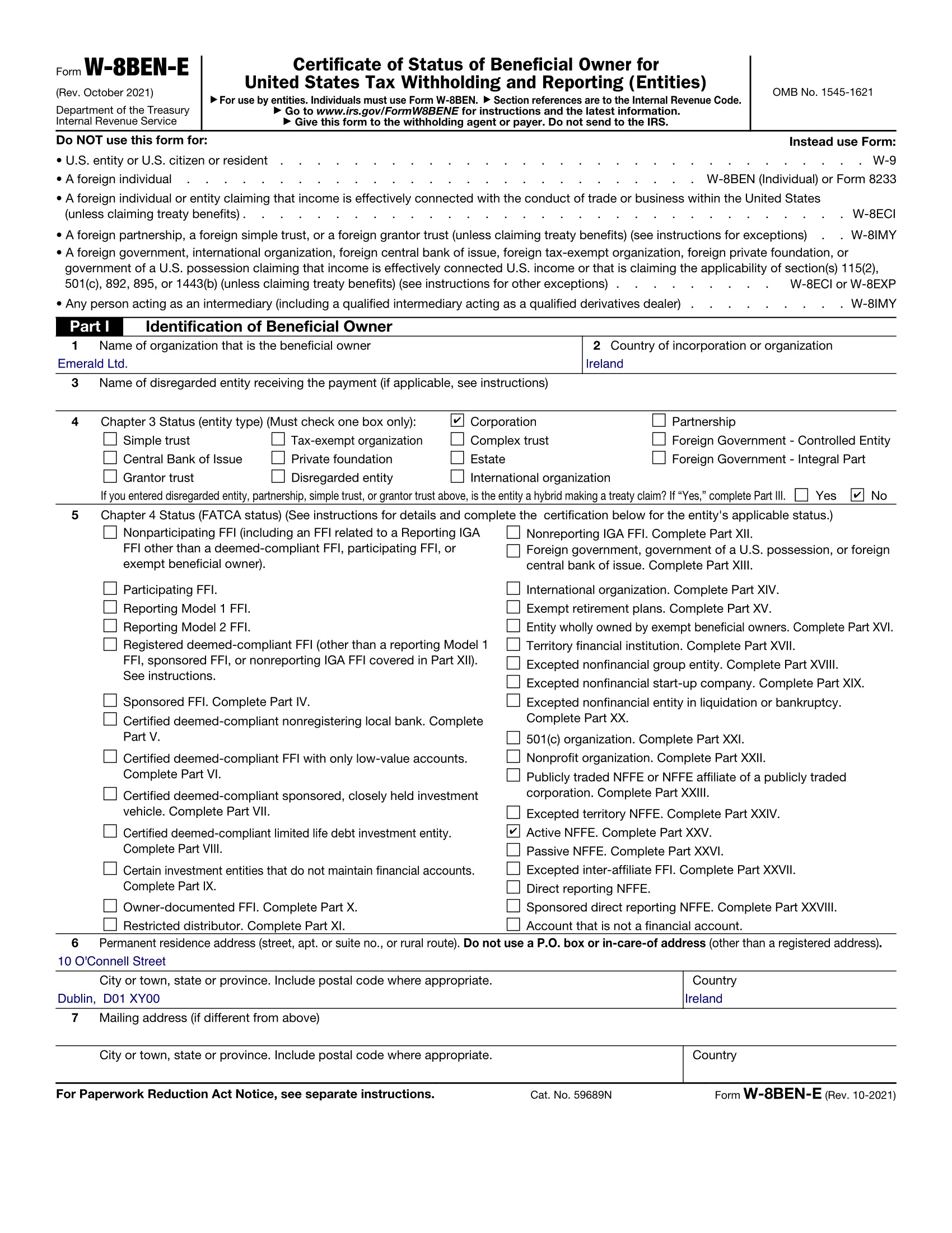
For illustration only — company name, address, director, and Tax Reference Number are fictional. Example: Emerald Ltd., Dublin, Tax Reference Number 9876543H, Chapter 3 Corporation, FATCA Active NFFE, US-Ireland treaty Article 7(1) (Business Profits) 0%.
Treaty rates by income type
The US-Ireland treaty is unusually generous on two income types — worth knowing before you assume a rate from another country's page:
| Income type | Article | Rate |
|---|---|---|
| Services / consulting / software (Business Profits) | Article 7 | 0% (with no US permanent establishment) |
| Dividends (company owning ≥10% of the payer's voting stock — not RIC/REIT) | Article 10(2)(a) | 5% |
| Dividends (all other ordinary cases, including individuals) | Article 10(2)(b) | 15% |
| Dividends from a US RIC or REIT | Article 10(4) | Not 5%. RIC: usually still 15% under 10(2)(b). REIT: generally no treaty reduction, except an individual owner holding under 10% |
| Interest (ordinary) | Article 11 | 0% (residence-only; not contingent or profit-linked interest) |
| Royalties (all types — no equipment-vs-IP split in this treaty) | Article 12 | 0% (residence-only; no source-country withholding) |
Unlike some other treaties, the US-Ireland treaty does not split royalties into a lower rate for equipment and a higher rate for software or other IP — it's a flat 0% for any royalty type. Ordinary interest is 0% under Article 11; Exchange of Notes item 6 still lets the US tax profit-linked or contingent interest at 15% under Article 10(2)(b). Don't assume a 5%/10% royalty split you may have seen mentioned for other countries; it doesn't exist in this treaty.
A blog post explaining the form, or the finished PDF right away?
The Irish-specific guides we found are either broker FAQs focused on the simpler individual W-8BEN (Davy Select, Goodbody), or generic global guides that treat every "Irish limited company" as an automatic Corporation without mentioning the ULC exception or the PPSN/Tax Reference Number distinction. Our wizard asks the right questions once and hands you the signature-ready PDF immediately.
| Criterion | Published guides | Our wizard |
|---|---|---|
| What you get | A general explanation that Irish limited companies are Corporations | The completed, signature-ready PDF itself |
| LTD/DAC/PLC/CLG vs ULC classification | Not distinguished by any guide we reviewed | Explained with the exact default rule, built into the Chapter 3 step |
| PPSN vs Tax Reference Number | Not distinguished — risk of using the wrong number on Line 9b | Asks for the correct company identifier specifically |
| Treaty article & rate (Line 15) | Worked out manually by you | Suggested automatically from your answers |
Start the wizard now and get your finished PDF in minutes.
Frequently asked questions about W-8BEN-E for Irish companies
Direct answers to the questions Irish company owners run into most often when filling this in.
What's the difference between LTD, DAC, PLC, CLG, and ULC for this form?
All five check "Corporation" on Line 4 EXCEPT a multi-member ULC (which is a Partnership by default) and a single-member ULC (which is a disregarded entity by default). PLC is always a Corporation because it's on the US per se corporation list. LTD, DAC, and CLG default to Corporation because their members have limited liability. A ULC's members have unlimited liability, so it does not get that default.
Is my ULC really not a Corporation?
Under the default US tax classification rules, correct — unless your company has filed Form 8832 to elect Corporation treatment. Check your Certificate of Incorporation to confirm you actually have a ULC (rather than an LTD) before relying on this. An Irish-resident ULC that claims Part III as the company is a hybrid making a treaty claim, so the Line 4 hybrid follow-up is typically Yes — not the "usually No" answer that applies to an ordinary LTD, DAC, PLC, or CLG.
What's the difference between my PPSN and my company's Tax Reference Number?
The PPSN (Personal Public Service Number) belongs to an individual and goes on a personal W-8BEN. The Tax Reference Number belongs to the company, is issued by Revenue when the company registers for Corporation Tax, and goes on the company's W-8BEN-E Line 9b. They often look similar (7 digits plus a letter), but they are different numbers from different sources — using the wrong one is a common mistake.
Do I need a US EIN, or is the Tax Reference Number enough?
For most LTD, DAC, and PLC companies, the Tax Reference Number is sufficient as the "Foreign TIN" on Line 9b. A US EIN is only needed in specific cases your payer will tell you about.
Which Line 14b box should my company check?
For a typical operating LTD, DAC, or PLC with no complex ownership structure, "Active trade or business" (the paragraph 3(a) test) is usually the applicable one. The ownership-and-base-erosion test in paragraph 2(c) is a separate, more specific test tied to who owns the company — our wizard walks through which applies to your situation.
What's Chapter 4 / Active NFFE?
It's a separate FATCA classification from your entity type. A normal trading company with under 50% passive income and assets is usually "Active NFFE".
What treaty rates typically apply?
Under the US-Ireland treaty: 0% on standard service income with no US permanent establishment (Article 7), 5% on dividends where your company directly owns at least 10% of the US company's voting stock, 15% otherwise (Article 10). RIC dividends are usually still 15% under Article 10(2)(b); REIT dividends generally get no treaty reduction except an individual owner holding under 10% (Article 10(4)). Ordinary interest is 0% (Article 11; profit-linked or contingent interest can still be taxed at 15% under Article 10(2)(b)), and royalties are 0% (Article 12) with no equipment-vs-IP split. Our wizard suggests the right one automatically.
Does the form go to Irish Revenue or the IRS?
No — W-8BEN-E goes only to the US payer (client, platform, or broker), never to Irish Revenue or the IRS directly.
How long is W-8BEN-E valid for?
Generally until the end of the third calendar year after signing — a form signed in 2026 is valid through 31 December 2029, provided none of the underlying details change.
What if my company details change?
A change of name, address, entity type, or ownership structure invalidates the existing form, and a new W-8BEN-E is required regardless of the usual three-year cycle.
I'm a sole trader, not a company — which form do I use?
The shorter W-8BEN, using your PPSN rather than a company Tax Reference Number. This page's line-by-line guidance is for incorporated companies (LTD, DAC, PLC, CLG, ULC).
Do I need an accountant to complete this?
Not necessarily for standard cases — an ordinary trading LTD, DAC, or PLC, Active NFFE, common income types can usually be completed with a guided wizard. A ULC, a holding structure, or a complex ownership situation is worth a brief check with an accountant or tax advisor first.
What does it cost to get W-8BEN-E right?
With our guided wizard, $30 per finished, signature-ready PDF for companies (or $5 for sole traders) — no subscription.
Related guides
For more detail on specific parts of the form:
- Entity type on Line 4 in detail: Full guide to Line 4
- Chapter 3 status in detail: Chapter 3 status guide
- Single-member ULC or other disregarded entity: Disregarded entity guide
- W-8BEN vs W-8BEN-E compared directly: The difference between W-8BEN and W-8BEN-E
- You're a sole trader, not a company: W-8BEN wizard for sole traders ($5)
Common mistakes to avoid
- Assuming every Irish limited company is a Corporation by default: LTD, DAC, PLC, and CLG are. A ULC (Unlimited Company) is NOT — its members' unlimited liability means it defaults to Partnership (multiple members) or a disregarded entity (single member) instead.
- Answering the Line 4 hybrid follow-up No while the ULC claims Part III: An Irish-resident ULC is a company in Ireland and a partnership or disregarded entity in the US by default — a hybrid. If the ULC itself is making the treaty claim, that follow-up is typically Yes. Hybrid No with Part III filled is for a flow-through that is not claiming treaty benefits in its own right.
- Confusing the PPSN with the company's Tax Reference Number: They often look alike (7 digits plus a letter), but the PPSN belongs to an individual and the Tax Reference Number belongs to the company — using the individual's PPSN on a company's W-8BEN-E is incorrect.
- Inventing a royalty rate split that doesn't exist in this treaty: Unlike some other countries' treaties, the US-Ireland treaty does not split royalties by equipment vs. IP — it's a flat 0% for any royalty type under Article 12.
- Citing Article 22 instead of Article 23 for Limitation on Benefits: The LOB article in the US-Ireland treaty is numbered 23, not 22 — a mistake that's easy to make if you've seen another country's treaty numbering first.
- Citing a treaty article without stating there's no US permanent establishment: Line 15 needs both the article/rate and a short explanation of why you qualify — for most service income, that means explicitly stating your company has no permanent establishment in the United States.
A quick note on Irish corporation tax
This page focuses entirely on US withholding tax — the reason your company needs to fill in W-8BEN-E at all. It doesn't cover Ireland's own tax treatment of that income, which has a well-known feature worth being aware of: Ireland's standard corporation tax rate on trading income is 12.5%, among the lowest in the EU — a large part of why Ireland hosts so many internationally-trading companies in the first place.
How that income is actually taxed once it reaches your Irish company is a question for a licensed Irish accountant or tax advisor, not something this page — or our wizard — determines for you. W-8BEN-E only affects what a US payer withholds at source; it has no bearing on how Ireland taxes your company's profits.
Ready to finish your own W-8BEN-E instead of reading more guides?
The guided wizard asks the same questions covered on this page — directly inside your own form, with the treaty article and rate suggested automatically.