W-8BEN-E for a Canadian Corporation: Line-by-Line Guide, Sample PDF, and the ULC Exception
This article was created with AI assistance and has not been reviewed by a human editor. It is provided for general informational purposes only and does not constitute tax, legal, or financial advice.
Treaty articles and rates on this page are checked directly against the current US-Canada Income Tax Convention (1980), as amended by the Third Protocol (1995) and the Fifth Protocol (2007) — last verified September 2026.
 AI-generated image
Your Canadian corporation just invoiced a US client for consulting, software development, or SaaS services — and the client is asking for a completed W-8BEN-E before they'll pay. That's the single most common reason Canadian company owners end up on this page.
This guide walks through the actual IRS line numbers for that exact scenario, using the current 2021 revision of the form, and shows a real filled example so you can see what a correct submission actually looks like — including the one Canadian entity type (the ULC) that almost every other guide gets wrong.
If you're a sole proprietor (not incorporated), the shorter W-8BEN applies instead — start the W-8BEN wizard with your Social Insurance Number (SIN) or Individual Tax Number (ITN). This page covers incorporated businesses: Corporation, ULC, and partnerships.
Or skip the reading and start the W-8BEN-E wizard — guided questions, an automatically suggested treaty article and rate, and a signature-ready PDF for $30.
Blank form or already filled in?
You can download the official, blank form from the IRS and complete it yourself — or get the same file already filled in correctly by our wizard in a few minutes.
- Blank official W-8BEN-E (IRS, free): Download W-8BEN-E as a PDF directly from the IRS — for Corporation, ULC, and partnerships.
- Blank official W-8BEN (IRS, free): Download W-8BEN as a PDF directly from the IRS — for sole proprietors.
- Already filled in (5–10 minutes): W-8BEN-E for Corporation/ULC/partnership ($30) or W-8BEN for sole proprietors ($5) — treaty article and rate suggested automatically, ready to sign as a PDF.
Which form applies: W-8BEN or W-8BEN-E?
The answer depends on how your business is structured, not your revenue:
- Sole proprietor: Not a separate legal entity — you're treated as an individual for US tax purposes regardless of revenue. You use the shorter W-8BEN, with your SIN or ITN, not W-8BEN-E.
- Corporation (Inc., Ltd., Corp., Corporation): A separate legal entity, federally or provincially incorporated. Under US tax rules, virtually every ordinary Canadian corporate form is a mandatory "per se corporation" (Treasury Regulation § 301.7701-2(b)(8) lists "Canada, Corporation and Company") — it can never be classified any other way. You use W-8BEN-E, Chapter 3 status Corporation.
- Unlimited Liability Company (ULC): The one Canadian entity type that is explicitly excluded from the per se corporation rule. A ULC — available in Nova Scotia, Alberta, British Columbia, and Prince Edward Island — is a foreign "eligible entity" that can elect its US tax classification. See the dedicated section below — this is the single most common classification mistake for Canadian entities.
- General or limited partnership: W-8BEN-E, Chapter 3 status Partnership.
This page focuses on the standard Corporation case first, then covers the ULC exception in detail — the scenario most competitor guides skip entirely.
One point worth being precise about: having a single shareholder does not make a Canadian Corporation a "disregarded entity" for US tax purposes. An ordinary Corporation is a per se corporation regardless of how many shareholders it has — the disregarded-entity question only becomes relevant for a ULC, covered below.
Who actually needs to fill in W-8BEN-E?
In short, any Canadian Corporation, ULC, or partnership that receives payments from a US business and wants to document its non-US tax status. Common situations:
- Invoicing US clients directly: Your company bills a US-based business for consulting, development, design, or other services.
- US payment platforms: Payouts from Stripe, Amazon, YouTube/AdSense, or similar US-headquartered platforms.
- US shares and dividends via a broker: Your company holds US securities through a broker (Wealthsimple, Questrade, RBC Direct Investing) and receives dividends.
- Royalty or interest income: Your company receives royalty or interest payments from a US source.
What happens without a valid form?
Without a submitted W-8BEN-E, the US payer generally withholds 30% of the gross payment — even if a lower rate (or 0%) would otherwise apply under the treaty. Some US platforms and brokers pause payment entirely until a valid form is on file.
The form is never sent to the CRA or the IRS — it stays with the US payer as their own compliance record. Your company still reports the US income as normal on its Canadian corporate tax return; W-8BEN-E only affects US withholding at source.
W-8BEN-E line by line: what a Canadian Corporation actually enters
Below is the official IRS "Line X" numbering exactly as printed on the current form, for the standard case: an operating Canadian Corporation, Active NFFE, claiming treaty benefits under the US-Canada treaty. Holding structures, ULCs, and financial institutions follow different rules on some lines — our wizard determines the right answer automatically from your answers.
| Line | What you enter |
|---|---|
| Line 1 | Your company's full legal name exactly as registered. |
| Line 2 | Country of incorporation: Canada — the same entry whether you're incorporated federally (Corporations Canada) or provincially. |
| Line 3 | Leave blank — only applies if a disregarded entity is receiving the payment (relevant for some ULCs, see below). |
| Line 4 | Check "Corporation" (this applies to Inc., Ltd., Corp., Corporation, and most ULCs electing corporate treatment; partnerships check "Partnership" instead). The "hybrid entity" follow-up question is usually "No" for an ordinary Corporation. |
| Line 5 | Chapter 4 (FATCA) status — for a normal operating company with no financial activity, usually "Active NFFE". |
| Line 6 | Your company's actual registered or operating address (not a PO box). |
| Line 7 | Only complete if your mailing address differs from Line 6. |
| Line 8 | Usually blank — a US TIN (EIN) is only required in specific cases your payer will tell you about. |
| Line 9a | Leave blank — a GIIN only applies to financial institutions. |
| Line 9b | Your CRA Business Number (BN) as "Foreign TIN", in the format 123456789RC0001 (9 digits plus the RC0001 program account suffix). Both federal and provincial incorporation trigger automatic BN assignment — there's no revenue threshold that exempts you. |
| Line 9c | In practice this is never checked for a registered Canadian corporation — you already have a BN from incorporation. |
| Line 10 | Usually blank — only completed at the payer's explicit request. |
| Part II (Lines 11–13) | Not completed for a normal Corporation — only applies to disregarded entities or branches (relevant for a single-owner ULC electing disregarded status). |
| Line 14a | Country of residence for treaty purposes: Canada. |
| Line 14b | Limitation on Benefits (LOB) category under Article XXIX A of the treaty — depends on ownership and business activity. Our wizard determines the right category from your answers. |
| Line 14c | Not normally checked — a narrow special case for dividends/interest paid through a foreign company. |
| Line 15 | Treaty article, paragraph, rate, and income type (e.g. "Article 7(1)", 0%, "Services" for service income with no US permanent establishment). Suggested automatically by the wizard. |
| Line 39 (Part XXV) | Check the "Active NFFE" certification, matching Line 5. |
| Part XXX | Signature, printed name, date. Normally signed by a director or other authorised signatory. |
Line numbers match the form currently in force (Rev. October 2021). If the IRS issues a new revision, always defer to the numbering on the actual PDF you download.
Every field in the table above is filled in automatically by our guided W-8BEN-E wizard based on your answers — including the treaty article and rate on Line 15.
The Canadian ULC exception: when "Corporation" doesn't mean per se corporation
The Unlimited Liability Company is a uniquely Canadian structure — available only in Nova Scotia, Alberta, British Columbia, and Prince Edward Island — where shareholders have unlimited liability for the company's debts. US Treasury regulations single it out by name as the one exception to Canada's otherwise sweeping per se corporation rule.
| Point | What it means |
|---|---|
| Why it's different | 26 CFR § 301.7701-2(b)(8) names "Canada, Corporation and Company" as a mandatory per se corporation — but the same regulation carves out "a Nova Scotia Unlimited Liability Company (or any other company or corporation all of whose owners have unlimited liability pursuant to federal or provincial law)." A ULC is a foreign "eligible entity" instead — it can elect its US classification. |
| Default classification | A single-owner ULC is disregarded for US tax purposes by default; a multi-owner ULC is a partnership by default. Either can instead elect to be taxed as a corporation by filing IRS Form 8832 (the "check-the-box" election). |
| Why US buyers use it | Because a single-owner ULC is typically disregarded for US purposes but remains an ordinary taxable corporation for Canadian purposes, it's a common cross-border planning and M&A vehicle — a genuine "hybrid entity." |
| The anti-abuse catch | Article IV(7)(b) of the treaty (added in 2010) can deny treaty benefits on payments from a hybrid entity like a disregarded ULC in certain double-dip financing structures. This doesn't affect an ordinary ULC operating an active business, but it's a reason to get professional advice before using a ULC purely for tax planning. |
If your company is a ULC, the correct W-8BEN-E treatment depends on your ownership structure and any classification election already on file — our wizard asks the right follow-up questions, but a ULC used for cross-border tax planning (rather than simply operating a Canadian business) is a case where a brief check with a cross-border tax advisor is worth it.
What a completed W-8BEN-E looks like for a Canadian Corporation
An anonymised example: a Toronto-based consulting Corporation with no US permanent establishment, Active NFFE, claiming treaty benefits under Article 7(1) — 0% withholding on US service income. This is the same signature-ready PDF our wizard produces automatically from the same inputs.
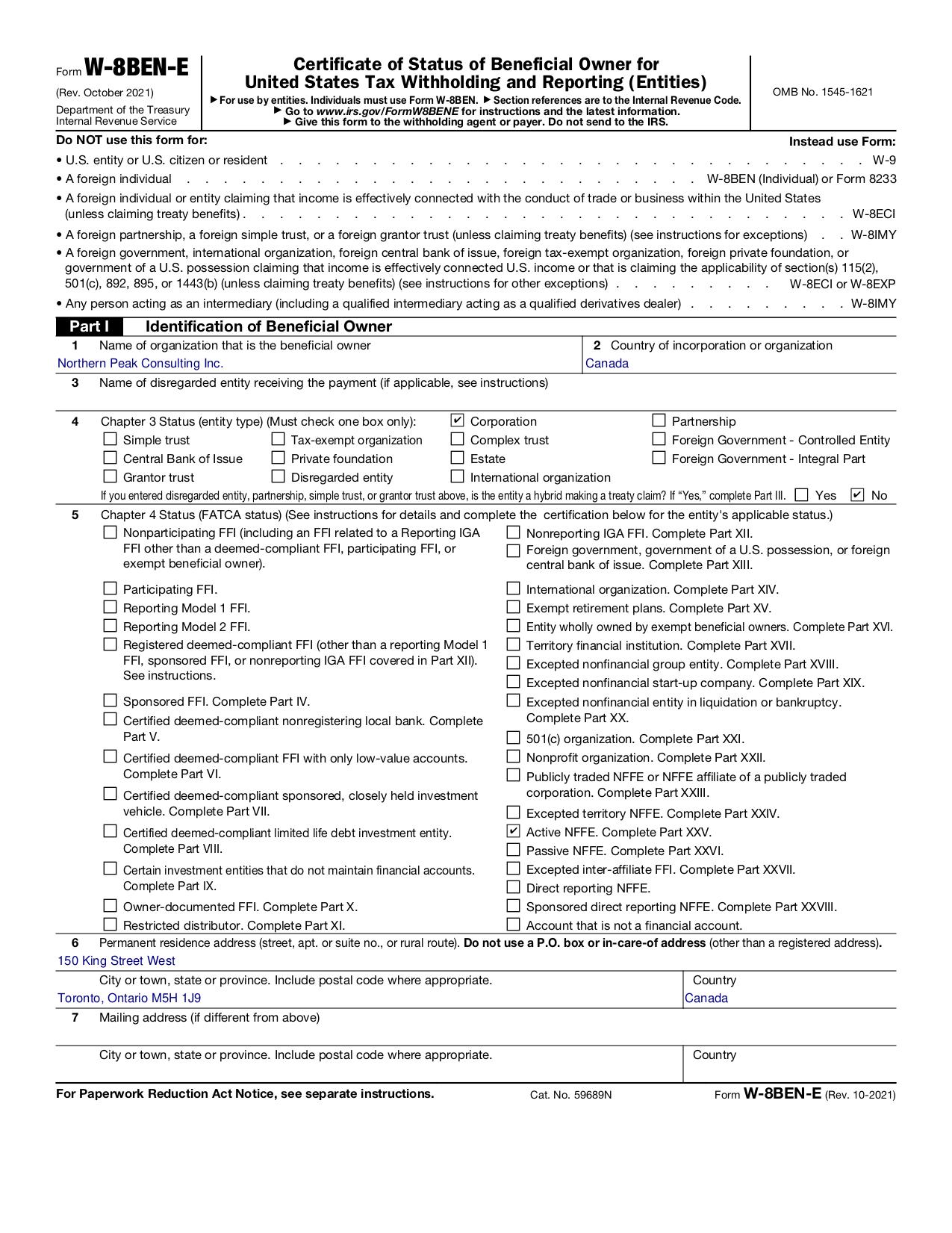
For illustration only — company name, address, and Business Number are fictional.
A blog post explaining the form, or the finished PDF right away?
The most detailed Canadian guides we found are personal-experience articles and accounting-firm blog posts — genuinely useful for understanding the concepts, but none walk through the ULC exception, the royalty carve-outs, or produce the finished document itself. Our wizard asks the same questions once and hands you the signature-ready PDF immediately.
| Criterion | Published guides | Our wizard |
|---|---|---|
| What you get | A general explanation of Active NFFE and the Business Number field | The completed, signature-ready PDF itself |
| ULC classification | Not covered by any guide we reviewed | Asks the right follow-up questions for ownership structure |
| Royalty withholding rate | Often stated as a flat 10% | Suggests the correct 0% or 10% category automatically |
| Treaty article & rate (Line 15) | Worked out manually by you | Suggested automatically from your answers |
Start the wizard now and get your finished PDF in minutes.
Frequently asked questions about W-8BEN-E for Canadian companies
Direct answers to the questions Canadian business owners run into most often when filling this in.
Do all Canadian companies need to fill in W-8BEN-E?
Only if your company has a business relationship with a US payer required to withhold US tax — for example a US client, a US payment platform, or a broker holding US securities on your behalf. Companies with no US-source income don't need the form.
What's the difference between a Corporation and a ULC for this form?
An ordinary Corporation (Inc., Ltd., Corp.) is a mandatory per se corporation under US rules and always files as "Corporation" on Line 4. A ULC is explicitly excluded from that rule and is instead an "eligible entity": by default, disregarded if it has one owner or a partnership if it has more than one — unless it elects corporation treatment on IRS Form 8832.
Does having one shareholder change anything for an ordinary Corporation?
No. A single-shareholder Canadian Corporation is still a per se corporation for US tax purposes — the disregarded-entity question only comes up for a ULC, not for an ordinary Corporation.
Where can a ULC be incorporated?
Nova Scotia, Alberta, British Columbia, and Prince Edward Island are the only four Canadian jurisdictions that permit ULCs. Nova Scotia also charges an annual special tax on ULCs not charged in the other three provinces.
Does my company need a US EIN?
Usually not. Most Canadian companies can use their CRA Business Number as a "Foreign TIN" on Line 9b. An EIN is only needed if your specific payer requires one.
What's Chapter 4 / Active NFFE?
It's a separate FATCA classification from your entity type. A normal trading company with under 50% passive income and assets is usually "Active NFFE".
Does federal vs. provincial incorporation change anything on the form?
No. Line 2 (country of incorporation) is always "Canada" regardless of whether your company was incorporated federally through Corporations Canada or under a provincial statute.
What treaty rates typically apply?
Under the US-Canada treaty: 0% on standard service income with no US permanent establishment (Article VII), 5% on dividends where your company directly owns at least 10% of the US company's voting stock, 15% otherwise (Article X), 0% on most cross-border interest (Article XI), and either 0% or 10% on royalties depending on the category (Article XII, see the mistakes section above). Your exact situation determines the applicable article and rate — our wizard suggests both automatically.
Does the form go to the CRA or the IRS?
No — W-8BEN-E goes only to the US payer (client, platform, or broker), never to the CRA or the IRS directly.
How long is W-8BEN-E valid for?
Generally until the end of the third calendar year after signing — a form signed in 2026 is valid through 31 December 2029, provided none of the underlying details change.
What if our company details change?
A change of name, address, entity type, or ownership structure invalidates the existing form, and a new W-8BEN-E is required regardless of the usual three-year cycle.
Do we need an accountant to complete this?
Not necessarily for standard cases — a normal trading Corporation, Active NFFE, common income types can usually be completed with a guided wizard. A ULC used for cross-border tax planning, or any structure with multi-tier ownership, is worth a brief check with a cross-border tax advisor first.
What does it cost to get W-8BEN-E right?
With our guided wizard, $30 per finished, signature-ready PDF for Corporation/ULC/partnership (or $5 for sole proprietors) — no subscription.
Related guides
For more detail on specific parts of the form:
- Entity type on Line 4 in detail: Full guide to Line 4
- Chapter 3 status in detail: Chapter 3 status guide
- W-8BEN vs W-8BEN-E compared directly: The difference between W-8BEN and W-8BEN-E
- Submitting the form to a Canadian broker: W-8BEN-E at Wealthsimple, RBC, TD, and Questrade
- You're a sole proprietor, not a corporation: W-8BEN wizard for sole proprietors ($5)
Common mistakes to avoid
- Treating a ULC exactly like an ordinary Corporation: A ULC is explicitly excluded from Canada's per se corporation rule (26 CFR § 301.7701-2(b)(8)) — it's an eligible entity that defaults to disregarded (single owner) or partnership (multiple owners) for US tax purposes, unless it elects corporation treatment on IRS Form 8832. Checking "Corporation" on Line 4 without confirming this can be the wrong answer for a single-owner ULC.
- Assuming all royalty income is taxed at a flat 10%: Under Article XII, copyright royalties (literary, dramatic, musical, or artistic works), computer software, patents, and know-how are exempt from withholding (0%) since the 1995 Third Protocol — only motion picture/broadcasting royalties and a few other categories remain at 10%. Several published guides state a flat 10% for all royalties, which overstates the withholding due on the most common categories for software and consulting businesses.
- Citing "Article 21" for Limitation on Benefits: The US-Canada treaty's LOB provision is Article XXIX A — a different numbering convention than some newer-template treaties (e.g. the current US-UK or US-Belgium treaties). Line 14b itself is a checkbox, not a citation, but if you reference the LOB article by name elsewhere, use Article XXIX A.
- Business Number formatted incorrectly on Line 9b: The BN goes on Line 9b as "123456789RC0001" — 9 digits plus the RC (corporate income tax) program suffix, not the 9-digit number alone and not a GST/HST program account (which uses a different suffix).
- Citing a treaty article without stating there's no US permanent establishment: Line 15 needs both the article/rate and a short explanation of why you qualify — for most service income, that means explicitly stating your company has no permanent establishment in the United States.
Ready to finish your own W-8BEN-E instead of reading more guides?
The guided wizard asks the same questions covered on this page — directly inside your own form, with the treaty article and rate suggested automatically.