W-8BEN-E for a Malta Ltd: the 6/7 refund can cancel the treaty rate
This article was created with AI assistance and has not been reviewed by a human editor. It is provided for general informational purposes only and does not constitute tax, legal, or financial advice.
Treaty articles and rates on this page are checked against the US-Malta Income Tax Convention signed at Valletta on August 8, 2008 (home.treasury.gov, Treaty-Malta-8-8-2008.pdf) — last verified September 2026. Instruments of ratification were exchanged on November 23, 2010. Withholding applies from January 1, 2011. The technical explanation is not the treaty text. No later protocol is on the IRS documents page.
 AI-generated image
If your Malta company pays out dividends to claim the 6/7 refund, check this before ticking Active trade or business. Article 22 counts those dividends toward a 25% cap when the owners are not qualifying residents of Malta or the United States. A company can have a real Maltese trade and still fail every main Limitation on Benefits test.
This guide is for a Malta private limited liability company (Ltd) that invoices US clients. It covers the Article 22 base-erosion clause, why a freelancer cites Article 7 and not Article 14, why royalties and ordinary interest are 10% and not 0%, which number goes on Line 9b, and what to do when profit is distributed to a non-resident owner. A sample PDF is included further down.
If you are a self-employed individual, you file Form W-8BEN, not this one: start the W-8BEN wizard. Article 3(1)(e) says business includes professional services and other activities of an independent character. There is no independent personal services article. Cite Article 7, not Article 14. Article 14 is Income from Employment. Do not invent a 183-day test for a freelancer. A Maltese national puts the identity card number on that form, for example 1234567M. That illustration is a format, not a published check digit.
If the base-erosion clause is met and the company has an active trade in Malta connected with the income, you can start the W-8BEN-E wizard now. In a few minutes you have a signature-ready PDF for $30, with Article 7(1) at 0% for services performed in Malta and no US permanent establishment, and Line 14b set to active trade or business under Article 22(4).
Blank form or already filled in?
You can download the official, blank form from the IRS and complete it yourself — or get the same file already filled in by our wizard.
- Blank official W-8BEN-E (IRS, free): Download W-8BEN-E as a PDF directly from the IRS — for a private Ltd or a public limited company.
- Blank official W-8BEN (IRS, free): Download W-8BEN as a PDF directly from the IRS — for a self-employed individual.
- Already filled in (5–10 minutes): W-8BEN-E for Malta companies ($30) or W-8BEN for individuals ($5).
- The convention: US-Malta Income Tax Treaty PDF on Treasury.gov — signed August 8, 2008. Article 7 is Business Profits. Article 22 is Limitation on Benefits.
Public limited company or private Ltd?
Malta company law uses more than one limited company, and US tax classification does not follow the local label one-for-one:
- Public limited company (p.l.c.): 26 CFR 301.7701-2(b)(8)(i) lists "Malta, Public Limited Company" as a per se corporation. It is a Corporation and cannot file Form 8832.
- Private limited liability company (Ltd): The usual operating company. It is not on the per se list. It defaults to Corporation because its members have limited liability, and a different US classification is made on Form 8832. A single-member private Ltd is not disregarded by default. Do not treat it as the public per se form.
- Partnership en nom collectif or en commandite: Defaults to Partnership when at least one partner has unlimited liability, under 26 CFR 301.7701-3(b)(2). Check Partnership in Part I, line 4, not Corporation.
- Self-employed individual: Not a company. That person files Form W-8BEN and cites Article 7, not Article 14.
The trap worth naming: a private Ltd is not the public company on the per se list. It defaults to Corporation and can leave that default on Form 8832. The treaty question is separate. Even a correctly classified Corporation gets no treaty rate unless Article 22 is met.
Chapter 3 still decides which form you file. The treaty rates sit in Part III, and Part III stays blank when the 25% clause fails and you are not claiming a rate.
Who actually needs to submit this form?
Any Malta private Ltd or public limited company that receives payments from a US business and needs to document that it is not a US person. Whether Part III is filled in depends on Article 22:
- Owners are residents of Malta, and dividends do not go to non-qualifying owners: If less than 25% of gross income is paid or accrued to persons who are not qualifying residents of the United States or Malta, and the company has an active trade in Malta connected with the income, Line 14b can be Active trade or business under Article 22(4). Services with no US permanent establishment are Article 7(1) at 0%.
- The company distributes profits to a non-resident owner: Those dividends count toward the 25%. A Malta Ltd owned by a resident of another country that pays out profits to support the 6/7 refund can fail Article 22(2)(c), 22(2)(f), and 22(4) together. For services performed outside the United States, leave Part III blank. For US-source royalties or dividends, the statutory 30% applies unless Article 22(6) relief is granted.
- A software licence, not a service invoice: A copyright licence of software is a royalty. Article 12(2) is 10% only if the company may claim the treaty. There is no 0% royalty rate. Equipment rental is Article 7, not Article 12.
Article 22 before you pick a Line 14b box
Publicly traded (Article 22(2)(c)), ownership and base erosion (Article 22(2)(f)), and active trade or business (Article 22(4)) each also require the same clause: less than 25% of gross income for the taxable year is paid or accrued, directly or indirectly, to persons who are not residents of either country entitled to benefits under Article 22(2)(a), (b), (c)(i), (d), or (e). Payments at arm length in the ordinary course for services or tangible property are left out. Dividends are not left out.
A yes on that 25% question does not by itself prove an active Maltese trade, and it does not answer the Article 22(4)(b) substantiality test. When the income comes from a US activity, Malta assets, gross income, and payroll for each of the three preceding years must each be at least 10% of the US activity, and the average of those three ratios must exceed 15%. Derivative benefits, the triangular permanent-establishment rule, competent-authority relief, and the remittance rule are not checkboxes.
| Step | Result |
|---|---|
| 1. Base erosion | Less than 25% paid or accrued to non-qualifying persons, and dividends to those owners count. If no, stop. Do not tick Active trade. |
| 2. If yes, and the company has a connected Maltese trade | Line 14b can be Active trade or business under Article 22(4), if Article 22(4)(b) is also met when it applies. |
| 3. If yes, and the company is mainly a holding company | Ownership and base erosion under Article 22(2)(f) still needs 75% of each class owned by qualified residents of Malta. United States residents do not count toward that 75%. Article 22(4) does not add this 75% test. |
| 4. If yes, and the shares are listed or a public company owns 75% | Publicly traded under Article 22(2)(c) is a real box. The Malta company can meet 22(2)(c)(i) on a recognized exchange in Malta. It can also meet 22(2)(c)(ii) when at least 75% of each class is owned by companies that meet 22(2)(c)(i) in their own residence state. A direct owner listed on the NYSE or NASDAQ counts. The same-state rule applies only to an intermediate owner in an indirect chain. |
| 5. If the clause fails | Foreign-source services: leave Part III blank. US-source royalties or dividends: 30%, unless Article 22(6) is granted. |
Why this treaty is strict
The United States terminated the 1980 convention effective January 1, 1997. The convention signed at Valletta on August 8, 2008 entered into force on November 23, 2010, when the instruments of ratification were exchanged. Withholding applies to amounts paid or credited on or after January 1, 2011. The State Department described this Limitation on Benefits article as more restrictive than in any other US income tax treaty. The text that makes that description concrete for a private Ltd is Article 22(2)(f)(ii): the 25% cap is not limited to deductible payments, so dividends count.
Line by line when the base-erosion clause is met
| Line | What you enter |
|---|---|
| Line 1 | The legal name, for example Valletta Digital Ltd. |
| Line 2 | Malta. |
| Line 4 | Corporation for a private Ltd or a p.l.c. Partnership for en nom collectif or en commandite. A self-employed individual files Form W-8BEN. |
| Line 6 | The registered office in Latin letters (e.g., 12, Triq il-Merkanti, Valletta, VLT 1170). |
| Line 9b | The company 9-digit income tax number issued by the Inland Revenue Department, for example 987654321. That example is a format illustration. No check digit is published for the series. Do not enter a registry number such as C12345. Do not add MT unless the payer asked for a VAT ID. |
| Line 14a | Malta, and only if you are claiming the treaty. If the 25% clause fails and the income is foreign-source services, leave Part III blank. |
| Line 14b | Active trade or business under Article 22(4) only after the 25% clause is met and the company has a connected trade in Malta. Ownership and base erosion is Article 22(2)(f). Publicly traded is Article 22(2)(c) and is allowed for Malta after the same clause. A direct United States owner listed on the NYSE or NASDAQ can satisfy 22(2)(c)(ii). Do not check No LOB article in treaty. |
| Line 15 | For services with no US permanent establishment: Article 7(1), 0%, type of income Services. Equipment rental is also Article 7, not Article 12. A software licence is Article 12(2) at 10%. Ordinary interest is Article 11(2) at 10%. Dividends to a company that owns directly at least 10% of the voting stock are Article 10(2)(a)(i) at 5%. Other dividends are Article 10(2)(a)(ii) at 15%. |
Read the 9-digit income tax number from the Inland Revenue record before Line 9b. The company registry number that starts with C is not the TIN. A Maltese national identity card number belongs on Form W-8BEN, not on the company form.
The guided W-8BEN-E wizard asks the 25% question before it offers Active trade or business.
Filled example: Valletta Digital Ltd
An operating private Ltd whose owners are residents of Malta and which does not pay dividends to non-qualifying owners. Chapter 3 Corporation, FATCA Active NFFE, Part III Article 7(1) at 0% for services, Line 14b active trade or business under Article 22(4), income tax number 987654321.
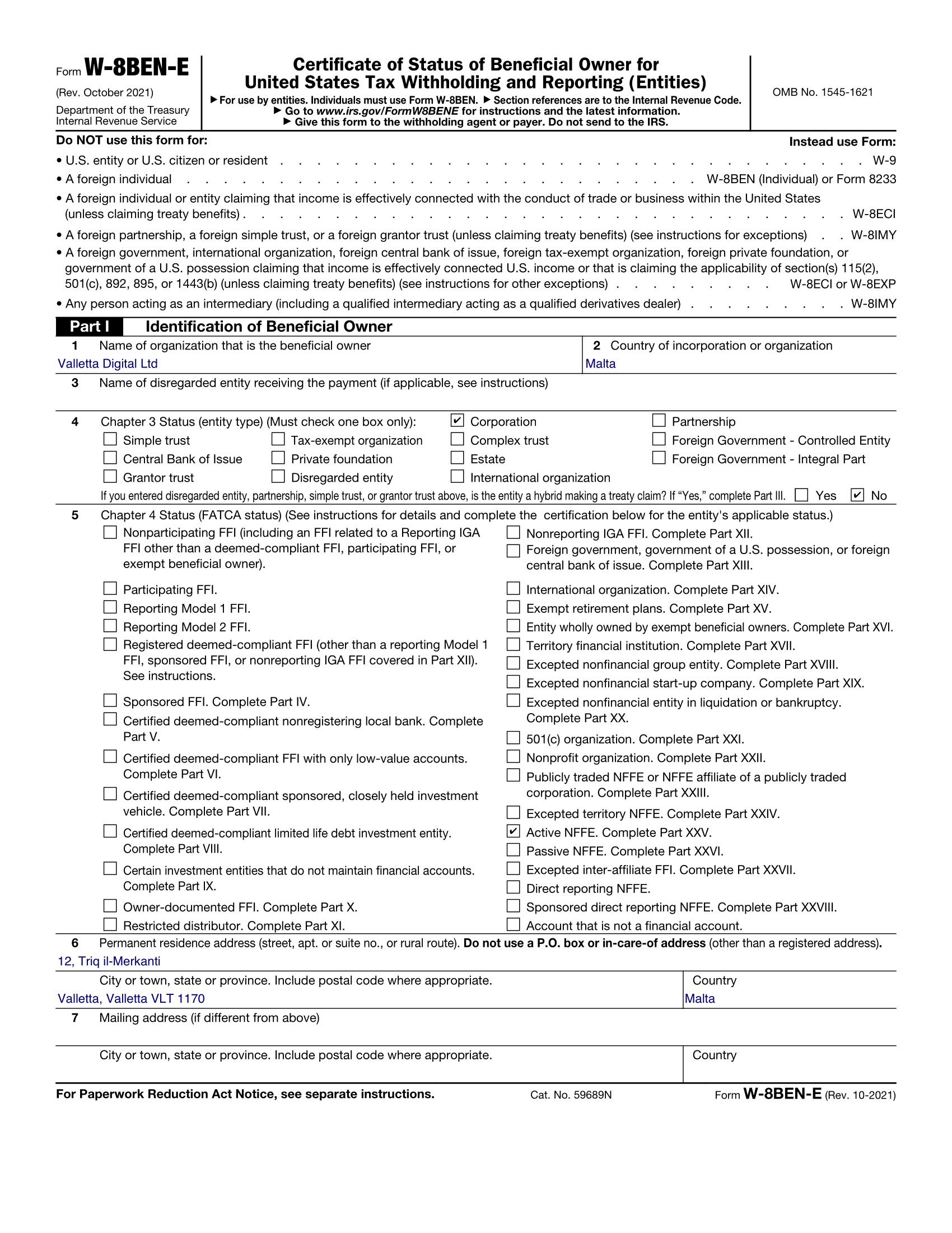
Sample only — uses a fictional company for illustration. Example: Valletta Digital Ltd, 12, Triq il-Merkanti, Valletta VLT 1170, Malta, income tax number 987654321, Chapter 3 Corporation, FATCA Active NFFE, Article 7(1) at 0%, Line 14b active trade or business under Article 22(4). The same company that distributes profits to a non-resident owner would leave Part III blank.
Articles and rates, if Article 22 is met
Use this table only when the 25% clause is met and the rest of the Limitation on Benefits test you rely on is also met. If the clause fails, do not put these rates on Line 15.
| Income type | Article | Rate |
|---|---|---|
| Services and equipment rental, no US permanent establishment | Article 7(1) | 0% |
| Software licences and other royalties in Article 12(3) | Article 12(2) | 10% |
| Ordinary interest | Article 11(2) | 10% |
| Dividends to a company that owns directly at least 10% of the voting stock | Article 10(2)(a)(i) | 5% |
| Other dividends, including portfolio dividends | Article 10(2)(a)(ii) | 15% |
| REIT dividends in the Article 10(4)(a) cases, including a company that holds a publicly traded class or a diversified REIT | Article 10(4)(a) | 15% |
| Other income that Article 21(3) lets the source state tax | Article 21(3) | up to 10% |
| Independent services of an individual (Form W-8BEN) | Article 7 | 0% |
Article 10(3) is 0% only for a pension fund, and only when the dividends are not from a trade or business of the fund or of an associated enterprise. Article 10(4)(a) removes the 5% rate for a RIC and a REIT. A RIC dividend is 15% under Article 10(2)(a)(ii), unless the pension-fund rule applies. A REIT dividend is 15% only in three cases: an individual or a pension fund holding not more than 10%; a person holding not more than 5% of any class when that class of REIT stock is publicly traded; or a person holding not more than 10% of a diversified REIT. In the last two cases the owner can be a company, including a private Ltd. The class of REIT stock is what must be publicly traded, not the owner. Outside those cases a REIT dividend has no treaty 15% rate. Article 11(3)(a) contingent interest can be up to 15%. A late-payment penalty is not interest. Article 21 is not the 2006 Model residence-only rule: the source state may also tax other income at up to 10%.
Questions people ask before they sign
Short answers for a private Ltd. A US office, a fund, or a financial institution needs an accountant, not a blog page.
Does the 6/7 refund affect my W-8BEN-E?
It can. The refund is a Malta tax computation. On the US form, the question is whether dividends paid to owners who are not qualifying residents of Malta or the United States use up the Article 22 25% cap. If they do, do not tick Active trade or business. For services performed outside the United States, leave Part III blank. US-source royalties or dividends would be 30% unless Article 22(6) relief is granted.
I'm a freelancer in Malta — which article?
Article 7, on Form W-8BEN. There is no independent personal services article. Article 14 is Income from Employment. Do not cite Article 14, and do not add a 183-day independent-services test. A remote individual with no US permanent establishment cites Article 7 at 0%.
Is there 0% on royalties?
No. Article 12(2) is 10% for copyrights, films, patents, trademarks, designs, secret formulas, and know-how, including a software licence. Equipment rental is not a royalty. It cites Article 7 at 0% when there is no US permanent establishment and the company may claim the treaty.
Does iGaming income qualify?
The treaty has no iGaming article. Qualification depends on the Article 22 tests, including the 25% clause, and on whether the income is US-source. A software licence is Article 12 at 10% only if the company may claim the treaty. Services with no US permanent establishment are Article 7 at 0% only on the same condition. Ask a tax advisor before you classify gaming receipts.
Which number goes on Line 9b?
The company 9-digit income tax number, for example 987654321. That is a format illustration. The OECD note does not publish a check digit for it. Do not enter C12345. That is the registry number. Do not enter a VAT number that starts with MT unless the payer asked for a VAT ID. A Maltese national identity card number, such as 1234567M, belongs on Form W-8BEN. The letters the OECD note lists are M, G, A, P, L, H, B, and Z. 1234567M is a format illustration, not a failed check digit.
Can a private Ltd file Form 8832?
Yes, when it needs a US classification other than Corporation. A public limited company is per se under "Malta, Public Limited Company" and cannot file Form 8832. A private limited liability company is not on that list. It defaults to Corporation, and Form 8832 is how it elects a different classification. A single-member private Ltd is not disregarded by default.
What to do next
- Fill out your W-8BEN-E in the guided wizard: Start the W-8BEN-E wizard ($30). It asks the 25% question before it suggests Active trade or business.
- Are you self-employed?: Use the W-8BEN wizard ($5) and cite Article 7, not Article 14.
Mistakes that get the form sent back
- Citing Article 14 for a freelancer: Article 14 is Income from Employment. An individual cites Article 7 on Form W-8BEN.
- Claiming 0% on royalties or ordinary interest: Both are 10% when the treaty applies. Article 12(2) for royalties. Article 11(2) for ordinary interest.
- Ticking Active trade without the 25% check: Article 22(4) includes the base-erosion clause. Dividends to non-qualifying owners count. If the clause fails, leave Part III blank for foreign-source services.
- Typing a C number on Line 9b: Line 9b takes the 9-digit income tax number, for example 987654321. C12345 is the registry number. MT plus digits is the VAT number.