W-8BEN-E for a Latvian SIA: 0% on Services, 10% on Software and Interest
This article was created with AI assistance and has not been reviewed by a human editor. It is provided for general informational purposes only and does not constitute tax, legal, or financial advice.
Treaty articles and rates on this page are checked against the US-Latvia Income Tax Convention signed at Washington on January 15, 1998 (irs.gov/pub/irs-trty/latvia.pdf) — last verified September 2026. The PDF header states a general effective date of 1 January 2000 under Article 29. No later protocol. The IRS documents page also lists a 1998 technical explanation. Line 15 follows the convention, not that explanation.
 AI-generated image
If your SIA sells services to US clients, the answer is 0%. If it licenses software, it is 10% — and no, EU membership does not change that. Do not copy a Danish, Austrian, Finnish, Czech, or Slovak guide that quotes 0% on interest or on software. Estonia's ordinary interest and royalty rates match these figures. What differs is Limitation on Benefits: Article 23 in this convention, Article 22 in the Estonian one.
This guide is for a Latvian sabiedrība ar ierobežotu atbildību (SIA) that invoices US clients or holds a US brokerage account. It covers the SIA versus an akciju sabiedrība (AS), why services stay at Article 7(1) while a software licence and ordinary interest are 10%, why equipment rental is a royalty at 5%, which number goes on Line 9b, and why Limitation on Benefits is Article 23 rather than Article 22. A sample PDF is included further down.
If you are an individual — an individuālais komersants (IK) or a pašnodarbinātais, not an SIA — you file Form W-8BEN, not this one: start the W-8BEN wizard. A person uses a personas kods. Codes issued from 1 July 2017 are 11 digits and start with 32, for example 32123456789, and they have no check digit. Codes issued earlier remain valid: the date of birth and a hyphen, DDMMYY-XXXXX. The wizard example shows only the newer format. A company uses an 11-digit reģistrācijas numurs. This page is for the company form.
If you prefer to skip the reading, you can start the W-8BEN-E wizard now. In a few minutes you have a signature-ready PDF for $30, with Article 7(1) at 0% for services performed in Latvia and no US permanent establishment.
Blank form or already filled in?
You can download the official, blank form from the IRS and complete it yourself — or get the same file already filled in by our wizard.
- Blank official W-8BEN-E (IRS, free): Download W-8BEN-E as a PDF directly from the IRS — for an SIA or an AS.
- Blank official W-8BEN (IRS, free): Download W-8BEN as a PDF directly from the IRS — for an IK or a pašnodarbinātais.
- Already filled in (5–10 minutes): W-8BEN-E for Latvian companies ($30) or W-8BEN for individuals ($5).
- The convention: US-Latvia Income Tax Treaty PDF on IRS.gov — signed January 15, 1998. The interest and royalty percentages match the Estonian convention. Do not copy its Article 22 onto Line 14b.
- Not the Estonian treaty: W-8BEN-E for an Estonian OÜ uses a different convention. Its Limitation on Benefits article is Article 22. Latvia's is Article 23.
SIA, AS, or an IK?
Latvian company law uses several forms, and US tax classification does not follow the local abbreviation one-for-one:
- Sabiedrība ar ierobežotu atbildību (SIA): The usual limited-liability company. It is not on the IRS per se corporation list. It defaults to Corporation because its members have limited liability, and it can elect a different US classification by filing Form 8832. A single-member SIA is not disregarded by default.
- Akciju sabiedrība (AS): The company limited by shares. 26 CFR 301.7701-2(b)(8)(i) lists "Latvia, Akciju Sabiedriba" as a per se corporation, generally for an entity formed on or after October 7, 2004. An AS is a Corporation. There is no Form 8832 election.
- Individuālais komersants (IK) or pašnodarbinātais: A sole trader. Not a separate legal entity. The individual files Form W-8BEN, not W-8BEN-E. Independent personal services are Article 14(1), and the foreign TIN is a personas kods, not the company's registration number.
- Pilnsabiedrība (PS) or komandītsabiedrība (KS): Partnership-style forms. Check "Partnership" in Part I, line 4, not "Corporation," unless a Form 8832 election says otherwise for an eligible entity.
The trap worth naming: an AS is per se. An SIA is the form that stays eligible for Form 8832. An Estonian OÜ write-up uses the same ordinary interest and royalty percentages. It does not use the same Limitation on Benefits article: that write-up cites Article 22, and this form cites Article 23.
Chapter 3 still decides which form you file and how the payer reads the certificate. The treaty rates sit in Part III, not in the Chapter 3 checkbox.
Who actually needs to submit this form?
Any Latvian SIA or AS that receives payments from a US business and needs to document that it is not a US person. Common situations:
- Invoicing US clients from Latvia: Your SIA bills a US company for consulting, design, or similar work performed in Latvia. With no US permanent establishment, that is Article 7(1) at 0%.
- A software licence, not a service invoice: A licence to use computer software is a royalty. Article 12(2)(b) caps US withholding at 10%. Article 12(3) only defines royalties. It is not the rate paragraph.
- US payment platforms: Payouts from Stripe, Amazon, YouTube/AdSense, or similar US-headquartered platforms.
- A US brokerage account: A broker that holds US stock for a Latvian company typically wants a current W-8BEN-E before it applies a treaty rate. An investor who is not a company uses Form W-8BEN and a personas kods, for example 32123456789.
What the payer withholds, and what the treaty actually changes
Without a submitted W-8BEN-E, the US payer generally withholds 30% of the gross payment under the Chapter 3 nonresident presumption rules. Filing the form is how the payer knows you are a foreign company and, when the facts fit, which treaty article and rate to apply.
Services performed in Latvia, with no permanent establishment in the United States, are business profits under Article 7(1). The residence state taxes them. The US rate on the form is 0%. That is not a royalty, and it is not Article 14. Article 14 is for an individual. A software licence is different: the convention names computer software inside the Article 12(3) definition, and the rate in Article 12(2)(b) is 10%. Interest the SIA receives on a loan to a US company is Article 11(2) at 10%. That is not the 0% residence-only rule in Austria, Denmark, Finland, Czechia, or Slovakia, and it is the same 10% the Estonian convention uses for ordinary interest. Interest on a deposit in a US bank, not connected with a US permanent establishment, is already 0% under IRC sections 871(i) and 881(d). That exemption does not need a treaty claim, and Article 11(2) does not raise it to 10%.
Form W-8BEN-E, line by line, for a Latvian SIA
The line numbers below match the current form (Rev. October 2021) for the standard case: an operating SIA, Active NFFE, claiming Article 7(1) at 0% on services performed in Latvia. Holding companies and financial institutions follow different rules on some lines.
| Line | What you enter |
|---|---|
| Line 1 | The legal name exactly as registered (e.g., "Daugava Software SIA"). |
| Line 2 | Country of incorporation: Latvia. |
| Line 3 | Leave blank unless a single-member SIA has filed Form 8832 to elect disregarded status (uncommon). An AS cannot make that election. |
| Line 4 | "Corporation" for an SIA (the default) and for an AS (per se). "Partnership" for a PS or a KS. Never check "Corporation" for an IK — that person files Form W-8BEN. |
| Line 5 | Chapter 4 (FATCA) status — almost always "Active NFFE" for an ordinary trading or services company. Ask an accountant if the company mainly holds investments. |
| Line 6 | The registered office in Latvia, in Latin letters (e.g., Brivibas iela 21-5, Riga, LV-1010). |
| Line 7 | Leave blank if it matches line 6. |
| Line 8 | Leave blank unless the company has actually received a US EIN. |
| Line 9a | Leave blank unless the entity is itself a Foreign Financial Institution. |
| Line 9b | The company's reģistrācijas numurs, 11 digits, for example 40003123453. A number starting with 40 is common, and a number starting with 42 is also a registration number. Do not require the prefix 40. Do not add an LV prefix: that is the PVN (VAT number), and only if the payer asked for a VAT ID. Do not enter a personas kods. That number belongs on Form W-8BEN. Codes issued from 1 July 2017 are 11 digits starting with 32, for example 32123456789, with no check digit. Codes issued earlier remain valid: the date of birth and a hyphen, DDMMYY-XXXXX. |
| Line 9c | In practice this is not checked for a registered SIA — the Enterprise Register already issued the number. |
| Line 10 | Leave blank unless the withholding agent specifically asked for a reference number. |
| Part II (Lines 11-13) | Not completed for an ordinary SIA. This part is only for a disregarded entity or a branch receiving the payment. |
| Line 14a | Latvia. The 1998 convention is in force. |
| Line 14b | Limitation on Benefits. An operating SIA certifies Active trade or business under Article 23(3). "No LOB article in treaty" is the wrong box. Do not cite Article 22: in this treaty Article 22 is Other Income. |
| Line 15 | For services with no US permanent establishment: Article 7(1), 0%, type of income Services. A software licence is Article 12(2)(b) at 10%. Equipment rental is Article 12(2)(a) at 5%. Interest on a loan to a US company is Article 11(2) at 10%. A deposit in a US bank that is not connected with a US permanent establishment stays at 0% under IRC sections 871(i) and 881(d). Do not cite Article 11(2) for that deposit. Dividends under 10% of the voting shares of an ordinary company are Article 10(2)(b) at 15%. A RIC dividend is also 15%. A REIT dividend paid to the SIA follows US domestic law, not Article 10(2)(b). |
Read the reģistrācijas numurs from the Enterprise Register extract before Line 9b. Keep all 11 digits. Do not substitute a director's personas kods, and do not type the PVN with an LV prefix unless the payer asked for the VAT ID.
The guided W-8BEN-E wizard fills these lines from your answers, including the article and rate on Line 15.
Filled example: Daugava Software SIA
An operating SIA, Chapter 3 Corporation, FATCA Active NFFE, Part III Article 7(1) at 0% for services, Line 14b active trade or business under Article 23(3).
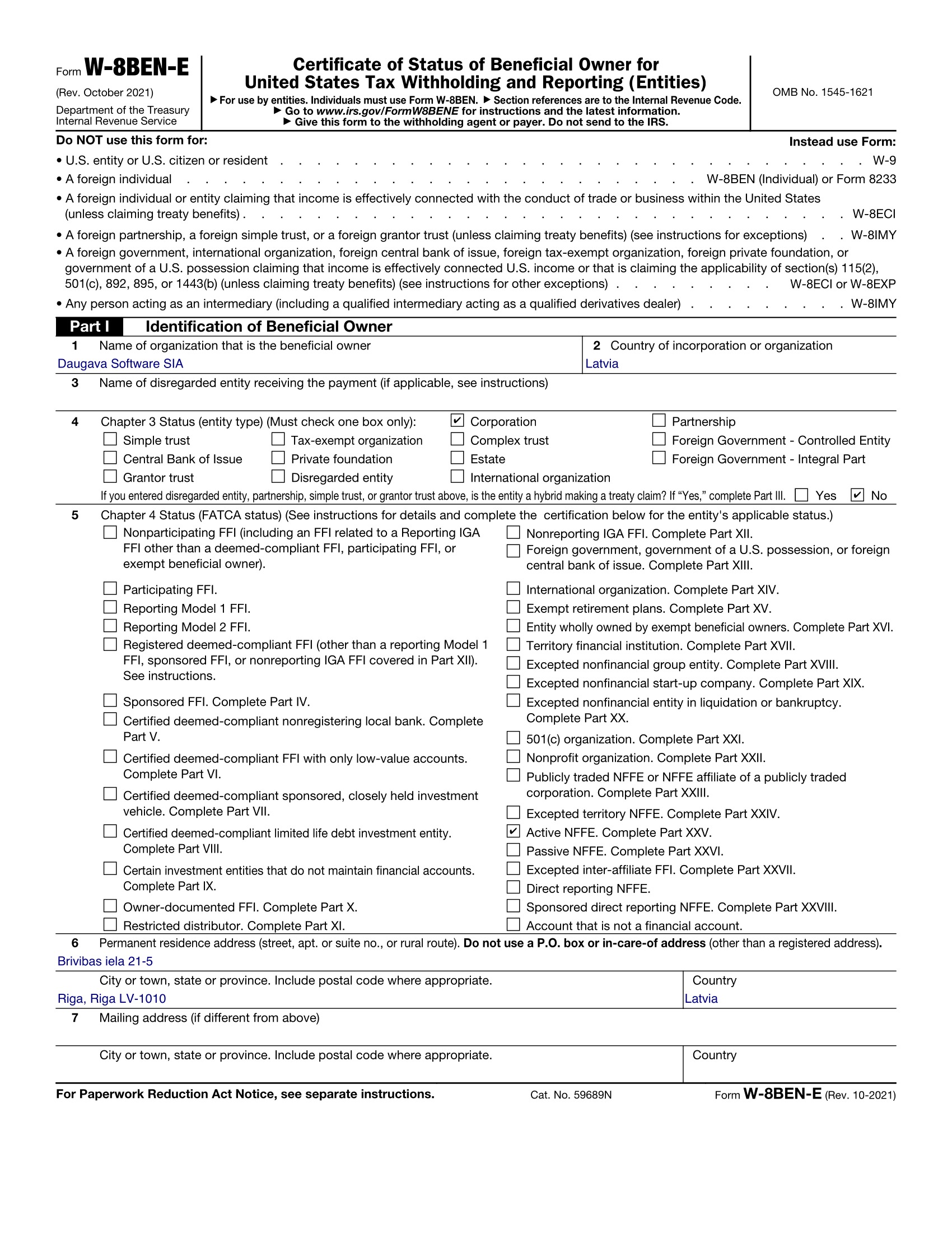
Sample only — uses a fictional company for illustration. Example: Daugava Software SIA, Brivibas iela 21-5, Riga LV-1010, Latvia, reģistrācijas numurs 40003123453, Chapter 3 Corporation, FATCA Active NFFE, Article 7(1) at 0%, Line 14b active trade or business under Article 23(3).
The rates on Line 15
Use this table for an operating SIA with no permanent establishment in the United States. Do not paste a Danish or Finnish 0% rate onto the Latvian form. Estonia's ordinary interest, software, and equipment rates match this table. Its Limitation on Benefits article does not.
| Income type | Article | Rate |
|---|---|---|
| Services / business profits, no US permanent establishment | Article 7(1) | 0% |
| Software licences, copyrights, patents, trademarks, and know-how | Article 12(2)(b) | 10% |
| Rental of industrial, commercial, or scientific equipment | Article 12(2)(a) | 5% |
| Ordinary interest on a loan to a US company | Article 11(2) | 10% |
| Interest on a deposit in a US bank, not connected with a US permanent establishment | Not a treaty claim. IRC 871(i) and 881(d) | 0% |
| Interest, government or central-bank debt, or a qualifying guarantee | Article 11(3)(a) | 0% |
| Interest on trade credit between unrelated enterprises | Article 11(3)(b) | 0% |
| Dividends, company holding directly at least 10% of the voting shares of an ordinary company (not a RIC or a REIT) | Article 10(2)(a) | 5% |
| Dividends, under 10% of the voting shares of an ordinary company, and every RIC dividend | Article 10(2)(b) | 15% |
| Dividends from a US REIT paid to an SIA or any company | US domestic law, not Article 10(2)(b) | Not the treaty 15% |
| Independent personal services of an individual (Form W-8BEN), no fixed base and not more than 183 days | Article 14(1) | 0% |
A deposit in a US bank that is not connected with a US permanent establishment stays at 0% under IRC sections 871(i) and 881(d). Do not cite Article 11(2) for that deposit, and do not treat the treaty ceiling as a reason to withhold 10%. Equipment rental is a royalty in this treaty. Article 7(7) does not move it into business profits. Do not cite Article 7 at 0% for a lease of industrial, commercial, or scientific equipment. Cite Article 12(2)(a) at 5%. A SaaS subscription that is a service, with no licence to copy or distribute the software, is usually Article 7, not a royalty. A licence to copy or distribute software is Article 12(2)(b) at 10%. If you are unsure which one you sold, ask an accountant before you certify Line 15. Contingent interest under Article 11(3)(d) can be taxed at the 15% dividend rate in Article 10(2)(b). Do not cite 10% for that kind of interest, and do not cite Article 11(3) as the rate for an ordinary cash loan.
Latvia versus Estonia, and Article 14 for a freelancer
The US signed the Latvian and Estonian conventions on the same day, January 15, 1998. They are still different texts. The ordinary rates are not the difference: software and ordinary loan interest are 10% in both, and equipment rental is 5% in both. Estonia's Limitation on Benefits article is Article 22. Latvia inserted Article 21 (Offshore Activities), so Other Income is Article 22 and Limitation on Benefits is Article 23. Do not certify "No LOB article in treaty." For an operating SIA with real activity in Latvia, Line 14b is active trade or business under Article 23(3). The safe harbour looks at assets, gross income, and payroll in Latvia, each at least 7.5% of the related US activity, with the average of those three ratios above 10%. Making or managing investments is not an active trade unless a bank, an insurance company, or a registered securities dealer carries it on. Article 23(4) is a request to the competent authority. It is not a checkbox. An individual who personally performs the work, including an IK, uses Form W-8BEN and Article 14(1). Income is taxable only in Latvia unless the services are performed in the United States and the person has a fixed base regularly available there. A stay of more than 183 days in any twelve-month period that begins or ends in the tax year is deemed to create that fixed base. The explanation should name both tests. Article 14 is not Article 7, and it is not Article 15 (employment wages).
Questions people ask before they sign
Short answers for an operating SIA. Unusual facts — a US office, a holding company, or a financial institution — need an accountant, not a blog page.
Is my SaaS subscription a royalty?
Usually no. A subscription for a service, with no licence to copy or distribute the software, is business profits under Article 7(1) at 0% when the SIA has no US permanent establishment. A licence to copy or distribute software is a royalty. The convention names computer software in Article 12(3), and the rate is Article 12(2)(b) at 10%. If you are not sure which one you sold, ask an accountant before you certify Line 15.
Is interest on my US bank deposit 0%?
Yes, when the deposit is with a US bank and the interest is not connected with a US permanent establishment. That 0% comes from IRC sections 871(i) and 881(d). It is not a treaty claim, and Article 11(2) does not raise it to 10%. Do not cite Article 11 on Line 15 for that deposit. A loan the SIA makes to a US company is different: the treaty ceiling is Article 11(2) at 10%. Article 11(3)(a) is 0% only for the other government, its subdivisions, the central bank, a wholly government-owned financial institution, or a loan they guarantee or insure. Article 11(3)(b) is 0% only for trade credit between unrelated enterprises. Do not copy a 0% treaty rule for that loan from Austria, Denmark, Finland, Czechia, or Slovakia. Estonia's ordinary loan interest is also 10%.
Which Limitation on Benefits article applies?
Article 23. Article 21 of this treaty is Offshore Activities, so Article 22 is Other Income, not Limitation on Benefits. An operating SIA certifies active trade or business under Article 23(3). "No LOB article in treaty" does not apply.
What rate applies to services performed in Latvia?
Article 7(1) at 0% when the SIA has no permanent establishment in the United States. Article 14 is for an individual on Form W-8BEN, not for the company.
Is equipment rental Article 7?
No. Rental of industrial, commercial, or scientific equipment is a royalty. Cite Article 12(2)(a) at 5%. Do not cite Article 7, and do not use the 10% software rate.
Which number goes on Line 9b?
The company's reģistrācijas numurs, 11 digits, for example 40003123453. A number starting with 40 is common, and a number starting with 42 is also a registration number. Do not add LV. That prefix is the PVN. A personas kods belongs on Form W-8BEN. From 1 July 2017 that code is 11 digits starting with 32, for example 32123456789. An older code remains valid: the date of birth and a hyphen, DDMMYY-XXXXX.
Does an IK file Form W-8BEN-E?
No. An individuālais komersants or a pašnodarbinātais is an individual. They file Form W-8BEN and, for independent services, cite Article 14(1). The explanation should mention both a fixed base and the 183-day deemed fixed base.
Is an AS the same as an SIA on Chapter 3?
Both are Corporations on the form, but for different reasons. An AS is per se under "Latvia, Akciju Sabiedriba" and cannot file Form 8832. An SIA defaults to Corporation and can elect via Form 8832. A single-member SIA is not disregarded by default.
Can I copy the Estonian OÜ rates?
The ordinary rates match. Software and ordinary loan interest are 10% in both conventions, and equipment rental is 5% in both. Do not copy the Limitation on Benefits article. Estonia's is 22. Latvia's is 23, because Article 21 here is Offshore Activities and Article 22 is Other Income. Do not copy Danish 0% interest or royalties onto either form.
What dividend rate applies if we own less than 10%?
Article 10(2)(b) at 15% when the payer is an ordinary US company, and the same 15% for every dividend from a US RIC. Article 10(2)(a) is 5% only when the beneficial owner is a company that holds directly at least 10% of the voting shares of an ordinary company. That 5% does not apply to a RIC or a REIT. A REIT dividend paid to an SIA follows the US domestic-law rate. Article 10(2)(b) at 15% applies to a REIT only when the owner is an individual holding less than 10% of the REIT. There is no 0% dividend tier. Do not cite Article 10(5): that is a branch-profits tax, not the portfolio rate.
What to do next
- Fill out your W-8BEN-E in the guided wizard: Start the W-8BEN-E wizard ($30)
- Are you an IK?: Use the W-8BEN wizard ($5) and cite Article 14(1), with both the fixed base and the 183-day test in the explanation.
- Comparing with Estonia: Read the Estonian OÜ guide so you do not copy Article 22 onto a Latvian SIA. The ordinary interest and royalty rates match. A Danish 0% royalty does not.
Mistakes that get the form sent back
- Citing Article 22 as Limitation on Benefits: In the Latvia treaty, Article 22 is Other Income. Limitation on Benefits is Article 23. An operating SIA uses Article 23(3) on Line 14b.
- Putting 0% on a software royalty: A software licence is Article 12(2)(b) at 10%. Article 12(3) is the definition, including the words computer software. It is not the rate.
- Sending equipment rental to Article 7: Equipment rental is Article 12(2)(a) at 5%. Article 7(7) does not treat it as business profits.
- Typing the PVN instead of the registration number: Line 9b takes the 11-digit reģistrācijas numurs, for example 40003123453. The PVN is that number with an LV prefix. Use the prefix only if the payer asked for a VAT ID.
- Putting a personas kods on the company form: A personas kods identifies a person. A code issued from 1 July 2017 starts with 32, for example 32123456789. An older code is the date of birth and a hyphen, DDMMYY-XXXXX. Either one goes on Form W-8BEN. The SIA uses the registration number.
- Copying a Danish 0% rate, or Estonia's Article 22: Denmark's interest and many royalties are 0%. Latvia's ordinary loan interest and software licences are 10%. Estonia uses those same percentages. Its Limitation on Benefits article is 22. Latvia's is 23.