W-8BEN-E for an Israeli Company: Ltd. vs Public Limited Company, the Real 1975 Article Numbers, and a Sample PDF
This article was created with AI assistance and has not been reviewed by a human editor. It is provided for general informational purposes only and does not constitute tax, legal, or financial advice.
Treaty articles and rates on this page are checked against the US-Israel Income Tax Convention signed November 20, 1975, as amended by the Protocol of May 30, 1980 and the Second Protocol of January 26, 1993 — last verified September 2026. The IRS PDF includes both protocols as an appendix. The 1975 body of Article 12 is not the operative dividend text.
 AI-generated image
An Israeli Ltd. invoices a US client for consulting or software work, and accounts payable asks for a W-8BEN-E before they pay. The mistake that shows up on almost every generic guide is the article number: business profits in this treaty are Article 8, not Article 7. Article 7 is income from real property. On Line 14b you certify the Limitation on Benefits category under Article 25 — for an operating company, that is Active trade or business, not "No LOB article in treaty."
This guide uses the current IRS line numbers (Rev. October 2021) for that case: a private Ltd. (Chevra Be'eravon Mugbal), Active NFFE, no US permanent establishment, claiming Article 8(1) at 0% on service fees. It also covers the 1980 dividend split, the 17.5% ordinary interest cap, and why Line 15 for a software license cites Article 14(1), not Article 14(2).
If you are not incorporated — an Osek Patur or Osek Murshe working under your own Teudat Zehut — you file Form W-8BEN, not this form: start the W-8BEN wizard. Independent personal services are Article 16, not Article 14. This page is for incorporated businesses.
Or skip the reading and start the W-8BEN-E wizard — guided questions, a suggested treaty article and rate, and a signature-ready PDF for $30.
Blank form or already filled in?
You can download the official blank form from the IRS and complete it yourself, or get the same file filled from your answers.
- Blank official W-8BEN-E (IRS, free): Download W-8BEN-E as a PDF directly from the IRS — for a private Ltd. or a Public Limited Company.
- Blank official W-8BEN (IRS, free): Download W-8BEN as a PDF directly from the IRS — for an Osek.
- 1975 Convention, with the 1980 and 1993 Protocols: Income Tax Treaty PDF on IRS.gov — Business Profits is Article 8, not Article 7. Both protocols are in the same PDF.
- IRS treaty documents page: Israel tax treaty documents.
- Already filled in (5–10 minutes): W-8BEN-E for Israeli companies ($30) or W-8BEN for an Osek ($5) — treaty article and rate suggested automatically, ready to sign as a PDF.
Which Israeli company type are you actually dealing with?
The Chapter 3 box depends on the legal form, not on revenue:
- Public Limited Company A publicly traded Israeli company is always a Corporation for US tax purposes. 26 CFR 301.7701-2(b)(8)(i) lists "Israel, Public Limited Company" as a per se corporation. There is no Form 8832 election.
- Private Ltd. A Chevra Be'eravon Mugbal is the usual startup and small-company form. It is not on the per se list. Members have limited liability, so it defaults to Corporation, but it can elect a different US classification on Form 8832.
- Osek Patur / Osek Murshe An individual registration, not a separate legal entity. The person files Form W-8BEN and cites Article 16, not this form and not Article 8.
- Shutafut A partnership (שותפות) is not a Corporation by default. Do not check Corporation only because the business has more than one owner.
A private Ltd. that has not filed Form 8832 checks Corporation on Line 4. A Public Limited Company checks Corporation too, and it cannot elect out.
Do not put a shareholder's Teudat Zehut on the company form. The company number (H.P. / Het Pei) is also 9 digits, so the length alone does not tell them apart.
Who actually needs to fill in W-8BEN-E?
Any Israeli Ltd. or Public Limited Company that receives payments from a US business and wants to document non-US status. Common situations:
- Consulting or software invoices A US client asks for the form before paying service fees.
- Royalties or a software license The payer needs a treaty claim before applying 10% or 15% instead of 30%.
- A broker or platform Dividends, interest, or royalties from a US account.
What happens without a valid form?
Without a W-8BEN-E, the US payer generally withholds 30% of the gross payment under the nonresident alien rules, even when the treaty would reduce that rate. Service fees with no US permanent establishment can be 0% under Article 8. Ordinary interest is capped at 17.5%, not 0%. A software-technology royalty is 15% under Article 14(1), not 10%. Some platforms hold the payment until a valid form is on file.
The form stays with the US payer. It is not filed with the Israel Tax Authority or the IRS. Israeli tax on the same income is a separate question.
W-8BEN-E line by line: what an Israeli Ltd. actually enters
Official IRS line numbers for an operating private Ltd., Active NFFE, claiming treaty benefits. A Public Limited Company uses the same lines except that it cannot elect out of Corporation. An Osek does not use this form.
| Line | What you enter |
|---|---|
| Line 1 | The company's legal name, for example Carmel Ltd. |
| Line 2 | Country of incorporation: Israel. |
| Line 3 | Leave blank unless a disregarded entity is receiving the payment for its owner. |
| Line 4 | Corporation for a Public Limited Company (always) or a private Ltd. (the default, unless Form 8832 says otherwise). The hybrid follow-up is usually No. |
| Line 5 | Chapter 4 (FATCA) status. An operating company with no financial business is usually Active NFFE. |
| Line 6 | The registered office. The sample uses Rothschild Blvd 10, Tel Aviv, 6688313. |
| Line 7 | Only if the mailing address differs from Line 6. |
| Line 8 | Usually blank. A US TIN is required only in the cases the payer names. |
| Line 9a | Leave blank. A GIIN is for financial institutions. |
| Line 9b | The company's H.P. number (Het Pei), 9 digits, as the foreign TIN. Do not enter a shareholder's Teudat Zehut, even though that number is also 9 digits. |
| Line 9c | Not checked for a registered company that has an H.P. number. |
| Line 10 | Usually blank unless the payer asks for a reference number. |
| Part II (Lines 11–13) | Not completed for an ordinary Ltd. Part II is for disregarded entities and branches. |
| Line 14a | Country of residence for treaty purposes: Israel. Part III is filled when you claim the treaty rate. |
| Line 14b | Limitation on Benefits. Article 25 exists (the 1993 Protocol replaced the old Investment or Holding Companies article). An operating Ltd. certifies Active trade or business under Article 25(3)(c). "No LOB article in treaty" is the wrong box. |
| Line 14c | Not normally checked. |
| Line 15 | For service fees with no US permanent establishment: Article 8(1), 0%, Services. For a software-technology royalty: Article 14(1), 15%, Royalties. Cite Article 14(1), not Article 14(2). Article 14(2) only defines the two royalty types. |
| Line 39 (Part XXV) | Check the Active NFFE certification if Line 5 is Active NFFE. |
| Part XXX | Signature, printed name, and date. The sample is signed by David Cohen. |
Line numbers match Rev. October 2021. If the IRS issues a new revision, follow the numbering on the PDF you sign.
The guided W-8BEN-E wizard fills these lines from your answers, including the article and rate on Line 15.
Public Limited Company, private Ltd., and an Osek are not the same box
The per se list names only the publicly traded form. A private Ltd. is still a Corporation by default, and an Osek is not a company at all.
| Point | What it means |
|---|---|
| Public Limited Company | Per se corporation under 26 CFR 301.7701-2(b)(8)(i). Check Corporation. Form 8832 cannot change that. |
| Private Ltd. | Not on the per se list. Limited liability means the default is still Corporation. A different US classification requires a filed Form 8832. |
| Osek Patur or Osek Murshe | Individual registration. File Form W-8BEN. Cite Article 16 for independent services, never Article 8 and never Article 14. |
| H.P. number vs Teudat Zehut | Both are 9 digits. Line 9b on this form is the company H.P. number. The individual's Teudat Zehut belongs on Form W-8BEN. |
Use the default that matches the company you actually registered, unless a Form 8832 election is already on file.
What a completed W-8BEN-E looks like for an Israeli Ltd.
An anonymised example: Carmel Ltd., a private limited company, Active NFFE, no US permanent establishment, claiming Article 8(1) at 0% on service fees and certifying Active trade or business on Line 14b. This is the PDF the wizard produces from the same inputs.
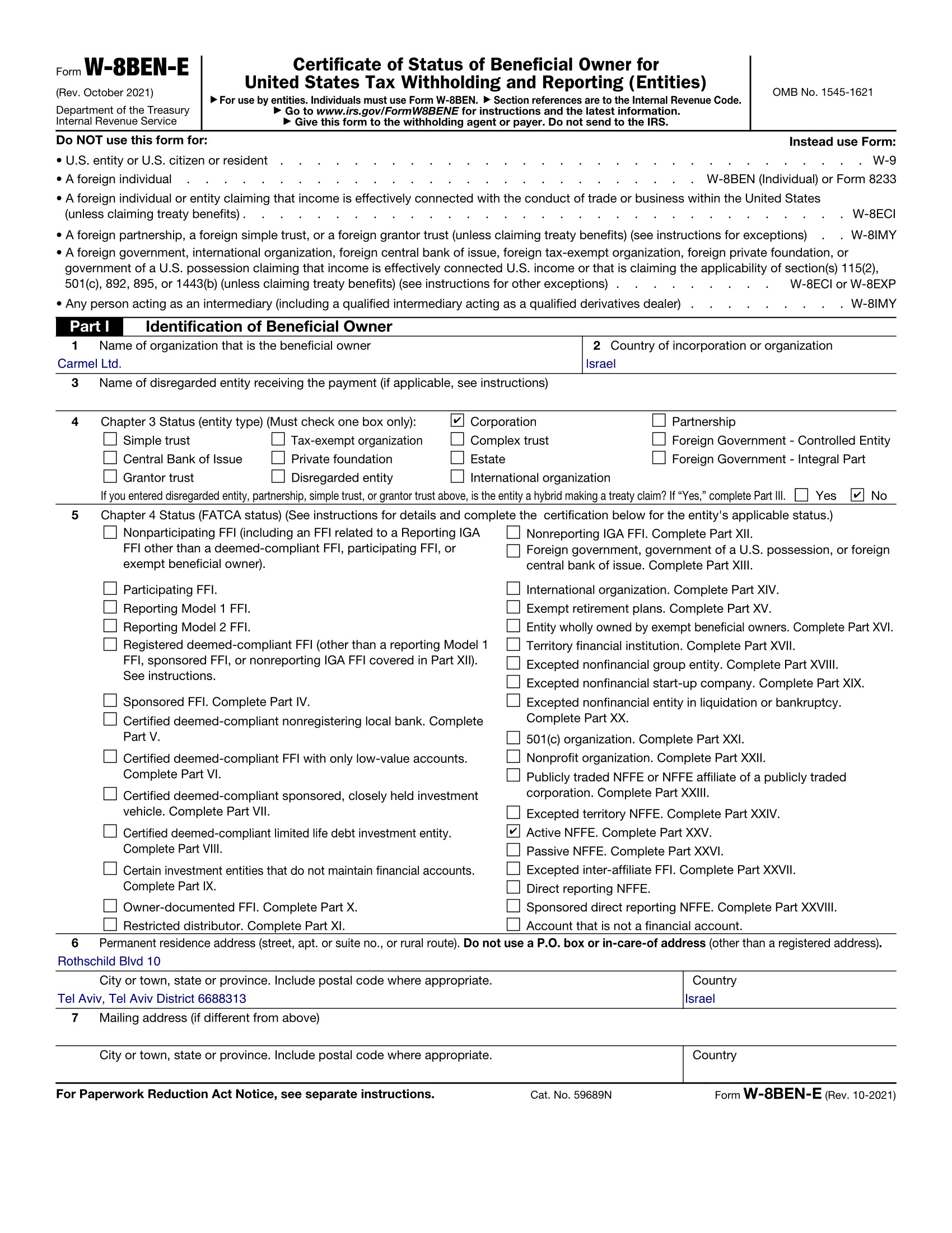
For illustration only. The company name, address, signer, and H.P. number are fictional. Example: Carmel Ltd., Tel Aviv, H.P. number 123456789, Chapter 3 Corporation, FATCA Active NFFE, US-Israel treaty Article 8(1) (Business Profits) 0%, Limitation on Benefits Active trade or business.
Treaty rates by income type
These rates come from the 1975 Convention plus the 1980 and 1993 Protocols. Do not copy a modern 7 / 10 / 11 / 12 map onto Israel.
| Income type | Article | Rate |
|---|---|---|
| Services / consulting (Business Profits, no US permanent establishment) | Article 8(1) | 0% |
| Equipment rental (tangible property; not a royalty) | Article 8(5) | 0% (with no US permanent establishment) |
| Dividends, general rate (under 10% voting stock, or any holder who does not meet the reduced-rate tests) | Article 12(2)(a) | 25% |
| Dividends to a company owning at least 10% of the voting stock, from income of a period when the payer is not an approved enterprise under the Encouragement of Capital Investments Law | Article 12(2)(b) | 12.5% |
| Dividends to a company owning at least 10% of the voting stock, from income of a period when the payer is an approved enterprise | Article 12(2)(c) | 15% |
| Interest, ordinary (not a bank, savings, or insurance loan) | Article 13(2) | 17.5% |
| Interest on a loan granted by a bank, savings institution, or insurance company | Article 13(2) | 10% |
| Interest beneficially derived by a Contracting State, or on debt that State guarantees or insures | Article 13(3) | 0% |
| Copyright or film royalties (literary, artistic, or scientific works, including motion-picture and radio/TV films) | Article 14(1) | 10% |
| Industrial royalties (patents, designs, secret processes, trademarks, software technology or know-how) | Article 14(1) | 15% |
On Line 15, cite Article 14(1) for either royalty tier. Article 14(2)(a) and 14(2)(b) only define copyright/film royalties versus industrial royalties. Do not write Article 14(2) as the rate paragraph. A license of proprietary software technology is the industrial tier at 15%, not the 10% copyright rate. Equipment rental is Article 8, not Article 14. The 12.5% dividend rate is not the ordinary 10% corporate rate: the 1980 Protocol limits 12.5% to income from a period when the payer is not an approved enterprise, and sets 15% when it is. A holder under 10% stays at 25% under 12(2)(a). Ordinary interest for a consulting company is 17.5%. The 10% rate is only for a loan granted by a bank, savings institution, or insurance company. Article 14-A is a branch tax on a company that already has a US permanent establishment (up to 12.5% on the dividend-equivalent amount). Do not cite 14-A for a no-PE services invoice.
An Osek cites Article 16, not Article 14 and not Article 8
Article 16 applies to an individual resident performing personal services in an independent capacity. The other country may tax that income only when the services are performed in that country and the individual is present there for 183 days or more in the taxable year. There is no fixed-base test and no permanent-establishment alternative inside Article 16. A remote Osek working from Israel, whose services are not performed in the United States, cites Article 16(1) at 0% even before counting days. Fewer than 183 days in the United States is still 0%. Article 18, not Article 16, covers public entertainers, and only when gross receipts exceed 400 US dollars for each day the person is present to perform. A Ltd. does not cite Article 16. Article 14 is royalties.
A blog post, or the finished PDF?
Hebrew FATCA guides already explain NFFE classifications. They rarely print the 1975 article numbers, the 1980 approved-enterprise dividend row, or the difference between Article 14(1) and Article 14(2). The wizard asks those questions once and returns the PDF.
| Point | This page | A generic guide |
|---|---|---|
| Article numbers | Article 8 for services, Article 14(1) for royalties, Article 16 for an Osek. | Often copies Article 7 / 12 / 14 from a modern treaty. |
| Line 14b | Active trade or business under Article 25. | Sometimes says there is no LOB article. |
| Finished form | Sample PDF for Carmel Ltd., plus a wizard that fills yours. | A checklist you still have to type into the IRS PDF. |
Start the wizard and download the filled PDF.
Frequently asked questions about W-8BEN-E for Israeli companies
Direct answers for a Ltd. billing US clients or receiving US investment income.
Which article do I cite for consulting fees?
Article 8(1), at 0% if the Ltd. has no permanent establishment in the United States. Article 7 in this treaty is income from real property. Do not cite Article 7 for services.
I am an Osek, not a Ltd. Which form and which article?
Form W-8BEN, Article 16(1), at 0% when the services are not performed in the United States or you are present there fewer than 183 days. Do not cite Article 14 (that is royalties) or Article 8 (that is the company's business-profits article, and it excludes an individual's personal services).
What rate applies to a software license?
Proprietary software technology or know-how is an industrial royalty: Article 14(1) at 15%. A copyright of a literary, artistic, or scientific work, including a film, is Article 14(1) at 10%. Article 14(2) defines those two categories. It is not the paragraph you write on Line 15.
Is equipment rental a royalty?
No. Article 8(5) treats rental of tangible personal property as industrial or commercial profits. With no US permanent establishment, cite Article 8 at 0%, not Article 14.
What do I check on Line 14b?
Active trade or business, which is Article 25(3)(c) of the 1993 Protocol. The 1975 Article 25 (Investment or Holding Companies) was replaced. "No LOB article in treaty" does not apply to Israel.
Why is the dividend rate 25%, not 12.5%?
12(2)(a) is 25% for a holder who does not meet the 10% voting-stock tests. The 1980 Protocol set 12.5% under 12(2)(b) only when those tests are met and the dividend comes from a period when the payer is not an approved enterprise under the Encouragement of Capital Investments Law. When the payer is an approved enterprise, 12(2)(c) is 15%.
Is ordinary interest 10%?
No. The ordinary cap in Article 13(2) is 17.5% of the gross amount. 10% applies only to interest from a loan granted by a bank, savings institution, or insurance company. 0% under Article 13(3) is for a Contracting State or for debt that State guarantees or insures.
What is Article 14-A?
A branch tax added in 1993. It can apply to a company that has a permanent establishment in the other country, up to 12.5% on the dividend-equivalent amount. It does not replace Article 14 royalties, and a company with no US permanent establishment does not cite it for service fees.
Public Limited Company or private Ltd. on Line 4?
Both check Corporation unless the private Ltd. has filed Form 8832. Only "Israel, Public Limited Company" is on the per se list. The private Ltd. is a Corporation by default because of limited liability.
H.P. number or Teudat Zehut on Line 9b?
The company's H.P. number. Both identifiers are 9 digits (the sample uses 123456789). The label on the company form is H.P. number, not the combined individual label.
Related guides
More on the form itself:
- Company form: W-8BEN-E wizard for a Ltd.
- Osek, not a company: W-8BEN wizard for an individual ($5)
- Chapter 3 status: Chapter 3 status guide
Common mistakes to avoid
- Citing Article 7 for services Article 7 is real property. Business profits are Article 8.
- Citing Article 14 for an Osek Article 14 is royalties. Independent personal services are Article 16.
- Writing Article 14(2) on Line 15 The rate cap is Article 14(1). Paragraph 14(2) only defines the two royalty types.
- Checking No LOB article Article 25 is a real Limitation on Benefits article. An operating Ltd. certifies Active trade or business.
- Using 12.5% for every dividend The general rate is 25%. 12.5% and 15% are the 10% ownership tiers, and they depend on whether the payer is an approved enterprise.
- Using 10% for ordinary interest 17.5% is the ordinary cap. 10% is the bank, savings, or insurance loan rate.
- Putting a Teudat Zehut on the company form Line 9b is the H.P. number. The digit count does not tell them apart.
A note on Israeli tax
This page is about US withholding. It does not determine how Israel taxes the same income. The Encouragement of Capital Investments Law matters on the form only because the 1980 Protocol uses "approved enterprise" status to choose between the 12.5% and 15% dividend rates.
Company tax, VAT, and whether a payer is an approved enterprise are questions for an Israeli accountant. The W-8BEN-E only tells the US payer which treaty rate to apply at source.
Ready to fill the form with the Israeli article numbers?
The wizard asks the same questions as this page and suggests the article and rate on Line 15.