W-8BEN-E for a Finnish Oy or Oyj: the 5% royalty paragraph is gone, and a sample PDF
This article was created with AI assistance and has not been reviewed by a human editor. It is provided for general informational purposes only and does not constitute tax, legal, or financial advice.
Treaty articles and rates on this page are checked against the US-Finland Income Tax Convention signed at Helsinki on September 21, 1989, together with the Protocol signed at Helsinki on May 31, 2006 — last verified September 2026. Instruments of ratification for the protocol were exchanged at Washington on December 28, 2007. Withholding under the protocol starts on February 1, 2008. Do not say the royalty change took effect in 2010. The protocol omitted Article 10 (Dividends) and Article 16 (Limitation on Benefits), added Article 11(6), and deleted Article 12(2). Articles 7, 11(1), 12(1), and 14 were not replaced. The 1989 PDF still prints the deleted 5% royalty paragraph. Do not use that PDF alone for dividends, royalties, or Limitation on Benefits.
 AI-generated image
A Finnish Oy invoices a US client, and accounts payable asks for a W-8BEN-E before they pay. Service fees with no current and no former US permanent establishment cite Article 7(1) at 0%. Article 7(1) says the enterprise "carries or carried" on business through a permanent establishment. After the 2006 Protocol, every royalty category cites Article 12(1) at 0%, including patents, trademarks, know-how, software, and films. The 1989 Article 12(2) 5% source tax on patents, trademarks, and know-how was deleted. On Line 14b you certify Limitation on Benefits under the protocol's Article 16. For an operating Oy that is Active trade or business, Article 16(4)(a). The 1989 Article 16 was omitted. "No LOB article in treaty" is the wrong box. This is not the US-Sweden treaty and not the US-Denmark treaty.
This guide uses the current IRS line numbers (Rev. October 2021) for that case: Suomi Oy, Active NFFE, no US permanent establishment, claiming Article 7(1) at 0% on service fees. It also covers the protocol dividend split (5% / 15% of voting stock, and a narrow 0% only at 80% of the voting power), ordinary interest at 0% under Article 11(1) since the 1989 text, and why contingent interest under the new Article 11(6) is not that 0% rate.
If you are not incorporated — a Toiminimi working under your own HETU — you file Form W-8BEN, not this form: start the W-8BEN wizard. Independent personal services are unnumbered Article 14. Cite Article 14, not Article 14(1). This page is for incorporated businesses.
Or skip the reading and start the W-8BEN-E wizard — guided questions, a suggested treaty article and rate, and a signature-ready PDF for $30.
Blank form or already filled in?
You can download the official blank form from the IRS and complete it yourself, or get the same file filled from your answers. Read the 1989 convention and the 2006 protocol together. The protocol is the operative text for dividends, the deleted royalty paragraph, the new interest exception, and Limitation on Benefits.
- Blank official W-8BEN-E (IRS, free): Download W-8BEN-E as a PDF directly from the IRS — for an Oy or an Oyj.
- Blank official W-8BEN (IRS, free): Download W-8BEN as a PDF directly from the IRS — for a Toiminimi.
- 1989 Convention: Income Tax Treaty PDF on IRS.gov — Articles 7, 11(1), 12(1), and unnumbered 14. Do not use this PDF alone for Article 10, Article 12(2), or Article 16. Those parts are stale.
- 2006 Protocol: Protocol PDF on IRS.gov — this replaced Article 10 and Article 16, added Article 11(6), and deleted the 5% royalty paragraph.
- IRS treaty documents page: Finland tax treaty documents. The operative withholding text for the protocol changes is the 2006 protocol PDF, in force from December 28, 2007.
- Already filled in (5–10 minutes): W-8BEN-E for Finnish companies ($30) or W-8BEN for an individual ($5) — treaty article and rate suggested automatically, ready to sign as a PDF.
Which Finnish company type are you actually dealing with?
The Chapter 3 box depends on the legal form, not on revenue:
- Julkinen osakeyhtiö / Publikt aktiebolag (Oyj/Abp) Always a Corporation for US tax purposes. 26 CFR 301.7701-2(b)(8)(i) lists "Finland, Julkinen Osakeyhtio/Publikt Aktiebolag" as a per se corporation. There is no Form 8832 election.
- Osakeyhtiö (Oy) The usual startup and small-company form, and the example name in the wizard is Suomi Oy. It is not on the per se list. Members have limited liability, so it defaults to Corporation, but it can elect a different US classification on Form 8832. A single-member Oy is not disregarded by default.
- Toiminimi An individual registration, not a separate legal entity. The person files Form W-8BEN and cites Article 14, not this form and not Article 7.
- Ay and Ky An avoin yhtiö (Ay) or kommandiittiyhtiö (Ky) is a partnership-style form, not a Corporation by default. Do not check Corporation only because the business has more than one owner.
An Oy that has not filed Form 8832 checks Corporation on Line 4. An Oyj checks Corporation too, and it cannot elect out.
Do not put a personal HETU on the company form. A HETU is 11 characters (the valid wizard example for a person is 010190-123M; the check character of 010190123 is M, not A). The company identifier is the Y-tunnus: 7 digits, a hyphen, and a check digit. The sample company uses 1234567-1. The check digit of 1234567 is 1, not 8.
Who actually needs to fill in W-8BEN-E?
Any Finnish Oy or Oyj that receives payments from a US business and wants to document non-US status. Common situations:
- Consulting or software invoices A US client asks for the form before paying service fees.
- Royalties or a patent or know-how license The payer needs a treaty claim before applying 0% instead of 30%. The old 5% paragraph is not the rate.
- A broker or platform Finnish investors meet Form W-8BEN at Nordnet Finland, Nordea, OP, and similar brokers. Those platforms collect the form. They do not calculate the treaty rate for you. Form W-8BEN-E is the company form, for an Oy or Oyj billing US clients, not for a personal brokerage account.
What happens without a valid form?
Without a W-8BEN-E, the US payer generally withholds 30% of the gross payment under the nonresident alien rules, even when the treaty would reduce that rate. Service fees with no US permanent establishment can be 0% under Article 7(1). Ordinary interest is 0% under Article 11(1). A patent, trademark, know-how, software, or film royalty is 0% under Article 12(1). Ordinary dividends are still 15% under Protocol Article 10(2)(b) unless a reduced-rate test is met. Some platforms hold the payment until a valid form is on file.
The form stays with the US payer. It is not filed with the Finnish Tax Administration or the IRS. Finnish tax on the same income is a separate question.
W-8BEN-E line by line: what a Finnish Oy actually enters
Official IRS line numbers for an operating Oy, Active NFFE, claiming treaty benefits. An Oyj uses the same lines except that it cannot elect out of Corporation. A Toiminimi does not use this form.
| Line | What you enter |
|---|---|
| Line 1 | The company's legal name, for example Suomi Oy. |
| Line 2 | Country of incorporation: Finland. |
| Line 3 | Leave blank unless a disregarded entity is receiving the payment for its owner. |
| Line 4 | Corporation for an Oyj (always) or an Oy (the default, unless Form 8832 says otherwise). The hybrid follow-up is usually No. |
| Line 5 | Chapter 4 (FATCA) status. An operating company with no financial business is usually Active NFFE. |
| Line 6 | The registered office. The sample uses Mannerheimintie 1 A 2, Helsinki, FI-00100. |
| Line 7 | Only if the mailing address differs from Line 6. |
| Line 8 | Usually blank. A US TIN is required only in the cases the payer names. |
| Line 9a | Leave blank. A GIIN is for financial institutions. |
| Line 9b | The company's Y-tunnus, 7 digits, a hyphen, and a check digit, as the foreign TIN. The sample is 1234567-1. Do not enter a personal HETU. |
| Line 9c | Not checked for a registered company that has a Y-tunnus. |
| Line 10 | Usually blank unless the payer asks for a reference number. |
| Part II (Lines 11–13) | Not completed for an ordinary Oy. Part II is for disregarded entities and branches. |
| Line 14a | Country of residence for treaty purposes: Finland. Part III is filled when you claim the treaty rate. |
| Line 14b | Limitation on Benefits. The 2006 Protocol replaced Article 16. An operating Oy certifies Active trade or business under Article 16(4)(a). "No LOB article in treaty" is the wrong box. |
| Line 14c | Not normally checked. |
| Line 15 | For service fees with no US permanent establishment: Article 7(1), 0%, Services. For a patent, trademark, know-how, software, or film royalty: Article 12(1), 0%, Royalties. Cite Article 12(1), not Article 12(2). After the protocol, Article 12(2) only defines royalties. Equipment rental is Article 7(1), not Article 12. Film rental is a royalty under Article 12(1), not Article 7. |
| Line 39 (Part XXV) | Check the Active NFFE certification if Line 5 is Active NFFE. |
| Part XXX | Signature, printed name, and date. The sample is signed by Juha Virtanen. |
Line numbers match Rev. October 2021. If the IRS issues a new revision, follow the numbering on the PDF you sign.
The guided W-8BEN-E wizard fills these lines from your answers, including the article and rate on Line 15.
Oyj, Oy, and a Toiminimi are not the same box
The per se list names only the Julkinen osakeyhtiö / Publikt aktiebolag. An Oy is still a Corporation by default, and a Toiminimi is not a company at all.
| Point | What it means |
|---|---|
| Oyj / Abp | Per se corporation under 26 CFR 301.7701-2(b)(8)(i), listed as "Finland, Julkinen Osakeyhtio/Publikt Aktiebolag". Check Corporation. Form 8832 cannot change that. |
| Osakeyhtiö (Oy) | Not on the per se list. Limited liability means the default is still Corporation. A different US classification requires a filed Form 8832. |
| Toiminimi | Individual registration. File Form W-8BEN. Cite Article 14 for independent services, never Article 7 and never Article 14(1). |
| Y-tunnus vs HETU | Line 9b on this form is the Y-tunnus 1234567-1. The HETU 010190-123M belongs on Form W-8BEN. |
Use the default that matches the company you actually registered, unless a Form 8832 election is already on file.
What a completed W-8BEN-E looks like for a Finnish Oy
An anonymised example: Suomi Oy, Active NFFE, no US permanent establishment, claiming Article 7(1) at 0% on service fees and certifying Active trade or business on Line 14b. This is the PDF the wizard produces from the same inputs.
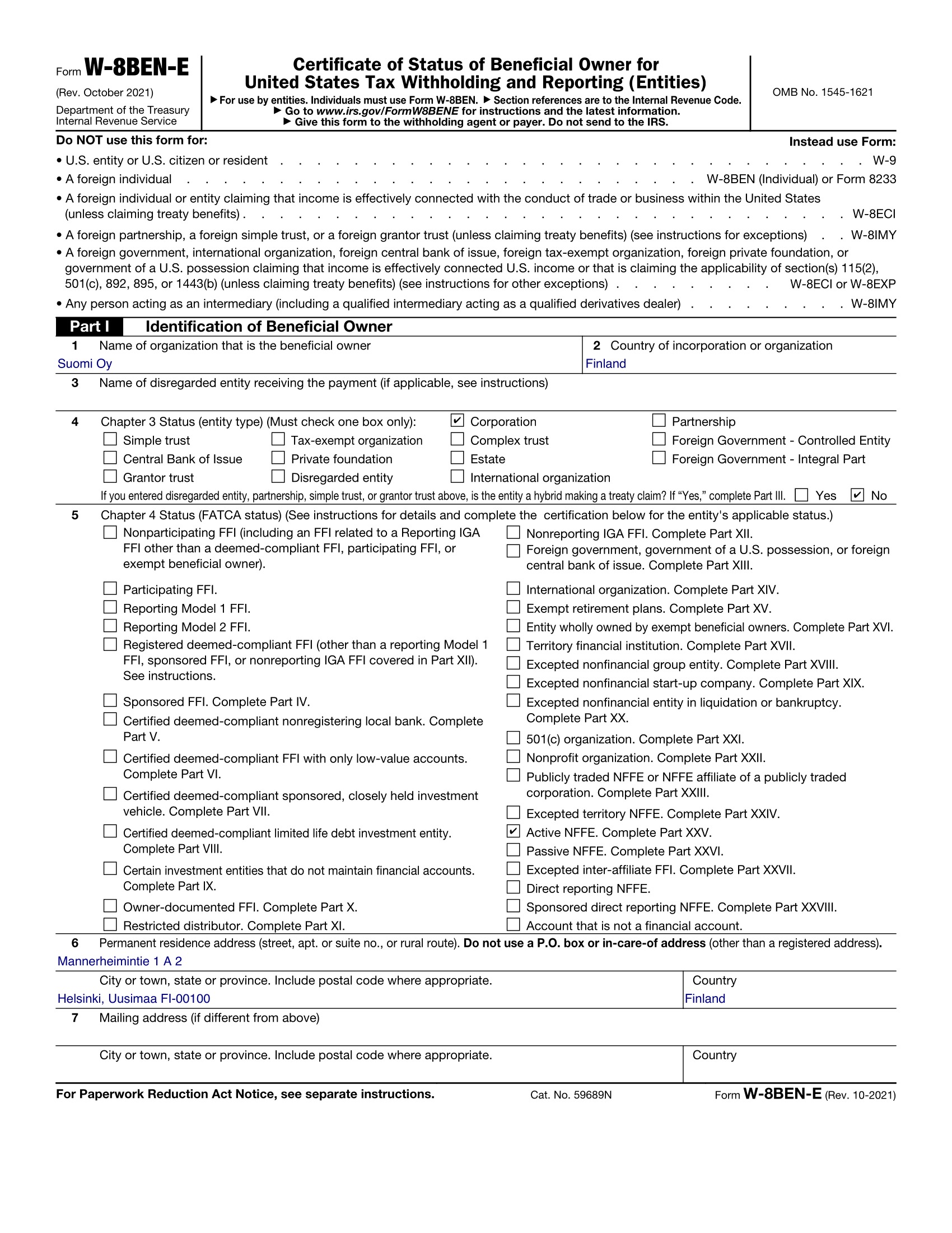
For illustration only. The company name, address, signer, and Y-tunnus are fictional. Example: Suomi Oy, Helsinki, Y-tunnus 1234567-1, Chapter 3 Corporation, FATCA Active NFFE, US-Finland treaty Article 7(1) (Business Profits) 0%, Limitation on Benefits Active trade or business.
Treaty rates by income type
These rates come from the 1989 Convention plus the 2006 Protocol. Dividends, the royalty deletion, the new interest exception, and Limitation on Benefits follow the protocol. Business profits, ordinary interest, the royalty rate paragraph, and independent personal services follow the 1989 text.
| Income type | Article | Rate |
|---|---|---|
| Services / consulting (Business Profits, no current or former US permanent establishment) | Article 7(1) | 0% |
| Equipment rental (tangible personal property; Article 7(7), not a royalty and not a film) | Article 7(1) | 0% |
| Dividends, company owning directly at least 10% of the voting stock | Article 10(2)(a) | 5% |
| Dividends, general rate (under 10% of the voting stock, or any holder who does not meet 10(2)(a)) | Article 10(2)(b) | 15% |
| Dividends, company that has owned 80% or more of the voting power for 12 months and meets an Article 16 test in 10(3)(a) | Article 10(3) | 0% |
| Interest, ordinary cash loan (not contingent interest, not a REMIC excess inclusion) | Article 11(1) | 0% |
| Contingent interest (Protocol paragraph 6; taxed at the Article 10(2)(b) rate) | Article 11(6)(a) | 15% |
| Royalties, including patents, trademarks, know-how, software, and films (operative Article 12(2) is the definition) | Article 12(1) | 0% |
| Independent personal services, individual with no fixed base in the United States | Article 14 | 0% |
On Line 15, cite Article 12(1) at 0% for a patent, a trademark, know-how, a software license, and a film royalty. In the 1989 PDF, Article 12(2) overrode Article 12(1) with a 5% source tax for patents, trademarks, designs, secret processes, and industrial, commercial, or scientific information. Copyrights and films were already at 0% under Article 12(1). Protocol Article V omitted paragraph 2 and renumbered the old definition so that the operative Article 12(2) is the definition, not a 5% rate. Do not cite Article 12(2) on Line 15, and do not cite 5%. The raw 1989 PDF is stale on that point. Unlike Austria, Finland has no remaining film rate. Unlike Denmark, the dividend test in Article 10(2)(a) is 10% of the voting stock, not 10% of the share capital. Equipment rental is not a royalty. Article 7(7) puts rental of tangible personal property in profits, and it excludes film rental. Equipment with no US permanent establishment cites Article 7(1) at 0%. Film rental cites Article 12(1) at 0%. Ordinary interest cites Article 11(1) at 0%. That 0% rate was already in the 1989 text. Article 11(2) is the definition. The 2006 Protocol added paragraph 6, not paragraph 5. Article 11(6)(a) taxes contingent interest at the Article 10(2)(b) rate of 15%, and Article 11(6)(b) leaves a REMIC excess inclusion to domestic law. Do not cite Article 11(6) for an ordinary cash loan, do not cite Article 11(5) as the contingent-interest rule, and do not describe interest as having no exceptions. The 5% dividend rate is Protocol Article 10(2)(a). The general rate is 10(2)(b) at 15%. Protocol Article 10(3) is 0% only for a company that has owned 80% or more of the voting power for 12 months and meets one of the Article 16 tests named there, or for a qualifying pension fund. Do not default an ordinary Oy to 0%. The 1989 Article 10(3) defined dividends. It was not a 0% rate. Because the protocol entered into force on December 28, 2007, Article 10(3) can apply to income derived on or after January 1, 2007, and other protocol withholding starts on February 1, 2008. Do not cite the branch-tax paragraphs for a company with no US permanent establishment.
A Toiminimi cites Article 14, not Article 7 and not Article 14(1)
Article 14 is one unnumbered paragraph. Income of an individual resident from personal services in an independent capacity is taxable only in the residence state. It may also be taxed in the other state to the extent that the services are or were performed in that other state and the income is attributable to a fixed base regularly available to the individual there. Both conditions are required. The fixed base is regularly available, not a past base. There is no day-count test in Article 14. On Line 15 cite Article 14, not Article 14(1). A remote freelancer working from Finland, with no fixed base regularly available in the United States, cites Article 14 at 0%. An Oy does not cite Article 14. The day-count test for employment wages is in Article 15, not here.
A blog post, or the finished PDF?
Generic guides often still quote the 1989 5% royalty paragraph, or they copy Denmark's share-capital dividend test onto Finland. The wizard asks those questions once and returns the PDF.
| Point | This page | A generic guide |
|---|---|---|
| Article numbers | Article 7(1) for services and equipment, Article 12(1) for patents, know-how, software, and films, Article 14 for a freelancer. | Often still cites the deleted Article 12(2) at 5%, or copies Austria's 10% film rate. |
| Line 14b | Active trade or business under Protocol Article 16(4)(a). | Sometimes uses the omitted 1989 Article 16, or says there is no LOB article. |
| Finished form | Sample PDF for Suomi Oy, plus a wizard that fills yours. | A checklist you still have to type into the IRS PDF. |
Start the wizard and download the filled PDF.
Frequently asked questions about W-8BEN-E for Finnish companies
Direct answers for an Oy or Oyj billing US clients or receiving US investment income.
Which article do I cite for consulting fees?
Article 7(1), at 0% if the Oy has no current and no former permanent establishment in the United States. The text says "carries or carried". Do not cite Article 12 or Article 14 for the company.
I am a Toiminimi, not an Oy. Which form and which article?
Form W-8BEN, Article 14, at 0% when you have no fixed base regularly available in the United States. Cite Article 14, not Article 14(1). The services must be or have been performed in the United States and the income must be attributable to that fixed base before the United States may tax them. Do not cite Article 7.
Is a patent or know-how license still 5%?
No. The 1989 Article 12(2) 5% rate for patents, trademarks, and know-how was deleted by Protocol Article V. Cite Article 12(1) at 0%. The operative Article 12(2) is the definition, not a rate. The 1989 PDF still prints the old 5% paragraph. Do not use it.
Is a film royalty 0%, or is it Austria's 10%?
Article 12(1) at 0%. Films were already in the 0% copyright category before the protocol. Finland has no remaining film rate. Do not copy Austria Article 12(2).
Is equipment rental a royalty?
No. Article 7(7) treats rental of tangible personal property as profits, and it excludes film rental. With no US permanent establishment, cite Article 7(1) at 0%, not Article 12. A film license stays a royalty under Article 12(1).
Is interest really 0% with no exceptions?
Ordinary interest is Article 11(1) at 0%, and that rate was already in the 1989 text. That is not every interest payment. Protocol Article 11(6)(a) lets the United States tax contingent interest at 15%, the Article 10(2)(b) rate. Article 11(6)(b) leaves a REMIC excess inclusion to domestic law. Do not cite Article 11(6) for an ordinary cash loan, and do not use Denmark's paragraph 5.
What do I check on Line 14b?
Active trade or business, which is Article 16(4)(a) of the 2006 Protocol. The 1989 Article 16 was omitted. "No LOB article in treaty" does not apply to Finland. Article 16(2)(f) is the ownership-and-base-erosion test, not the default for an operating Oy.
Why is the dividend rate 15%, not 0% or Denmark's share-capital test?
Protocol Article 10(2)(b) is 15% for a holder who does not own directly at least 10% of the voting stock. 10(2)(a) is 5% when a company owns directly at least 10% of the voting stock. That is voting stock, not Denmark's share-capital test. 10(3) is 0% only when a company has owned 80% or more of the voting power for 12 months and meets an Article 16 test named in that paragraph. The 1989 Article 10(3) defined dividends and is no longer the text.
Oyj or Oy on Line 4?
Both check Corporation unless the Oy has filed Form 8832. Only "Finland, Julkinen Osakeyhtio/Publikt Aktiebolag" is on the per se list. The Oy is a Corporation by default because of limited liability.
HETU or Y-tunnus on Line 9b?
The company's Y-tunnus. The sample uses 1234567-1. The check digit of 1234567 is 1, not 8. A HETU belongs on Form W-8BEN. The valid personal example is 010190-123M. The check character is M, not A.
Related guides
More on the form itself:
- Company form: W-8BEN-E wizard for an Oy or Oyj
- Not a company: W-8BEN wizard for an individual ($5)
- Chapter 3 status: Chapter 3 status guide
Common mistakes to avoid
- Putting a HETU on the company form Line 9b is the Y-tunnus 1234567-1. A HETU such as 010190-123M belongs on Form W-8BEN.
- Citing the deleted 5% royalty paragraph The rate is Article 12(1) at 0%, including patents, trademarks, know-how, software, and films. The operative Article 12(2) only defines royalties.
- Saying the change happened in 2010 The protocol entered into force on December 28, 2007. US withholding under it starts on February 1, 2008.
- Copying Austria's film rate or Denmark's share-capital test Finland has no film rate. Article 10(2)(a) looks at voting stock, not share capital. Contingent interest is Article 11(6), not Denmark's Article 11(5).
- Calling every interest payment 0% Ordinary interest is Article 11(1) at 0%. Contingent interest is Article 11(6)(a) at 15%.
- Using the 1989 dividend article The 2006 Protocol replaced Article 10. The old Article 10(3) defined dividends. It was not the 0% rate.
- Checking No LOB article Protocol Article 16 is a real Limitation on Benefits article. An operating Oy certifies Active trade or business under 16(4)(a).
- Citing Article 14(1) Article 14 has no numbered paragraphs. Write Article 14. Do not copy Denmark's Article 14(1).
A note on Finnish tax
This page is about US withholding. It does not determine how Finland taxes the same income, and it does not calculate Finnish tax on US dividends.
Company tax, VAT, and whether a dividend meets the 80% voting-power test are questions for a Finnish accountant. The W-8BEN-E only tells the US payer which treaty rate to apply at source.
Ready to fill the form with the Finnish article numbers?
The wizard asks the same questions as this page and suggests the article and rate on Line 15.