W-8BEN-E for a Cyprus Ltd: check Article 26 before you pick a rate
This article was created with AI assistance and has not been reviewed by a human editor. It is provided for general informational purposes only and does not constitute tax, legal, or financial advice.
Treaty articles and rates on this page are checked against the US-Cyprus Income Tax Convention signed at Nicosia on March 19, 1984 (irs.gov/pub/irs-trty/cyprus.pdf) — last verified September 2026. The PDF header states a general effective date of 1 January 1986 under Article 30. An exchange of notes was signed with the convention. No later protocol has changed the rates or the article numbers.
 AI-generated image
Before you pick a treaty rate, check whether your Cyprus company can claim the treaty at all. Article 26 has no active trade or business test. A private Ltd owned by people who are not tax residents of Cyprus usually fails Article 26(1). For services performed outside the United States, that often costs nothing, because the income is foreign-source and is not subject to US withholding. Leave Part III blank in that case. Do not tick Active trade or business on Line 14b.
This guide is for a Cyprus private company limited by shares that invoices US clients. It covers the 75% ownership rule, why Article 8 is business profits and Article 7 is Non-Discrimination, why a software licence is Article 14 at 0% and ordinary loan interest is Article 13 at 10%, which number goes on Line 9b, and what to do when the owners are not Cypriot residents. A sample PDF is included further down.
If you are a self-employed individual, you file Form W-8BEN, not this one: start the W-8BEN wizard. Independent personal services are Article 17. The other state may tax them only if you are present there for 183 days or more in the taxable year, or you have a fixed base regularly available there. From 27 March 2023 a new TIC, for a person or for a company, starts at 60000000. The announcement illustration is 60000000A. An older company TIC that starts with 1, such as 10123456O, stays valid.
If the owners are individual tax residents of Cyprus and the base-erosion condition is met, you can start the W-8BEN-E wizard now. In a few minutes you have a signature-ready PDF for $30, with Article 8(1) at 0% for services performed in Cyprus and no US permanent establishment, and Line 14b set to ownership and base erosion under Article 26(1).
Blank form or already filled in?
You can download the official, blank form from the IRS and complete it yourself — or get the same file already filled in by our wizard.
- Blank official W-8BEN-E (IRS, free): Download W-8BEN-E as a PDF directly from the IRS — for a private Ltd or a public Ltd.
- Blank official W-8BEN (IRS, free): Download W-8BEN as a PDF directly from the IRS — for a self-employed individual.
- Already filled in (5–10 minutes): W-8BEN-E for Cyprus companies ($30) or W-8BEN for individuals ($5).
- The convention: US-Cyprus Income Tax Treaty PDF on IRS.gov — signed March 19, 1984. Article 7 is Non-Discrimination. Article 8 is Business Profits.
Public Ltd or private Ltd?
Cyprus company law uses more than one limited company, and US tax classification does not follow the local label one-for-one:
- Public limited company (PLC / Public Ltd): 26 CFR 301.7701-2(b)(8)(i) lists "Cyprus, Public Limited Company" as a per se corporation. It is a Corporation and cannot file Form 8832.
- Private company limited by shares (Ltd): The usual operating company. It is not on the per se list. It defaults to Corporation because its members have limited liability, and a different US classification is made on Form 8832. A single-member private Ltd is not disregarded by default. Do not treat it as the public per se form.
- General or limited partnership: Defaults to Partnership when at least one partner has unlimited liability, under 26 CFR 301.7701-3(b)(2). Check Partnership in Part I, line 4, not Corporation.
- Self-employed individual: Not a company. That person files Form W-8BEN. Independent personal services are Article 17, not Article 14.
The trap worth naming: a private Ltd is not the public company on the per se list. It defaults to Corporation and can leave that default on Form 8832. The treaty question is separate. Even a correctly classified Corporation gets no treaty rate unless Article 26(1) is met, or Article 26(2) is determined by the competent authority.
Chapter 3 still decides which form you file. The treaty rates sit in Part III, and Part III stays blank when the company fails Article 26(1) and you are not claiming a rate.
Who actually needs to submit this form?
Any Cyprus private Ltd or public Ltd that receives payments from a US business and needs to document that it is not a US person. Whether Part III is filled in depends on Article 26:
- Owners are individual residents of Cyprus: If more than 75% of each class of shares is owned, directly or indirectly, by those individuals, and gross income is not used in substantial part to pay third-country residents who are not US citizens, Line 14b is Ownership and base erosion under Article 26(1). Services with no US permanent establishment are Article 8(1) at 0%.
- Owners live somewhere else: A Cyprus Ltd owned by a resident of Ukraine, Poland, or another country generally fails Article 26(1). There is no active-trade substitute. For services performed outside the United States, leave Part III blank. For US-source royalties or dividends, the statutory 30% applies unless a tax advisor obtains Article 26(2) relief.
- A software licence, not a service invoice: A copyright licence of software is a royalty. Article 14(1) is 0% only if the company may claim the treaty. Article 12 is Dividends, not royalties.
Line by line for an operating private Ltd that meets Article 26(1)
| Line | What you enter |
|---|---|
| Line 1 | The legal name, for example Aphrodite Software Ltd. |
| Line 2 | Cyprus. |
| Line 4 | Corporation for a private Ltd or a public Ltd. Partnership for a general or limited partnership. A self-employed individual files Form W-8BEN. |
| Line 6 | The registered office in Latin letters (e.g., 25 Makariou III Avenue, Office 301, Limassol, 3105). |
| Line 9b | The company TIC. An older company number starts with 1 and has a VAT check letter, for example 10123456O. 10123456X fails that older check. Do not use a number that starts with 12. A company registered from 27 March 2023 may instead have a TIC that starts with 6. The announcement illustration is 60000000A. That series is randomly generated, so do not apply the older VAT letter and do not reject a letter on it. Put the company's own TIC here, whether it starts with 1 or with 6. Do not enter an HE number such as HE123456. Do not add CY unless the payer asked for a VAT ID. |
| Line 14a | Cyprus, and only if you are claiming the treaty. If Article 26(1) fails and the income is foreign-source services, leave Part III blank. |
| Line 14b | Ownership and base erosion under Article 26(1), when more than 75% of each class is owned by individual residents of Cyprus, or when the company's own stock has substantial trading on a recognized exchange in Cyprus, and the base-erosion condition is also met. Do not check Publicly traded. A parent-company listing is not the Article 26(1)(a) presumption. Do not check Active trade or business. Do not check No LOB article in treaty. |
| Line 15 | For services with no US permanent establishment: Article 8(1), 0%, type of income Services. Equipment rental is also Article 8, not Article 14. A software licence is Article 14(1) at 0%. Ordinary loan interest is Article 13(2) at 10%. Late payment on an invoice is Article 13(3)(d) at 0%. Portfolio dividends are Article 12(2)(a) at 15%. The 5% rate is Article 12(2)(b), and only with the prior-year holding and the 25% passive-income condition. The text says owned, not owned directly. |
Read the TIC from the Tax Department record before Line 9b. Keep all 8 digits and the check letter. The HE registration number is not the TIN.
The guided W-8BEN-E wizard asks the Article 26 questions before it offers a treaty rate.
Filled example: Aphrodite Software Ltd
An operating private Ltd whose owners are individual residents of Cyprus. Chapter 3 Corporation, FATCA Active NFFE, Part III Article 8(1) at 0% for services, Line 14b ownership and base erosion under Article 26(1), TIC 10123456O.
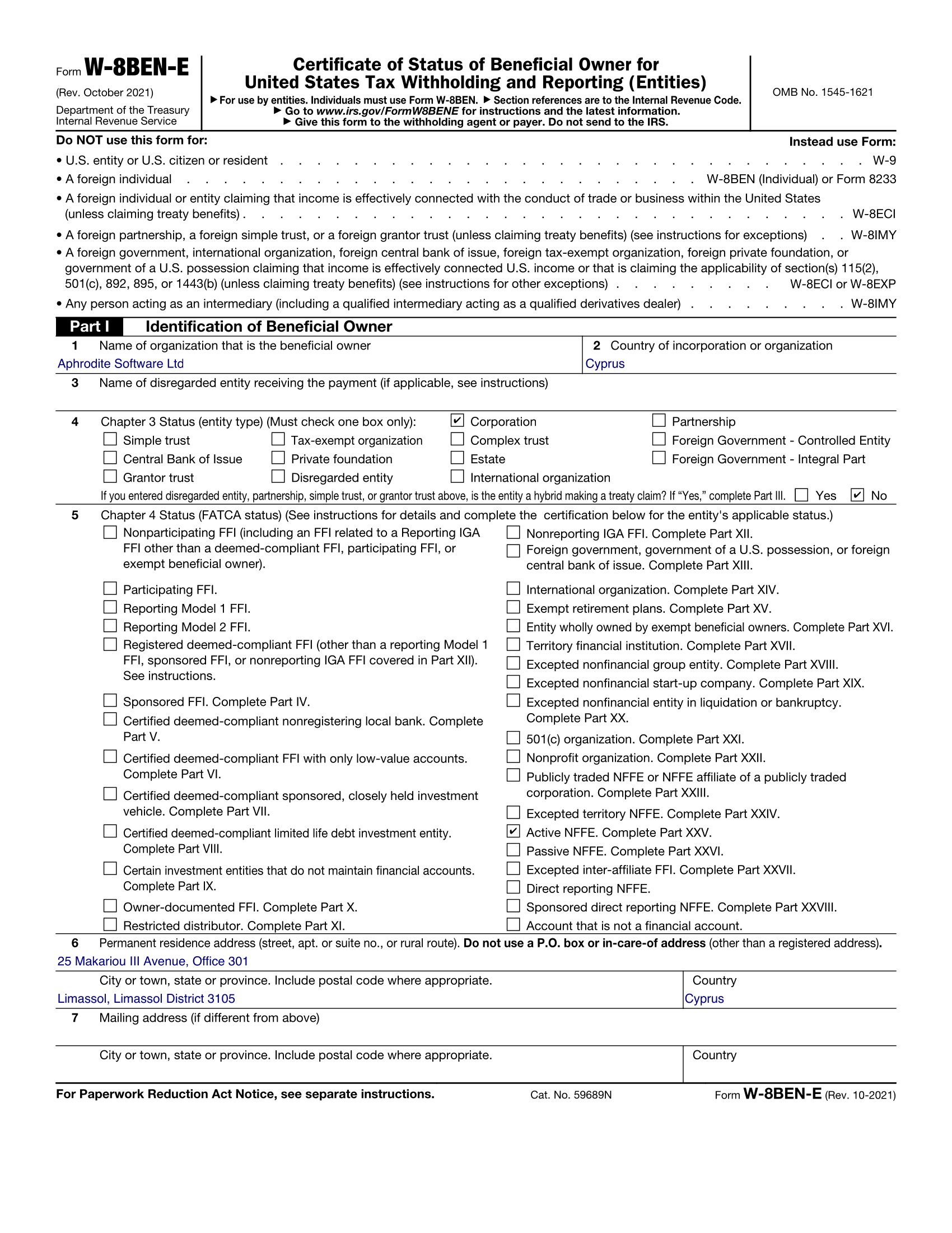
Sample only — uses a fictional company for illustration. Example: Aphrodite Software Ltd, 25 Makariou III Avenue, Office 301, Limassol 3105, Cyprus, TIC 10123456O, Chapter 3 Corporation, FATCA Active NFFE, Article 8(1) at 0%, Line 14b ownership and base erosion under Article 26(1). The same company with a non-resident owner would leave Part III blank.
Articles and rates, if Article 26 is met
| Income type | Article | Rate |
|---|---|---|
| Services and equipment rental, no US permanent establishment | Article 8(1) | 0% |
| Software licences, copyrights, films, patents, trademarks, and know-how | Article 14(1) | 0% |
| Ordinary interest on a loan to a non-financial company | Article 13(2) | 10% |
| Interest on a late invoice for goods or services | Article 13(3)(d) | 0% |
| Interest beneficially owned by a bank or other financial institution | Article 13(3)(c) | 0% |
| Interest on a deposit in a US bank, not connected with a US permanent establishment | Not a treaty claim. IRC 871(i) and 881(d) | 0% |
| Portfolio dividends that do not meet the 5% conditions | Article 12(2)(a) | 15% |
| Dividends to a corporation that owned at least 10% of the voting stock through the prior taxable year, and the payer prior-year passive income is not over 25% | Article 12(2)(b) | 5% |
| Independent personal services of an individual (Form W-8BEN) | Article 17 | 0% |
Use this table only when Article 26(1) is met in full. Substantial trading in the company's own stock on a recognized exchange in Cyprus presumes only subparagraph (a), ownership by Cypriot residents. Subparagraph (b), the base-erosion test, still has to be met. A listing of a parent company is not that presumption, and it is not a reason to check Publicly traded. If Article 26(1) fails, do not put these rates on Line 15.
Questions people ask before they sign
Short answers for a private Ltd. A US office, a fund, or a financial institution needs an accountant, not a blog page.
I'm Ukrainian and own a Cyprus Ltd — does the treaty apply?
Usually no under Article 26(1). The shares have to be owned, directly or indirectly, by individuals who are tax residents of Cyprus, more than 75% of each class. An owner who is a tax resident of Ukraine or Poland does not meet that test. For services performed outside the United States, you can leave Part III blank. US withholding generally does not apply to that foreign-source income. US-source royalties or dividends would be 30% unless Article 26(2) relief is determined for you. Do not tick Active trade or business.
Can I tick Active trade or business?
No. The US-Cyprus treaty has no active trade or business test, and Article 26 has no publicly traded test. Line 14b for a company that meets Article 26(1) is Ownership and base erosion. Substantial trading in the company's own stock on a recognized exchange in Cyprus presumes only Article 26(1)(a). The base-erosion test in Article 26(1)(b) still has to be met. A parent-company listing is not that presumption. Do not check Publicly traded. Article 26(2) is a determination, not a checkbox.
Why Article 8 and not Article 7?
Article 7 of this convention is Non-Discrimination. Business profits, including services and equipment rental, are Article 8. A software licence is Article 14(1) at 0%, not Article 12. Article 12 is Dividends. An individual cites Article 17, not Article 14.
Will a new treaty change this?
No new income tax treaty is in force as of September 2026. The convention signed on March 19, 1984, with the exchange of notes signed with it, is still the text. No later protocol has changed the rates or the article numbers.
Which number goes on Line 9b?
The company's own TIC. An older company number starts with 1 and uses the VAT check letter, for example 10123456O. 10123456X fails that older check. Do not use a number that starts with 12. From 27 March 2023 new registrations, including companies, receive a TIC that starts at 60000000. The announcement illustration is 60000000A. The OECD note of 28 April 2023 says the Latin character is generated from an algorithm for the check character. Published descriptions of the announcement say the new codes are randomly generated. Do not apply the older VAT letter table to a TIC that starts with 6. Do not say a letter on a 6-series TIC fails, and do not refuse a company TIC that starts with 6. An HE number is not the TIN. A CY VAT prefix is not Line 9b unless the payer asked for a VAT ID. A personal TIC still belongs on Form W-8BEN. Older individual numbers that start with 0 or 9 remain valid.
Can a private Ltd file Form 8832?
Yes, when it needs a US classification other than Corporation. A public limited company is per se under "Cyprus, Public Limited Company" and cannot file Form 8832. A private company limited by shares is not on that list. It defaults to Corporation, and Form 8832 is how it elects a different classification. A single-member private Ltd is not disregarded by default.
What to do next
- Fill out your W-8BEN-E in the guided wizard: Start the W-8BEN-E wizard ($30). It asks the Article 26 questions before it suggests a rate.
- Are you self-employed?: Use the W-8BEN wizard ($5) and cite Article 17, with both the 183-day test and the fixed base in the explanation.
Mistakes that get the form sent back
- Ticking Active trade or business: That test is not in the US-Cyprus treaty. If the owners are not individual residents of Cyprus, leave Part III blank for foreign-source services.
- Citing Article 7 for services: Article 7 is Non-Discrimination. Services with no US permanent establishment are Article 8(1) at 0%, and only if Article 26 lets you claim the treaty.
- Citing Article 14 for a freelancer: Article 14 is Royalties. An individual cites Article 17 on Form W-8BEN. The day-count is 183 days or more in the taxable year, or a fixed base.
- Typing an HE number instead of the TIC: Line 9b takes the TIC, for example 10123456O. HE123456 is the company registry number. CY plus digits is the VAT number.
- Claiming 0% on a royalty without passing Article 26: Article 14(1) is 0% only for a resident who is entitled to the treaty. A company that fails Article 26(1) does not get that rate. US-source royalties would be 30%.