W-8BEN-E for a Bulgarian EOOD (and W-8BEN for an ET): US–Bulgaria Treaty Guide (2026)
This article was created with AI assistance and has not been reviewed by a human editor. It is provided for general informational purposes only and does not constitute tax, legal, or financial advice.
 AI-generated image
Your US client asked for a W-8BEN-E. Services of a Bulgarian EOOD are Article 7. Portfolio dividends are 10%, not 15%. And an EOOD owned from outside Bulgaria usually cannot tick the ownership test.
This guide is for an ednolichno druzhestvo s ogranichena otgovornost (EOOD) that invoices US clients, licenses software, or holds US shares. It covers the ET, the 10% dividend rate, Line 14b, and the EIK on Line 9b. A sample PDF is included further down.
If you are an ednolichen targovets (ET) or a freelancer, you are an individual. You file Form W-8BEN in your own name: start the W-8BEN wizard. Services are business profits under Article 7, not Article 14. Article 14 of this treaty is Income from Employment.
If you prefer to skip the reading, you can start the W-8BEN-E wizard now. It asks whether the company directly holds at least 10% of the voting stock, and it notes that owners outside Bulgaria do not count toward Article 21(2)(e). In a few minutes you have a signature-ready PDF for $30.
Blank form or already filled in?
You can download the official, blank form from the IRS and complete it yourself — or get the same file already filled in by our wizard.
- Blank official W-8BEN-E (IRS, free): Download W-8BEN-E as a PDF directly from the IRS — for an EOOD, an OOD, or an AD.
- Blank official W-8BEN (IRS, free): Download W-8BEN as a PDF directly from the IRS — for an ET or a freelancer.
- Already filled in (5–10 minutes): W-8BEN-E for Bulgarian companies ($30) or W-8BEN for individuals ($5).
- The convention: US–Bulgaria Income Tax Treaty PDF on Treasury.gov, signed at Washington on February 23, 2007, in force December 15, 2008. The 2008 protocol is Treaty-Bulgaria-Protocol-2-26-2008.pdf. Withholding applies from January 1, 2009.
EOOD, OOD, AD, or an ET?
Bulgarian company law uses more than one form, and US tax classification does not follow the local abbreviation one-for-one:
- Aktsionerno druzhestvo (AD), including EAD: An aktsionerno druzhestvo (AD), including a single-shareholder EAD, formed on or after January 1, 2007 is a per se corporation and cannot file Form 8832. An AD formed before January 1, 2007 becomes a per se corporation only from the date on which persons who were not owners of that AD as of January 1, 2007 own, in the aggregate, a 50% or greater interest in it, measured by vote or value. Until that date — including while interests move only among persons who were already owners as of January 1, 2007 — that AD remains an eligible entity and may file Form 8832.
- Ednolichno druzhestvo s ogranichena otgovornost (EOOD) or druzhestvo s ogranichena otgovornost (OOD): Not on the per se list. It defaults to Corporation because members have limited liability, and a different US classification is Form 8832. A single-member EOOD is not disregarded by default.
- Sabiratelno druzhestvo (SD), komanditno druzhestvo (KD), or KDA: An SD or a KD is a Partnership. A KDA defaults to Partnership because it has a member with unlimited liability.
- Ednolichen targovets (ET) or a freelancer: An individual, not a company. That person files Form W-8BEN, not W-8BEN-E, and cites Article 7. Never cite Article 14 for these services.
The trap worth naming: many guides put 15% on portfolio dividends. Article 10(2)(b) of the US–Bulgaria treaty is 10% in all other cases. The 5% rate needs a company that owns directly at least 10% of the voting stock.
Chapter 3 still decides which form you file. Part III is where the article and the rate go.
Who actually needs to submit this form?
Any Bulgarian EOOD, OOD, or AD that receives payments from a US business and needs to document that it is not a US person:
- Services: An EOOD that invoices a US client for work performed in Bulgaria.
- Royalties: A software licence, a film, a patent, a trademark, or know-how.
- Dividends or interest: A holding in a US company, or a loan to a US debtor.
What the payer withholds, and what the treaty actually changes
Without a submitted W-8BEN-E, the US payer generally withholds 30% of the gross payment. Filing the form is how the payer knows the company is foreign and which article and rate to apply.
Services performed in Bulgaria are business profits under Article 7 for an EOOD and for an ET. The US rate is 0% only when there is no US permanent establishment, including the services permanent establishment in Article 5(8). A software licence is a copyright licence under Article 12(3)(a) at 5%. Equipment rental is not a royalty. Ordinary interest is 5% under Article 11(2). Article 11(3) is 0% only in the cases in that paragraph. Trade credit and installment interest stay at 5%. Article 11(8), as amended by the February 26, 2008 Protocol, applies notwithstanding paragraphs 2 and 3. US-source interest that is contingent interest and is not portfolio interest may be taxed at up to 10%, including when the owner would otherwise have 0% under Article 11(3), such as a bank or a pension fund. REMIC excess inclusion under Article 11(8)(c) follows US domestic law.
Form W-8BEN-E, line by line, for a Bulgarian EOOD
The line numbers below match the current form (Rev. October 2021) for an operating EOOD, Active NFFE, claiming Article 7 at 0% on services performed in Bulgaria, with an owner resident in Bulgaria.
| Line | What you enter |
|---|---|
| Line 1 | The legal name exactly as registered (e.g., "Vitosha Code EOOD"). |
| Line 2 | Country of incorporation: Bulgaria. |
| Line 3 | Leave blank unless a single-member EOOD has filed Form 8832 to elect disregarded status. That is not the default. |
| Line 4 | Corporation for an EOOD or an OOD. An aktsionerno druzhestvo (AD), including a single-shareholder EAD, formed on or after January 1, 2007 is a per se corporation and cannot file Form 8832. An AD formed before January 1, 2007 becomes a per se corporation only from the date on which persons who were not owners of that AD as of January 1, 2007 own, in the aggregate, a 50% or greater interest in it, measured by vote or value. Until that date — including while interests move only among persons who were already owners as of January 1, 2007 — that AD remains an eligible entity and may file Form 8832. Partnership for an SD, a KD, or a KDA. An ET does not use this form. |
| Line 5 | Chapter 4 (FATCA) status — almost always Active NFFE for an ordinary trading or services company. |
| Line 6 | The registered office in Bulgaria, in Latin letters (e.g., bul. Vitosha 15, Sofia, 1000). |
| Line 9b | The 9-digit EIK (BULSTAT), for example 123456786. Do not type a BG prefix. An individual or an ET on Form W-8BEN uses a 10-digit EGN, or an LNCh for a foreign resident, for example 8501011234. Do not put the ET’s EIK on Form W-8BEN. |
| Line 14a | Bulgaria. |
| Line 14b | Ownership and base erosion when the owner is resident in Bulgaria and Article 21(2)(e) is met. A German-resident owner or a US-resident individual does not count toward 21(2)(e)(i). Active trade under Article 21(4), or derivative benefits under Article 21(3), are the other routes. |
| Line 15 | For services with no US permanent establishment: Article 7, 0%, business profits (services); no US permanent establishment. |
| Part XXX | Signed by a manager or other authorized person, with capacity stated. The sample uses Georgi Ivanov. |
This reflects the Rev. October 2021 revision of Form W-8BEN-E. Cross-check the current IRS PDF before you submit.
Every field in the table above is filled in by our guided W-8BEN-E wizard.
Sample: completed W-8BEN-E for a Bulgarian EOOD
A filled example for a fictional EOOD with no US permanent establishment, Active NFFE status, Ownership and base erosion on Line 14b, and Article 7 at 0%.
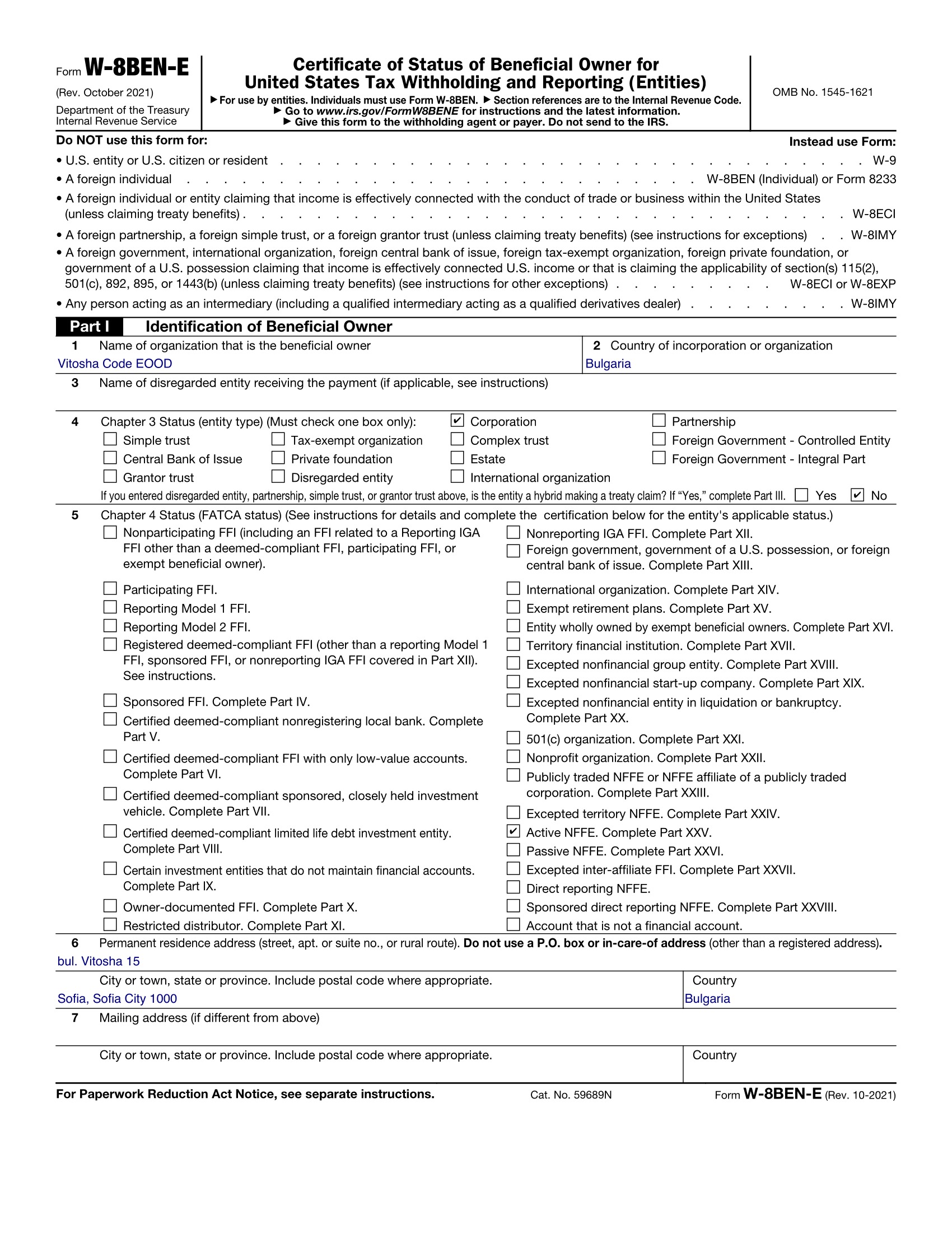
Sample only — uses a fictional company for illustration. Example: Vitosha Code EOOD, bul. Vitosha 15, Sofia 1000, Bulgaria, EIK 123456786, Chapter 3 Corporation, FATCA Active NFFE, Article 7 at 0%.
The rates on Line 15
Each row states the condition. Do not cite Article 14 for a freelancer, and do not apply 15% to dividends.
| Income type | Article | Rate and condition |
|---|---|---|
| Services of an EOOD | Article 7 | 0% only if there is no US permanent establishment, including the 183-day services permanent establishment in Article 5(8) |
| Services of an ET or a freelancer | Article 7 | 0% on the same permanent-establishment test as a company. Never Article 14. Article 14 is Income from Employment. |
| Dividends — company owning directly at least 10% of the voting stock | Article 10(2)(a) | 5%, and not for RIC or REIT dividends |
| Dividends — all other cases | Article 10(2)(b) | 10% (not 15%) |
| Dividends to a Bulgarian pension fund | Article 10(4) | 0% only when the dividends are not from the fund’s trade or business or from an associated enterprise other than a pension fund |
| REIT dividends | Article 10(3) | 10% only in the three Article 10(3) cases: an individual or pension fund holding not more than 10% of the REIT; a dividend paid on a publicly traded class and the owner holds not more than 5% of any class; or not more than 10% of a diversified REIT. Otherwise 30% |
| Interest | Article 11 | 5% under Article 11(2). 0% under Article 11(3) only for a government, subdivision, local authority, central bank, or wholly owned institution; debt guaranteed, insured, or indirectly financed by such a body of the owner’s own State; a financial institution, such as a bank or an insurance company, unless the loan is back-to-back; or a pension fund when the interest is not from carrying on a business. Trade credit and installment interest stay at 5%. Article 11(8), as amended by the February 26, 2008 Protocol, applies notwithstanding paragraphs 2 and 3: US-source contingent interest that is not portfolio interest may be taxed at up to 10%, including for a bank or a pension fund that would otherwise have 0% under Article 11(3). REMIC excess inclusion under Article 11(8)(c) follows US domestic law. |
| Software, film, patent, trademark, or know-how | Article 12 | 5%, never 0%. A licence to use a copyrighted program is Article 12(3)(a). |
| Equipment rental | Article 7 | 0% without a US permanent establishment. It is not a royalty. |
Article 5(8)(a) creates a services permanent establishment when services in the United States are performed by an individual who is present there for 183 days or more during any twelve-month period and, during that period, more than 50% of the enterprise’s gross active business income is income from services that individual performed in the United States. That individual can be someone other than an employee or an owner. Article 5(8)(b) requires that the services are furnished for 183 days or more for the same or a connected project, and only for customers who are residents of the United States or who have a permanent establishment there to which the services are provided. A project for a customer who is not a US resident and has no US permanent establishment does not meet Article 5(8)(b). When either paragraph applies, Article 7 is not 0%.
Line 14b and Article 21
Limitation on Benefits is already Article 21 of the February 23, 2007 convention. Article 22 of that convention is relief from double taxation. The February 26, 2008 Protocol does not change the article number. It inserts a new paragraph 5 of Article 21 and moves the former paragraphs 5 and 6 to paragraphs 6 and 7. Ownership and base erosion is Article 21(2)(e). On at least half the days, persons resident in the same Contracting State as the company, and entitled under Article 21(2)(a), (b), (c)(i), or (d), must own at least 50% of the aggregate voting power and value. For a Bulgarian company only Bulgarian-resident qualified persons count. (a) An EOOD owned 100% by an individual resident in Plovdiv meets that ownership prong. (b) An EOOD owned 100% by an individual resident in Germany does not. Consider Active trade under Article 21(4), or derivative benefits under Article 21(3) when the owners are equivalent beneficiaries in the EU, the EEA, or a NAFTA country. (c) An EOOD owned 100% by a US-resident individual also fails the ownership prong. A US-resident individual does not count. Less than 50% of gross income, as determined in Bulgaria, may be paid as deductible payments to persons who are not residents of either State entitled under those subparagraphs, excluding arm’s-length payments in the ordinary course for services or tangible property. A payment to a US-resident individual is not base erosion. Dividends are generally not deductible and do not count. Article 21(3) is the derivative benefits test: at least 95% owned by seven or fewer equivalent beneficiaries, and the base-erosion clause. The Line 14b box is Company that meets the derivative benefits test. Article 21(4) is an active trade carried on in Bulgaria. The substantiality test has no numerical safe harbor. Do not import the Estonia or Malta ratios. Article 21(5) is a triangular rule and is not a Line 14b box.
Questions people ask before they sign
Short answers for an EOOD or an ET. A fund or a financial institution needs an accountant, not a blog page.
Does an ET file W-8BEN-E?
No. An ET or a freelancer files Form W-8BEN and cites Article 7. Do not cite Article 14. Use the owner’s EGN or LNCh, not the ET’s EIK.
Is the dividend rate 15%?
No. Article 10(2)(b) is 10% in all other cases, not 15%. Article 10(2)(a) is 5% only when a company owns directly at least 10% of the voting stock. That 5% rate is not for RIC or REIT dividends.
Can a German-resident owner tick ownership and base erosion?
No. Article 21(2)(e)(i) counts only residents of Bulgaria. A German-resident individual does not count. Consider Active trade under Article 21(4) or derivative benefits under Article 21(3).
Is installment interest or late interest 0%?
No. Interest on a deferred payment for goods, equipment, or services is 5% under Article 11(2). There is no 0% for trade credit.
Our AD was founded in 2003 — can it still file Form 8832?
An aktsionerno druzhestvo (AD), including a single-shareholder EAD, formed on or after January 1, 2007 is a per se corporation and cannot file Form 8832. An AD formed before January 1, 2007 becomes a per se corporation only from the date on which persons who were not owners of that AD as of January 1, 2007 own, in the aggregate, a 50% or greater interest in it, measured by vote or value. Until that date — including while interests move only among persons who were already owners as of January 1, 2007 — that AD remains an eligible entity and may file Form 8832.
What to do next
- Fill out your W-8BEN-E in the guided wizard: Start the W-8BEN-E wizard ($30).
- Are you an ET?: Use the W-8BEN wizard ($5) and cite Article 7.
Mistakes that get the form sent back
- Citing Article 14 for a freelancer: An ET cites Article 7. Article 14 is Income from Employment.
- Putting 15% on dividends: Article 10(2)(b) is 10%, not 15%.
- Ticking ownership for a foreign-owned EOOD: Owners resident outside Bulgaria, including a US resident, do not count toward Article 21(2)(e)(i).
- Putting the ET’s EIK on Form W-8BEN: The individual uses an EGN or an LNCh. The EIK belongs on the company form.
- Typing a BG prefix: Line 9b is the digits only. BG plus the number is a VAT ID.
- Claiming 0% on a software licence: Article 12 is 5%, never 0%.