EIN, ITIN, SSN, or Foreign TIN: What Goes on W-8BEN Line 6?
This article was created with AI assistance and has not been reviewed by a human editor. It is provided for general informational purposes only and does not constitute tax, legal, or financial advice.
 AI-generated image
Line 6 of IRS Form W-8BEN asks for your foreign tax identifying number—and yet it causes more rejections and forum confusion than almost any other field. U.S. payers throw around SSN, EIN, and ITIN in the same onboarding email, which leads many non-U.S. freelancers to wonder whether they need an American number before they can get paid.
For most individuals abroad, the answer is simple: enter your home-country tax ID on Line 6 and leave Line 5 blank unless you already hold a U.S. SSN or ITIN. EIN belongs on entity forms, not on an individual's W-8BEN. Mixing up these identifiers is a common reason payers flag a certificate or apply backup withholding.
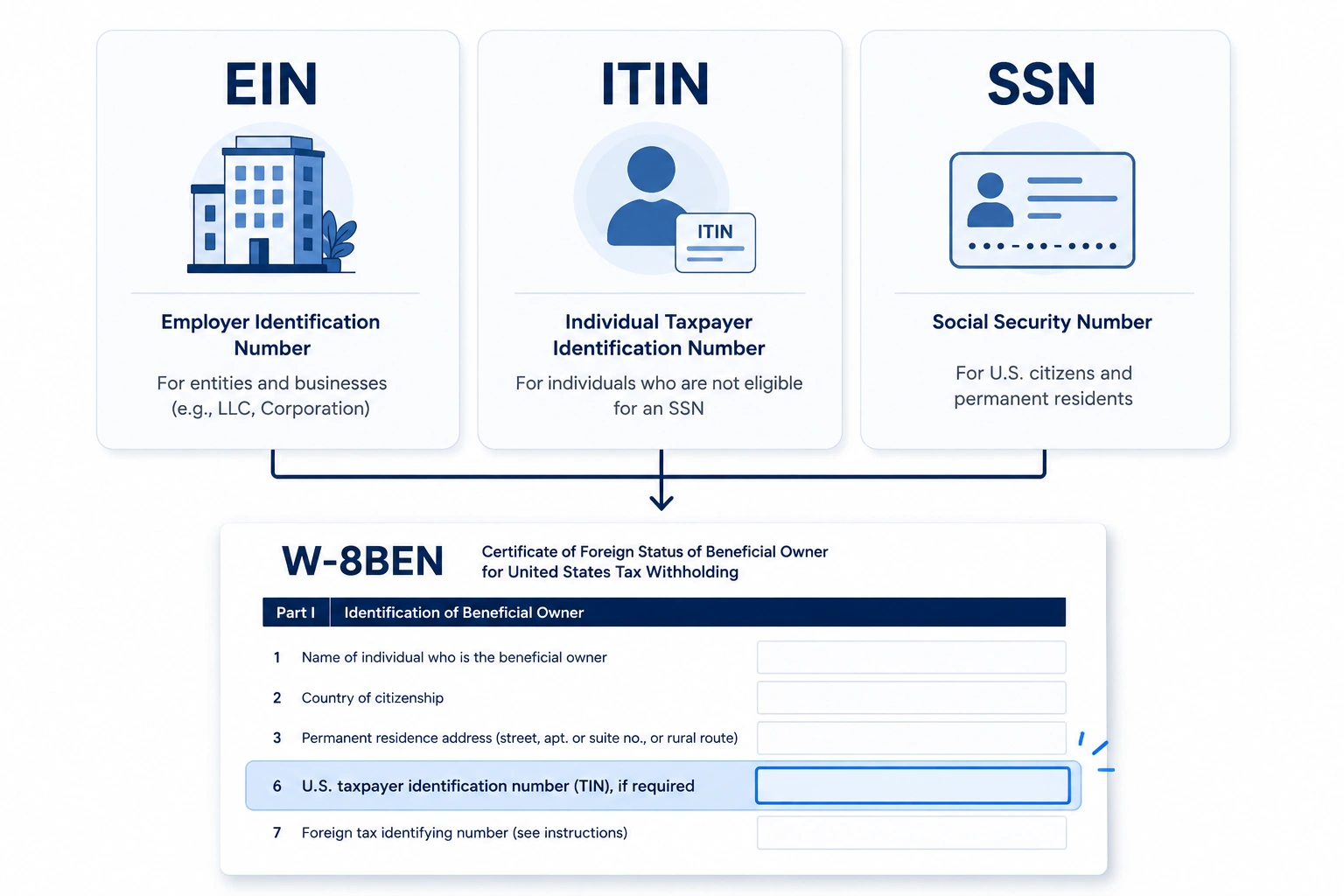
This guide explains SSN, EIN, ITIN, and foreign TIN—how they differ, what belongs on W-8BEN Lines 5 and 6, and a decision table for typical situations. This is general education, not individualized tax or legal advice.
Ready to enter the right ID without guessing? Fill W-8BEN online with the W8GetEasy wizard ($5, payer-ready PDF in minutes).
What is an SSN (and why non-U.S. residents usually don't have one)
A Social Security Number (SSN) is a nine-digit identifier issued by the U.S. Social Security Administration primarily for Social Security benefits and, in practice, for U.S. employment and federal tax administration. U.S. citizens, lawful permanent residents, and certain visa holders who are authorized to work may obtain an SSN. The format is XXX-XX-XXXX.
- Who has an SSN: U.S. citizens, green card holders, and some work-authorized non-citizens who applied through the SSA. Most people who have lived their entire lives outside the United States do not have one.
- What it is used for in the U.S.: Employment reporting, Social Security credits, and as a U.S. taxpayer identification number on federal forms—including Line 5 of W-8BEN when you are an individual who has been issued an SSN.
- On W-8BEN for foreign individuals: If you are a non-U.S. person with no U.S. work history, you typically do not have an SSN and should not invent or borrow one. Line 5 stays blank; your home-country tax ID goes on Line 6.
- Do not put an SSN on Line 6: Line 6 is reserved for your foreign tax identifying number. An SSN is a U.S. TIN and belongs on Line 5 only if you have one and instructions require it.
- Official reference: See the IRS W-8BEN instructions for current Line 5 and Line 6 rules.
Unless you previously lived or worked in the United States, focus on your foreign TIN—not on U.S. identifiers you do not need for routine withholding documentation.
For a full walkthrough of Part I fields—including name, address, and date of birth that must match your TIN entries—see How to fill W-8BEN Part I.
What is an EIN (and when a company needs it)
An Employer Identification Number (EIN) is a nine-digit federal tax ID issued by the IRS to U.S. businesses and certain other entities. Despite the word 'employer,' you do not need employees to obtain one—sole proprietors, LLCs, corporations, and partnerships often use an EIN for banking, payroll, and U.S. tax filings. The format is XX-XXXXXXX.
- Who has an EIN: U.S. companies, U.S. LLCs, partnerships, trusts, estates, and some sole proprietors who applied for a federal EIN. Foreign companies may have a U.S. EIN if they registered for U.S. tax purposes, but most individual freelancers abroad do not.
- EIN vs individual TIN: An EIN identifies an entity. Form W-8BEN is for individuals only. If income is paid to you personally, an EIN is not what Line 6 asks for—even if you once heard a U.S. client mention 'tax ID' generically.
- When EIN appears in W-8 workflows: Entities receiving U.S.-source payments file Form W-8BEN-E and may enter a U.S. EIN or foreign entity TIN in the fields that apply to their Chapter 3 status—not on an individual's W-8BEN.
- Common mistake: Entering a client's EIN or your platform's EIN on your personal W-8BEN. Those numbers identify businesses, not you as the beneficial owner.
What is an ITIN (who gets one and when)
An Individual Taxpayer Identification Number (ITIN) is a nine-digit tax processing number issued by the IRS to individuals who are not eligible for an SSN but who need a U.S. taxpayer identification number for a federal tax purpose. ITINs also use the XXX-XX-XXXX pattern and often start with 9, but an ITIN is not work authorization and does not change immigration status.
Most non-U.S. individuals completing W-8BEN for platform payouts or freelance income do not need to apply for an ITIN first. You obtain an ITIN by filing Form W-7 when you must file a U.S. tax return, claim a U.S. refund, or meet an IRS or payer rule that requires a U.S. TIN for your facts. On W-8BEN, an ITIN belongs on Line 5 only when you already hold one and instructions require it—not on Line 6. Your national tax ID remains on Line 6. For deeper guidance, read ITIN for W-8BEN: when you need it and when you don't.
What is a foreign TIN?
A foreign tax identifying number is the ID your country of tax residence uses for income tax. On W-8BEN, Line 6 asks for this number. Every country names it differently—Steuer-ID in Germany, PESEL or NIP in Poland, Codice Fiscale in Italy, My Number in Japan—but the IRS label is the same: foreign tax identifying number.
- Who has a foreign TIN: Tax residents of countries that assign individual income-tax numbers—most European, Latin American, and Asian jurisdictions do. If you file an annual income tax return at home, you almost certainly have one.
- What to enter on Line 6: The number exactly as shown on your tax assessment, national ID card, or tax authority portal. Do not add country prefixes unless your payer's instructions require them.
- Foreign TIN vs passport number: Line 6 expects a tax ID, not a travel document number. If your country uses a national ID for both tax and civil identification, use the number designated for tax purposes.
- When Line 6 may be left blank: Only when current IRS instructions and your payer explicitly allow it. Many U.S. platforms require a foreign TIN before releasing payouts or applying treaty rates.
The next section covers Line 6 in detail and includes a side-by-side comparison of all four ID types—who holds each number, its format, and where it belongs on W-8BEN.
What to enter on W-8BEN Line 6
Form W-8BEN separates U.S. and foreign identification on purpose. Line 5 is for a U.S. taxpayer identification number—SSN or ITIN—only if you have been issued one and the instructions for your situation require it. Line 6 is for your foreign tax identifying number: the ID your country uses to identify you as an individual taxpayer.
For the typical non-U.S. freelancer or creator, enter your home-country tax ID on Line 6 and leave Line 5 blank. If you hold an ITIN from a prior U.S. filing, it may go on Line 5 while your foreign TIN stays on Line 6. Swapping the lines is a common rejection trigger. See the W-8BEN Part I line-by-line guide for fields that must match your TIN entries.
- SSN — comparison: Who has it: U.S. citizens and residents authorized for an SSN. Format: XXX-XX-XXXX. On W-8BEN: Line 5 only (U.S. TIN), if you have one. Non-U.S. individuals without U.S. work history typically leave Line 5 blank.
- EIN — comparison: Who has it: U.S. and some foreign entities registered with the IRS. Format: XX-XXXXXXX. On W-8BEN: not for individuals—entities use W-8BEN-E. Never substitute a company EIN on a personal certificate.
- ITIN — comparison: Who has it: non-U.S. individuals who applied via Form W-7 for a U.S. tax purpose. Format: XXX-XX-XXXX (often starts with 9). On W-8BEN: Line 5 when you hold one and instructions require it; not a replacement for Line 6.
- Foreign TIN — comparison: Who has it: tax residents of your home country issued an individual income-tax ID. Format: varies by country (often 9–13 digits or alphanumeric). On W-8BEN: Line 6—the default field for most non-U.S. freelancers and creators.
Decision table: which ID for which situation
Use this checklist when a payer's onboarding screen lists SSN, EIN, ITIN, and 'foreign TIN' in the same dropdown. Pick the row that matches who receives the payment and which numbers you actually hold.
- Non-U.S. individual, never had a U.S. tax number: Line 6: your foreign TIN. Line 5: blank. This is the standard path for most freelancers and platform creators abroad.
- Non-U.S. individual with a valid ITIN from a prior U.S. filing: Line 5: ITIN (if instructions require a U.S. TIN). Line 6: your foreign TIN. Do not put the ITIN on Line 6.
- Dual-status or former U.S. resident with an SSN: Line 5: SSN when you are certifying as an individual with a U.S. TIN. Line 6: foreign TIN if you remain a tax resident abroad and the form asks for both.
- Payment goes to your company (LLC, Ltd., GmbH, etc.): Do not use W-8BEN. File Form W-8BEN-E with the entity's foreign TIN or U.S. EIN in the applicable entity fields—not an individual SSN or ITIN.
- Payer demands a U.S. number but you only have a foreign TIN: Ask which field failed. Many platforms accept Line 6 alone. See our ITIN guide before applying for Form W-7.
Worked example: a UK freelancer who entered the wrong ID on Line 6
Rosie Hartley, a freelance web developer in Sheffield operating as a sole trader, was owed £700 for a project from a US client. On her first W-8BEN, she entered her Companies House registration number on Line 6, assuming any official UK number would work as her 'tax ID.' The client's payment system couldn't match a company registration number to an individual beneficial owner, so it withheld the default 30%—£210—as if no valid foreign TIN were on file.
After correcting Line 6 to show her UTR (Unique Taxpayer Reference)—her actual personal tax identifying number, not a business registration number—the client accepted the certificate. The full £700 reached her account on the next payment, without withholding.
- Business ID on Line 6 by mistake: 30% withheld as if no valid foreign TIN were on file—£210 on a £700 payment.
- Correct personal ID (UTR) on Line 6: full £700 reaches the account.
Related guides
Once you know which number belongs on Line 6, these pages help you finish the rest of your withholding certificate:
- Part I line by line: How to fill W-8BEN Part I for name, address, citizenship, and TIN placement.
- ITIN deep dive: ITIN for W-8BEN — when you need Form W-7 and when your foreign TIN is enough.
- Fill online: Generate W-8BEN online ($5) with guided Line 5 and Line 6 prompts.
The business-ID-vs-personal-ID mix-up freelancers make in the UK
The UK has several official numbers, and it's easy to grab the wrong one for Line 6. A Companies House registration number identifies a limited company—not you personally—even if you are the sole director. A VAT registration number identifies a VAT-registered business, not an individual taxpayer.
Line 6 wants your Unique Taxpayer Reference (UTR)—the 10-digit number HMRC issues when you register for Self Assessment. If you trade as a sole trader under your own name, this is the number that identifies you as an individual for tax purposes, distinct from any company or VAT number your business might also hold.
- Never enter a Companies House number or VAT registration number on Line 6—those identify businesses, not individuals.
- Use your personal UTR, found on Self Assessment correspondence from HMRC.
- If you operate through a limited company rather than as a sole trader, the company should file W-8BEN-E instead, not your personal W-8BEN.
Frequently asked questions: EIN, ITIN, SSN, and W-8BEN Line 6
What should I put on W-8BEN Line 6 as a non-U.S. individual?
Enter your foreign tax identifying number—the income-tax ID your home country assigned to you. Leave Line 5 blank unless you have a U.S. SSN or ITIN and instructions require it on Line 5.
Can I use my EIN on W-8BEN Line 6?
No. An EIN identifies a business entity. Form W-8BEN is for individuals. If payments go to your company, use Form W-8BEN-E with the entity's TIN fields instead.
Do I need an ITIN before I can complete W-8BEN?
Usually no. Most foreign individuals enter a foreign TIN on Line 6 without ever applying for an ITIN. See our ITIN guide for the exceptions.
What is the difference between Line 5 and Line 6 on W-8BEN?
Line 5 is for a U.S. TIN (SSN or ITIN) when you have one. Line 6 is for your foreign tax ID. They are not interchangeable—putting the wrong type on the wrong line is a common rejection reason.
I don't have an SSN because I never worked in the U.S. Is that a problem?
No. W-8BEN is designed for foreign individuals. Absence of an SSN is normal. Focus on providing a valid foreign TIN on Line 6.
My platform dropdown lists SSN, EIN, and ITIN. Which do I choose?
For personal payouts, select the option for foreign tax ID or non-U.S. TIN and enter your home-country number on Line 6. Do not select EIN unless you are submitting as a U.S. or foreign entity on W-8BEN-E.
Can I leave Line 6 blank?
Only when current IRS instructions and your payer allow it. Many platforms require a foreign TIN for onboarding. A blank TIN when one is expected can block treaty relief or trigger 30% default withholding.
Does entering the wrong ID type affect withholding tax?
A mismatched TIN can cause rejection or 30% default withholding until you submit a corrected certificate.
How do I complete W-8BEN if I only know my foreign tax ID?
Enter it on Line 6, complete Part I, add Part II if you claim a treaty rate, sign, and deliver the PDF to your payer—not the IRS. W8GetEasy ($5) walks you through TIN fields step by step.
W-8BEN Line 6 is not asking for an EIN, and most non-U.S. individuals do not need an ITIN or SSN. Enter your foreign tax ID on Line 6, keep any U.S. TIN on Line 5 only when you have one, and use W-8BEN-E when the payee is your company. This article is general education; consult a qualified tax professional for complex cases.
Ready to complete W-8BEN with the correct tax ID?
Fill W-8BEN online — $5. W8GetEasy guides you through Line 5 and Line 6, Part II treaty claims, and delivers a formatted, signed PDF for your payer.